 Cre8Travel
CRE8TRAVEL · NEW YORK PLACES
Lonesome Bay State Forest
Lonesome Bay: A Forest of Contrasting Ground and Trees
Discover
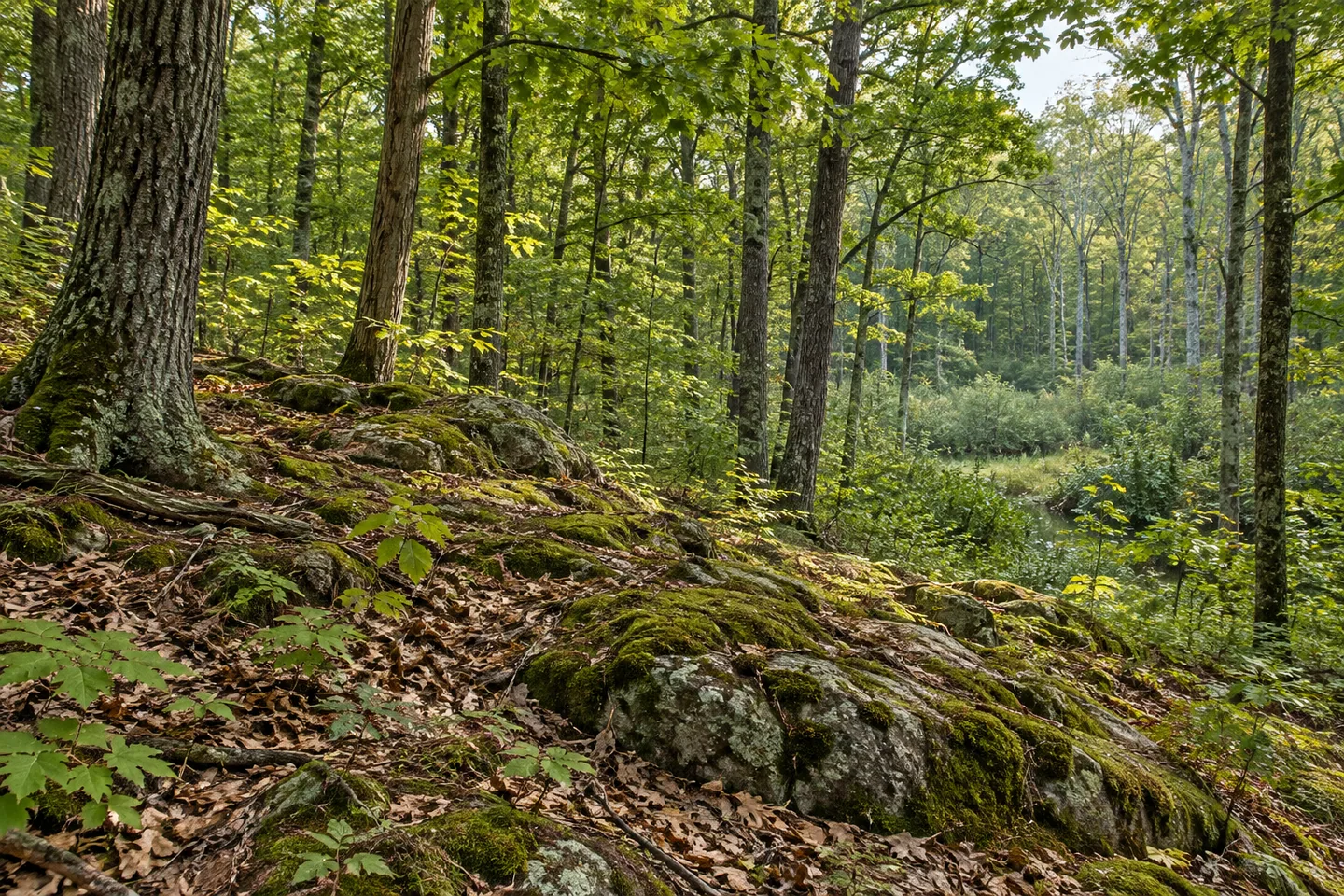
Lonesome Bay State Forest is best introduced through its variety of ground and trees. The 1,122-acre property in Hammond, St. Lawrence County, contains a changing mixture of upland forest, rocky sites and wetter lowlands. DEC's description gives those differences particular botanical detail, making the forest a place to consider how several woodland communities can occupy one public holding. The useful theme is the variation within the landscape, rather than a single named scenic destination.
Uplands with deeper soils support basswood, sugar maple and black cherry. This is one set of relationships between the ground and its tree cover, offering a starting point for noticing the forest's composition. Where these trees are visible from appropriate access, their different forms can be appreciated as part of the same woodland setting. A visitor need not identify every specimen to recognize that the property holds several kinds of trees and growing conditions.
Drier rocky sites support another combination: northern red oak, bitternut hickory and eastern hophornbeam. The species contrast gives the rocky ground an identity of its own within the broader forest. Compare what is visible at a suitable position with the deeper-soil woodland described elsewhere, keeping the actual route and boundaries in mind. The interest lies in how different parts of a relatively compact public property support different vegetation.
Lowland areas introduce a wetter collection of hardwoods. Red maple, green ash, American elm and slippery elm occur in the swamp-forest mosaic described by DEC. These wooded lowlands add something different from either the drier rocky sites or the deeper-soil uplands. Their presence makes the forest's composition more varied than a general label of northern woodland would suggest, while the relationship between tree cover and wet ground supplies a clear observation theme.
At the wettest end of the spectrum are communities of shrubs and grasses. The official account also identifies more than 150 acres of silver-maple-dominated swamp hardwoods, a substantial feature within the 1,122-acre holding. Consider that scale when studying the map and the visible landscape, without assuming an established route through the wetland. Appreciating the habitat from suitable ground preserves the relationship between water, vegetation and the larger forest around it.
Butternut and cork elm add another distinctive detail to the upland description, with locally abundant populations identified in the property information. Their inclusion broadens the picture beyond the more familiar maples and pines associated with many New York forests. A woodland visit can make room for this kind of detail: observing differences among visible trees, then relating them to the documented communities rather than trying to turn the outing into a complete botanical inventory.
The documented parking reference is on Alamogin Road. There are no maintained recreation trails, so choose an objective with the current official map and the property's actual access in mind. Lonesome Bay's character comes from the combination of wooded and wetter ground across a single holding. A modest visit focused on that setting can connect rocky uplands, hardwood lowlands and wetland vegetation, leaving a more specific impression of the forest than a distance walked or a landmark reached.
Fun facts
- Lonesome Bay State Forest covers 1,122 acres in Hammond, St. Lawrence County.
- Deeper-soil uplands support basswood, sugar maple and black cherry.
- Drier rocky ground supports northern red oak, bitternut hickory and eastern hophornbeam.
- DEC identifies more than 150 acres of silver-maple-dominated swamp hardwoods.
Before you go
- Use the current map and Alamogin Road access reference to select an objective.
- Plan around a forest without maintained recreation trails.
- Observe wetland communities from suitable ground rather than creating a route through sensitive vegetation.
Capture
- Compare visible tree forms and vegetation settings without entering wetlands for a composition.
- Let actual ground conditions determine which woodland contrasts can be photographed.
- Use a generic woodland concept rather than an exact wetland, stand map or unverified botanical specimen.
 Raymondville State Forest
 Pleasant Lake State Forest
 Lincoln Mountain State Forest
Social
Lonesome Bay State Forest covers 1,122 acres in Hammond. #Cre8Travel
The woodland changes with deeper soils, rocky ground and wetter lowlands.
Basswood, sugar maple and black cherry are part of the deeper-soil upland setting.
Drier rocky sites have a different combination of oak, hickory and hophornbeam.
Swamp hardwoods and wetland shrubs give the lowlands their own character.
More than 150 acres of silver-maple-dominated swamp are identified by DEC.
Alamogin Road is the documented access reference; there are no maintained recreation trails.
Observe the forest’s different communities from appropriate ground. Its variety is the central attraction.
Hashtags