 Cre8Travel
CRE8TRAVEL · NEW YORK PLACES
Fairfield State Forest
Fairfield State Forest: Three Generations of Reforestation
Discover
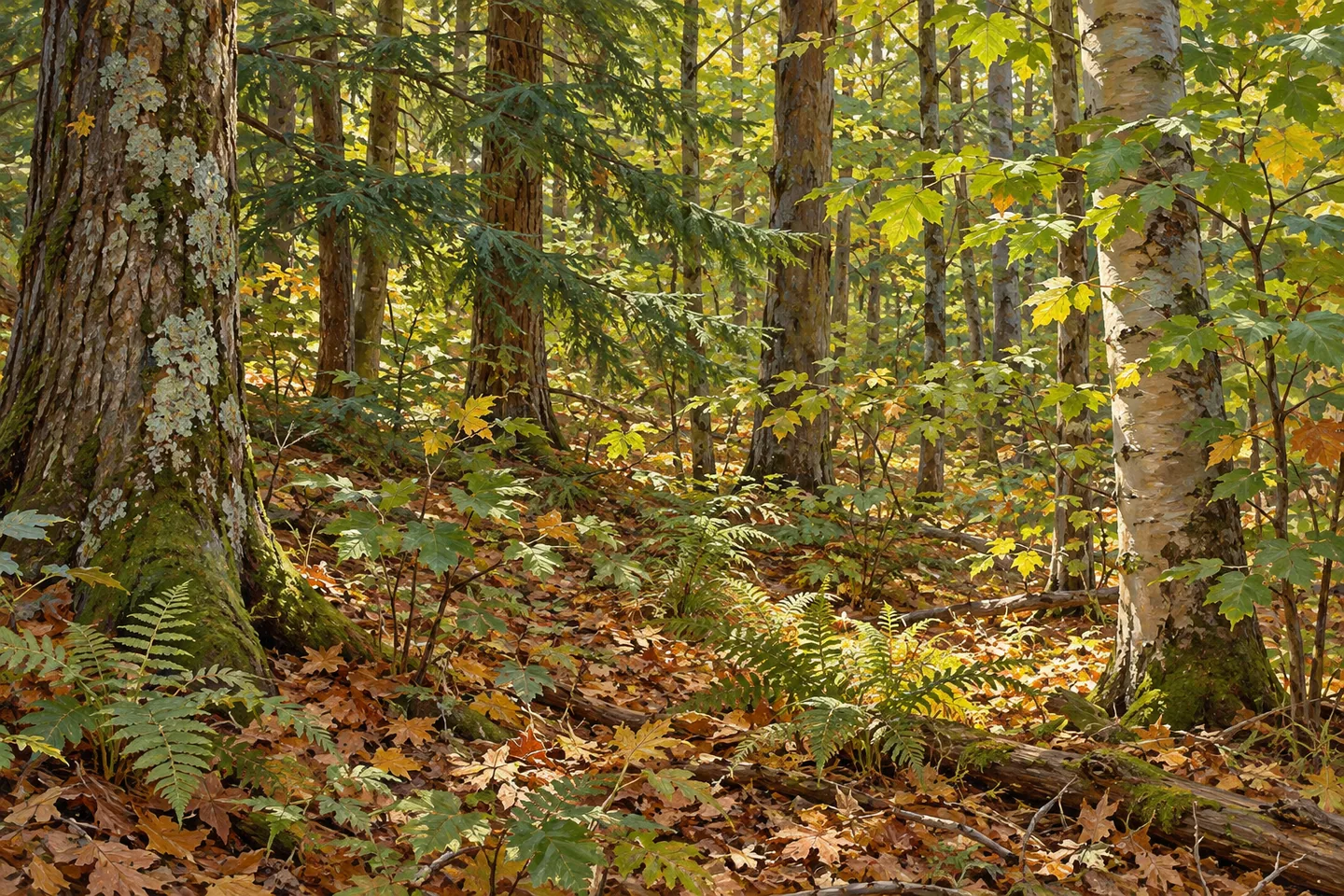
Fairfield State Forest has a planting story precise enough to give an ordinary woodland scene a particular history. Across 815 acres in Candor, Tioga County, trees returned to land that had been cleared for farming. The work happened over several decades, alongside changes in public ownership. Today, a mixture of hardwoods, southern-slope oaks and hemlock in ravines creates a setting where forest structure and small plants can hold attention together, without a single constructed attraction defining the visit.
The state acquired the original land between 1932 and 1940 and added another purchase in 1962. Earlier farmers had faced steep, acidic soils, harsh winters and a short growing season. Reforestation gave those marginal agricultural properties a different role, including water protection, forest products and recreation. The forest boundary now seen on a map therefore contains more than one chapter: earlier cleared ground, successive acquisitions and deliberate efforts to establish tree cover.
The first major planting described by DEC occurred in 1934, when Civilian Conservation Corps workers hand-planted more than 434,000 seedlings. Another 30,750 trees followed in 1938 through the Slaterville Springs camp. In 1963, Conservation Department staff planted 18,700 more with a tractor and spade. Those separate projects are more useful than a single compressed founding date. They show how the transformation of farmland continued across different periods and methods of work, with the trees themselves carrying the landscape change forward.
The present woodland also has a botanical scale smaller than its tree canopy. DEC identifies clubmoss, painted trillium and Christmas fern, together with pink lady's slipper and blue cohosh. Their mention gives a walk specific subjects for observation, while seasonal timing and actual conditions determine what is visible. A plant does not have to be flowering to belong to the forest's story. Look at the relationship between understory, leaf litter and the shelter of taller trees, leaving plants where they grow.
The wider ecological setting is the Central Appalachians subzone. Oaks on southern slopes, mixed hardwood woodland and hemlocks in ravines provide different structural elements within that setting. From an appropriate walking position, changes in canopy and ground cover can suggest those contrasts without requiring an exact species inventory. The interest lies in what is actually present along the selected section, rather than expecting every tree and plant in the description to appear together in one view.
Access remains modest. A 2 mile public forest access road and Jenksville Hill Road serve the property; the latter is a seasonal town road that is not plowed. There are no formal hiking trails, although walking is permitted unless posted otherwise. Use the current property map to choose an approach and return, with roadside parking arranged appropriately. The separate 1.6 miles of winter recreational trails should not be turned into an assumed additional walking loop or added to the road distance without checking overlap.
A visit can be centered on a short road-based section and still give the forest's history sustained attention. Compare the form of the woodland with the chronology of planting, then shift focus to the small vegetation beneath it. Follow current signs and leave the ground and plants undisturbed. Fairfield's distinction is the meeting of a documented reforestation effort with a living woodland floor, making several decades of land-use change visible through the details of a present forest.
Fun facts
- Fairfield State Forest covers 815 acres in Candor, Tioga County.
- More than 434,000 seedlings were hand-planted in 1934.
- Further planting included 30,750 trees in 1938 and 18,700 in 1963.
- The forest has no formal hiking trails.
Before you go
- Use the property map to choose a road-based approach and return.
- Jenksville Hill Road is seasonal and not plowed.
- Observe understory plants without picking or moving them.
Capture
- Frame ordinary woodland structure to suggest the reforestation theme.
- Photograph plants from the available walking surface without trampling vegetation.
- Use the contrast between hemlock-like conifers and broadleaf canopy where visible.
 Albany Hive
 Fort Jackson State Forest
 Glenmeal State Forest
Social
Fairfield State Forest protects 815 acres of woodland in Candor. #Cre8Travel
The property’s public-land story includes acquisitions in the 1930s and a 1962 addition. #Cre8Travel
More than 434,000 seedlings were planted by hand in 1934. #Cre8Travel
Further planting projects in 1938 and 1963 continued the conversion of former farmland. #Cre8Travel
Painted trillium, Christmas fern and other understory plants give the woodland a smaller scale of interest. #Cre8Travel
Oaks on southern slopes and hemlocks in ravines add contrast to the forest setting. #Cre8Travel
Choose a mapped road-based visit: formal hiking trails are not provided. #Cre8Travel
An ordinary woodland view can hold a specific story of planting, growth and changing land use. #Cre8Travel
Hashtags