 Cre8Travel
CRE8TRAVEL · NEW YORK PLACES
Albany Hive
Albany Hive: How a Neighborhood Metaphor Became a Place
Discover
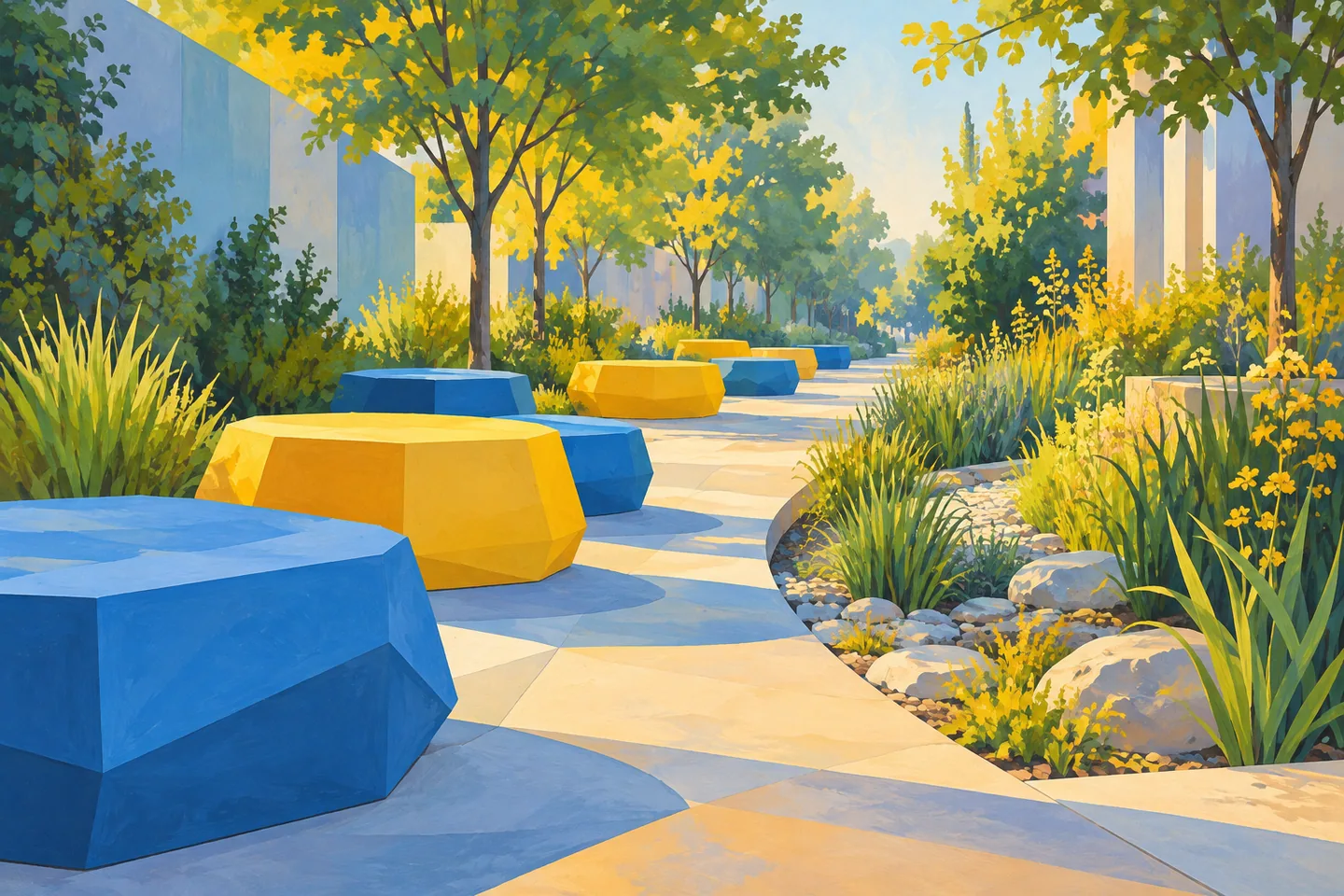
At Albany Hive, a neighborhood's own description of itself became the basis for a new public space. Residents compared their community to a beehive, helping and supporting one another. The design that followed brought blue and yellow sculptural forms, seating and artwork into a city-owned alley near Quail and First Streets in Albany's West Hill neighborhood. Its story is less about a single object than the process that connected local ideas with an everyday shared place.
The alley already sat beside active community projects: Albany Victory Gardens and Grateful Villages' West Hill Farmers Market. Yet the space between them had problems of its own, including debris, poor drainage and an overgrown canopy that limited light. The project treated the alley as a potential connection rather than an overlooked gap. Improving it could support activities already taking place nearby, while giving the surrounding community a more inviting setting in which to gather.
Before the designers began drawing, project partners held dozens of conversations with community groups and more than 400 residents. The beehive comparison emerged from those discussions. It provided both an image and a useful way of thinking about a shared space: different people contributing to something larger than an individual activity. Subsequent engagement sessions allowed residents to respond to ideas and influence the design. The community's role was part of the process, rather than an interpretation added after the objects were finished.
The resulting scheme centers on six beehive-inspired sculptures in vivid blue and yellow. Seating elements make the forms useful as well as visual, while polycarbonate panels provide places for community-created artwork. The project description also includes words of aspiration and places to play and reflect. These features give a visitor several scales to notice, from the overall rhythm of the sculptural group to the smaller relationship between a seat, a panel and the route through the alley.
Landscape work accompanies the art. New planters and swales help absorb rainwater, while improvements address the pathway, lighting, access and drainage. Those practical features matter to the design story. A successful public-space project involves ground conditions and ongoing use as well as recognizable shapes. The partners also developed a long-term stewardship and maintenance plan, connecting the initial installation with the care needed after a launch celebration has ended.
The published timeline makes the development stages clear. Community engagement began in September 2021, followed by further concept discussions and design review that autumn. Partner workshops and fabrication preparation continued from January 2022 into May 2023. Site cleanup and installation followed between June 2023 and October 2024. A community celebration on October 5, 2024 marked the completed work. These dates describe the project's development, rather than a recurring event calendar for visitors today.
Van Alen Institute identifies a broad collaboration of neighborhood organizations, designers, the city and other partners behind the Hive. For a visit, think of it as a public alley shaped through local participation, rather than a large attraction with a scheduled tour. Look at how the blue and yellow forms relate to the path and planting, and how places to sit can alter a small urban space. Albany Hive makes a specific idea visible: community identity can become part of the design of the ground people share.
Fun facts
- Albany Hive occupies a city-owned alley near Quail and First Streets in West Hill.
- More than 400 residents contributed to the project’s early conversations.
- The design uses six blue-and-yellow beehive-inspired sculptures with seating and artwork panels.
- A community celebration marked the completed work on October 5, 2024.
Before you go
- Treat the Hive as a shared neighborhood space and leave room for local use.
- Look at planting and drainage features alongside the sculptural forms.
- Check the project’s current channels for any public programming.
Capture
- Compare the rhythm of the blue-and-yellow forms with the route through the alley.
- Study the relationship between a seat, a panel and neighboring planting.
- Choose a detail of material or color without intruding on community activities.
 Amagansett National Wildlife Refuge
 Fairfield State Forest
 Fort Jackson State Forest
Social
Albany Hive began with residents comparing their community to a beehive. #Cre8Travel
More than 400 residents contributed to early project conversations.
The Hive redesigns a city-owned alley near Quail and First Streets.
Six blue-and-yellow sculptural forms connect seating with community-made artwork.
Planters, swales and drainage improvements are part of the design, alongside public art.
The project timeline spans engagement in 2021 through installation completed in 2024.
A community celebration marked the completed work on October 5, 2024.
How can a neighborhood’s own metaphor change the design of a shared space?
Hashtags