 Cre8Travel
CRE8TRAVEL · NEW YORK PLACES
Cranberry Creek Wildlife Management Area
Cranberry Creek Wildlife Management Area: A Closer Look
Discover
Thirteen acres can carry a surprising amount of history. Cranberry Creek Wildlife Management Area occupies 13.4 acres in the Town of Alexandria, Jefferson County, where wooded upland meets wetland and a deep emergent marsh. The contrast is the attraction: a small public parcel with different kinds of habitat, a short approach to the water, and a memorial that gives the creek a human story as well as a natural one.
The memorial gravesite commemorates American soldiers who died during the Battle of Cranberry Creek in the War of 1812. Informational signs explain the battle. Rather than treating those signs as a quick interruption to a nature walk, give them a separate pause. They offer a reason to think about this particular creek, rather than seeing an interchangeable patch of water and trees. The history belongs to the place; the memorial deserves a considerate visit.
A short foot trail connects the parking area with the memorial and the water's edge. This is a more useful starting point for planning than the acreage alone. Think of a visit around that documented approach, then leave time to observe rather than expecting a long circuit or an extensive trail system. The New York State Department of Environmental Conservation (DEC) asks visitors to remain on designated trails to protect the area's plant communities.
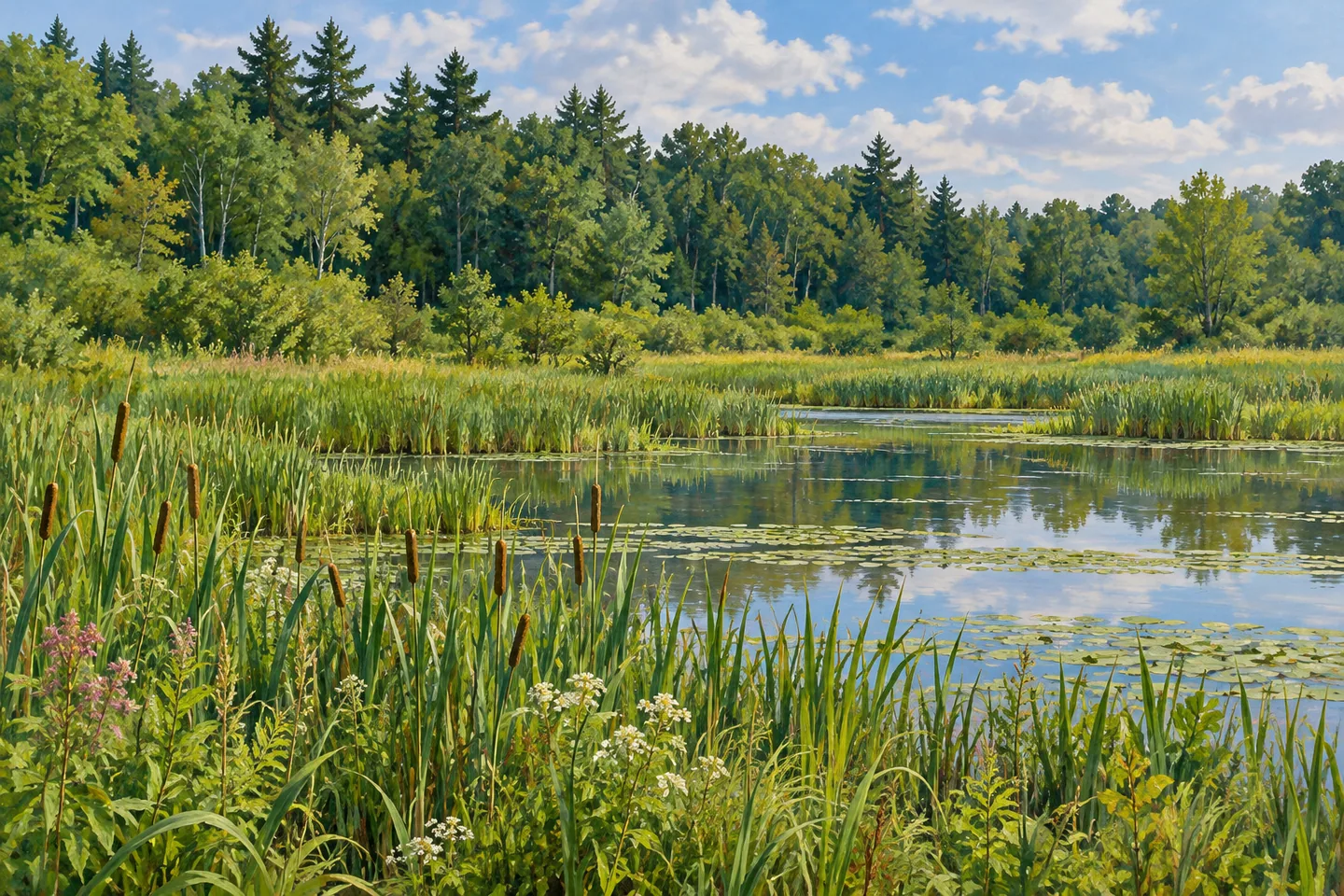
At the wetland edge, look at how the scene is organized before looking for an animal. Where does open water give way to emergent vegetation? How does the wooded upland change the background? Those are observation questions, not a suggested route through the marsh. They provide something worthwhile to notice even when wildlife remains out of sight. Staying on the designated approach also keeps a photograph from becoming an excuse to enter sensitive vegetation.
DEC identifies the habitat as supporting waterfowl, warm-water fish, furbearers and rare birds such as the least bittern. That describes habitat value, rather than a list of animals promised on arrival. Use the agency's bird and vertebrate checklists as reference material, and enjoy any observation on its own terms. A small protected area can be interesting without a sighting becoming the test of whether the visit succeeded.
Habitat management and public access have separate planning documents here. The Habitat Management Plan identifies target species and habitat goals; the Access and Public Use Plan addresses recreational opportunities and access features. Reading that distinction helps explain the WMA designation. This is land managed for wildlife and wildlife-dependent recreation, with public use considered alongside habitat needs. A plan states goals and proposals; it does not mean every possible facility has been built.
For the approach, use the DEC map and the Swan Hollow Road location north of Alexandria Bay. Do not mistake the small acreage for evidence of universal accessibility. Follow the posted conditions and Leave No Trace guidance, and include tick precautions in preparations, as DEC advises for these lands. The most satisfying visit may be a measured one: read the history, follow the short trail, and let the meeting of woods and water hold your attention.
Fun facts
- The WMA covers 13.4 acres in the Town of Alexandria, Jefferson County.
- Wooded upland and wetland include a deep emergent marsh.
- A memorial gravesite commemorates soldiers from the War of 1812 Battle of Cranberry Creek.
- A short foot trail connects the parking area with the memorial and water's edge.
- DEC identifies least bittern habitat, without guaranteeing an individual sighting.
Before you go
- Plan around the documented short foot trail rather than assuming a long loop.
- Stay on designated trails to protect the plant communities.
- Pause at the informational signs to understand the memorial.
- Use DEC bird and vertebrate checklists as observation references.
- Follow DEC tick precautions and Leave No Trace guidance.
Capture
- Frame the meeting of wooded upland, marsh vegetation and open water from the designated approach.
- Try a close study of vegetation textures without entering the marsh or moving plants.
- If wildlife remains out of sight, make the habitat itself the subject; no animal is needed for a considered composition.
 Otsquago State Forest
 Honeyville Wildlife Management Area
 Indian River Wildlife Management Area
Social
Cranberry Creek WMA is a 13.4-acre meeting of wooded upland and wetland in Alexandria, Jefferson County. #Cre8Travel
The short foot trail at Cranberry Creek WMA links the parking area with the memorial and water's edge. #Cre8Travel
A memorial at Cranberry Creek recalls the War of 1812 battle. Give its informational signs a thoughtful pause. #Cre8Travel
Deep emergent marsh is part of Cranberry Creek WMA's habitat mix. Look at the boundary between water and vegetation. #Cre8Travel
DEC lists least bittern among the wildlife supported by this habitat. Habitat value is not a sighting guarantee. #Cre8Travel
At Cranberry Creek, designated trails help protect the plant communities. Leave the marsh vegetation undisturbed. #Cre8Travel
A short walk can leave time for a longer look. Cranberry Creek pairs waterside observation with local history. #Cre8Travel
Would you begin with the historical signs or the water's edge? Both help tell Cranberry Creek WMA's story. #Cre8Travel
Hashtags