 Cre8Travel
CRE8TRAVEL · NEW YORK PLACES
Carlton Hill Multiple Use Area
Carlton Hill: From Abandoned Farms to a Habitat Mosaic
Discover
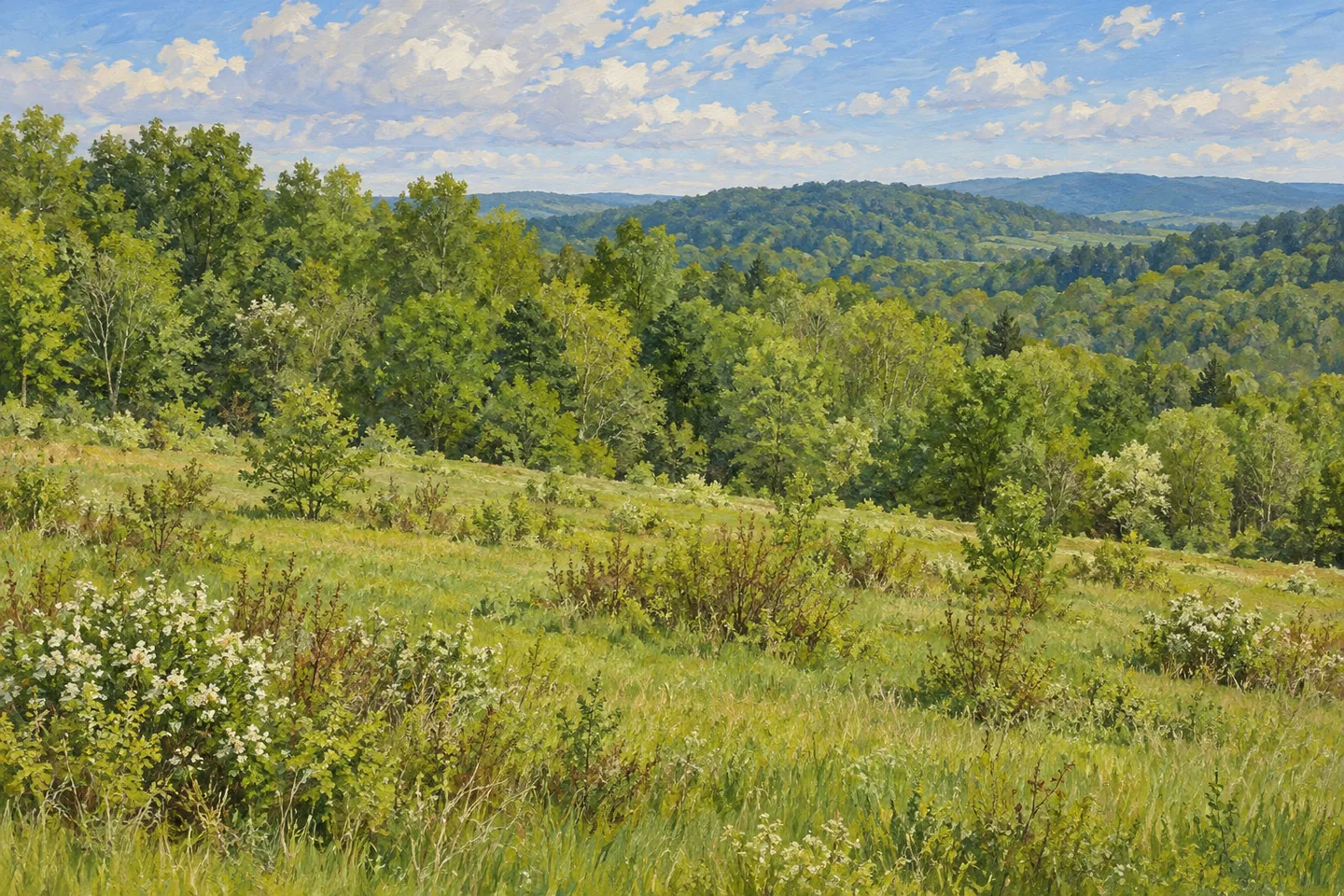
Carlton Hill Multiple Use Area is a landscape whose former farming history and present conservation purpose belong in the same view. Its 2,500 acres lie in the Town of Middlebury, Wyoming County, north of Warsaw. Woodland, open ground and other habitats occupy an upland setting shaped by valleys and changes in land use. A visit can focus on those relationships rather than looking for one signature monument or a single scenic stop that explains the whole property.
The surrounding ecological zone is characterized by flat-topped uplands separated by deep valleys. Poor soils and steep slopes made farming difficult, and many farms were abandoned during the 1920s and 1930s. Economic pressure added to the decline. This history is important to the management area's character: the land did not begin as a public nature destination, and its wooded or open sections belong to a setting where agricultural use had already changed substantially before the state started purchasing properties.
DEC began acquiring land in 1961 under the 1960 Park and Recreation Land Acquisition Bond Act. The distinction between the act's date and the later purchases keeps the chronology clear. Public ownership brought the earlier farmland and woodlots into a setting managed for wildlife and compatible recreation. That purpose helps explain why habitat variety is a central theme, while visitor use remains tied to the designated routes and rules of a multiple-use area.
A 2019 habitat plan gives a more detailed picture of that variety at a particular point in time. Its inventory distinguished forest, shrubland, grassland, agricultural land, wetland and open water. Forest accounted for more than two-thirds of the recorded area. Those dated categories show why the description of former farmland should be read as a land-use history, rather than as a claim that today's entire property consists of open fields dotted with a few trees.
The plan also separated recorded conditions from desired habitat changes. That is an important distinction when thinking about a managed landscape: a goal for more young forest does not prove that particular work has already happened. For a visit, the useful theme is the relationship among different habitats and their management, not a checklist of proposed features to find. Give attention to the transitions that can actually be observed from a designated route.
Bird diversity is one of the stated management objectives, including habitat for species at risk. That purpose makes an observation-focused outing relevant without promising a particular sighting. Remaining on designated trails helps protect the plant communities that form part of this wider habitat setting. Camping is prohibited, so the area should be planned as a day visit rather than as a place to finish a walk by choosing an informal overnight spot.
Several parking references serve different parts of the property, including Middlebury Road, Dale Road, Casselberry Road and locations on Bank Street Road. Choose the access point that belongs to the intended route rather than assuming all entrances lead to one standard circuit. Carlton Hill's distinctive interest comes from its sequence of changes: difficult farmland, abandonment, state acquisition and habitat management. Keeping those chapters visible can make a measured walk more revealing than a search for a promised wildlife encounter or a conventional park attraction.
Fun facts
- DEC began acquiring land in 1961 under the 1960 land-acquisition act.
- The 2,500-acre area lies in Middlebury, Wyoming County.
- The 2019 habitat inventory distinguished forest, shrubland, grassland, agricultural land, wetlands and open water.
- Camping is prohibited at Carlton Hill.
Before you go
- Plan a day visit; camping is not permitted.
- Stay on designated trails to protect plant communities.
- Use the 2019 plan’s habitat goals as planning history, not as confirmation that proposed changes are complete.
Capture
- Compare open and wooded habitat from a designated route without entering managed fields.
- Use the upland setting and vegetation transitions as subjects without inventing an exact viewpoint.
- Keep an illustration general rather than reconstructing proposed habitat work or staging a rare bird.
 Canadaway Creek Wildlife Management Area
 Charleston State Forest
 Chautauqua Lake Fish And Wildlife Management Area
Social
Carlton Hill Multiple Use Area brings former farming land into a wildlife-management landscape. #Cre8Travel
Its 2,500 acres lie in Middlebury, Wyoming County, north of Warsaw.
Many farms in the area were abandoned during the 1920s and 1930s, with poor soils and steep slopes among the pressures.
State land acquisition began in 1961, following the 1960 Park and Recreation Land Acquisition Bond Act.
A 2019 inventory recorded several habitat types, including woodland, shrubland, grassland, wetlands and open water.
The plan’s desired conditions are goals, not proof that every proposed change has taken place.
Stay on designated trails and plan a day outing: camping is prohibited.
Notice transitions between habitats rather than depending on a wildlife sighting. Carlton Hill’s landscape has a history worth reading in its own right.
Hashtags