 Cre8Travel
CRE8TRAVEL · NEW YORK PLACES
Cameron State Forest
Cameron State Forest: Three Ponds and a Changing Landscape
Discover
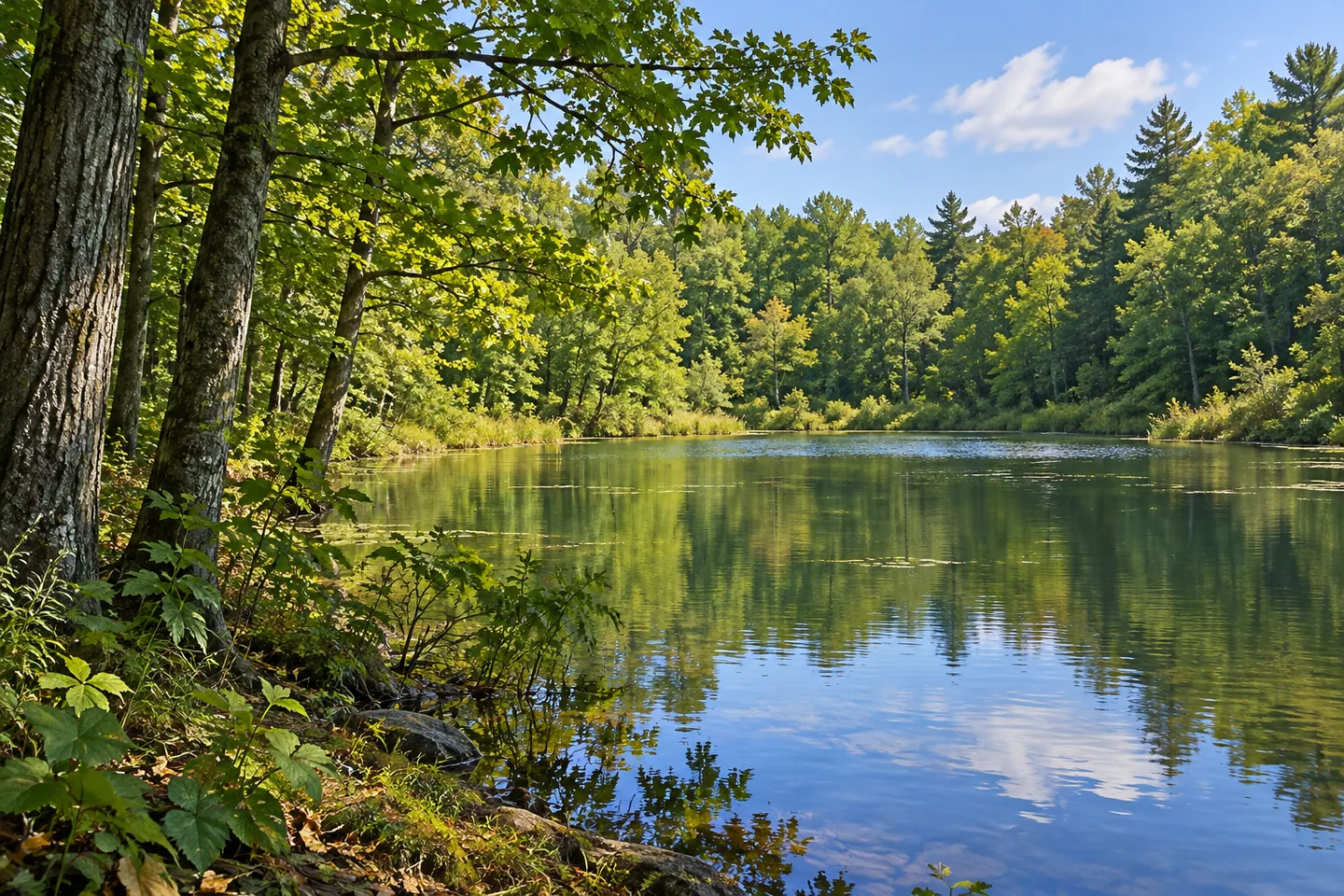
Cameron State Forest has a landscape with several distinct layers: three ponds, woodland, a native grassland near its southern end and a pipeline crossing much of the property. Within its 1,990 acres in Steuben County, these elements tell a story of public land shaped for different purposes over time. The central Cameron Pond provides a recognizable focus, while the surrounding forest asks for a different kind of attention from a park organized around a marked walking circuit.
Public ownership began with purchases in 1934 and 1935. More land followed after the Second World War, with acquisitions in 1947, 1948, 1950 and 1951, then further additions in 1964 and 1965. The 2018 draft Canisteo River Basin management plan identifies Cameron as Steuben County's fourth reforestation area. Its history is therefore one of successive additions, rather than a single opening date that neatly explains everything now inside the boundary.
The ponds are part of that history too. The plan records three ponds constructed for wood duck habitat during the 1950s and late 1960s through cooperation among state, county and federal government. Cameron Pond and the public forest access road serving it were completed in 1970. This documented purpose adds meaning to a view of water among trees without promising a particular bird sighting. The ponds were created within a managed landscape; they are not evidence of an untouched setting.
Other interventions are equally part of the picture. The pipeline crossing the property was built in 1974, and the grassland at the southern end introduces an open component alongside the wooded areas. Cameron's management combines timber production, wildlife habitat, water protection and compatible recreation. Observing the transitions between these elements can be more revealing than trying to make every part of the forest resemble the same woodland scene.
For practical orientation, Cameron Pond lies off West Cameron Road. Stone House Road also provides access to the state forest. The pond area has limited parking, so it should be understood as a modest access point rather than a large visitor complex. Cameron Pond supports day use, but its presence does not establish a maintained waterside loop or facilities at the two smaller ponds. Each part of a visit needs to match the access that is actually documented.
Elsewhere, the walking possibilities involve old roads, animal paths and pipeline corridors. DEC states that these routes are unmarked and that few are mapped; there are no designated hiking trails. That is a substantive planning condition, not a minor detail to discover after arriving. The forest is a poor choice for anyone whose outing depends on following an obvious sequence of trail markers. Keep route decisions within your preparation and the actual conditions.
Five designated primitive campsites provide another example of modest development. They are simple spaces, some graveled and others openings in the woods, with no additional facilities. Their existence should not be confused with a serviced campground. Whether the visit centers on the pond or a carefully planned woodland outing, Cameron is most interesting when its different histories remain visible: land purchases, habitat construction, access roads and an ongoing balance among public uses.
Fun facts
- State purchases began in 1934 and 1935.
- Three ponds were constructed for wood duck habitat during the 1950s and late 1960s.
- Cameron Pond and its public forest access road were completed in 1970.
- The pipeline crossing much of the forest was constructed in 1974.
Before you go
- Use the documented West Cameron Road access for Cameron Pond.
- Do not expect designated hiking trails; old roads and other routes are unmarked and few are mapped.
- Treat the five primitive campsites as basic spaces without additional facilities.
Capture
- Use the contrast between water and surrounding trees as a composition idea without implying a guaranteed reflection or wildlife encounter.
- Where visible from a legitimate route, compare an open grassland edge with the wooded landscape.
- Frame ordinary woodland textures rather than inventing a landmark or a maintained lakeside path.
 Stanley J. Hamlin Marsh Wildlife Management Area
 Huckleberry Ridge State Forest
 Stewart State Forest
Social
Cameron State Forest brings three ponds, woodland and a southern grassland into one managed Steuben County landscape. #Cre8Travel
Public purchases began in 1934 and 1935, with later additions after the war and during the 1960s.
Three ponds were built for wood duck habitat in the 1950s and late 1960s. Their purpose adds context without guaranteeing birds on a visit.
Cameron Pond and the public forest access road serving it were completed in 1970.
The forest’s pipeline dates to 1974. Infrastructure is part of this landscape’s history, alongside its habitat work.
Cameron Pond is accessed from West Cameron Road. Do not assume that the two smaller ponds have the same facilities or route conditions.
There are no designated hiking trails. The old roads and other routes described by DEC are unmarked, and few are mapped.
Five primitive campsites do not make a serviced campground. Cameron’s appeal is in understanding its particular combination of modest access and managed land.
Hashtags