 Cre8Travel
CRE8TRAVEL · NEW YORK PLACES
Amboy 4-H Environmental Education Center
Amboy 4-H: Learning the Landscape Through Woodland and Wetland
Discover
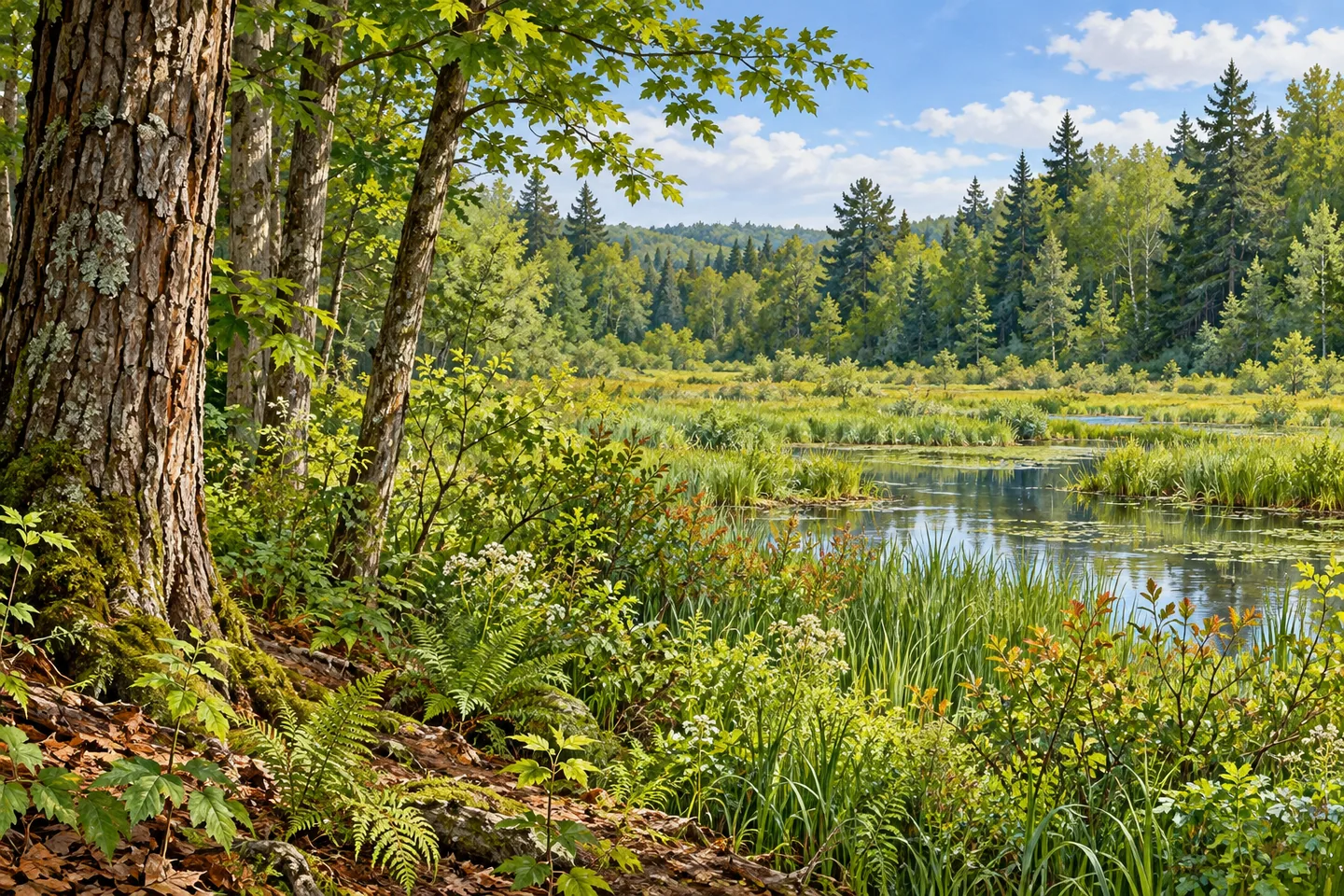
Amboy 4-H Environmental Education Center brings outdoor learning into a 150-acre landscape of mixed woodland and wetlands in Oswego County. Operated by Cornell Cooperative Extension of Oswego County, it offers three miles of marked trails and a setting shaped in part by Rowell Brook. The center describes its grounds as a field laboratory, a useful idea for a visit here. A walk becomes a chance to compare habitats, ask questions and notice the smaller details that help explain the landscape.
Woodland and wetland provide the basic contrast. Tree cover gives one kind of structure, while water and lower vegetation create another. Follow the marked route and watch how the surroundings change between those settings. A difference in the spacing of trunks, the plants close to the ground or the openness of a view can become the subject of a pause. The aim is attentive observation, giving the visible place time before moving to the next section.
The operator's trail map identifies Beaver Marsh, Woodpecker Wood and Trout Brook routes. Their names provide different themes for looking at the grounds, while the map also records features such as a seep and a beaver dam. Use the current route information to select an appropriate walk. The map includes an accessible portion of Beaver Marsh Trail; check the actual present condition and selected section when planning for a particular mobility need, since a mapped designation describes a specific approach.
Observation decks associated with the beaver pond and wetlands offer defined places to study those habitats. From suitable public access, look at the relationship between water, vegetation and the surrounding trees. Beaver natural history is one of the center's request-based education topics, connecting a familiar animal with the way a wetland landscape can be understood. An independent visit can keep the same questioning spirit while accepting that wildlife may remain unseen during the walk.
Trees supply another learning thread. The center lists tree identification among its educational topics, along with a spring woodland ramble. Comparing leaf forms, bark and branching patterns gives a woodland walk a practical focus, using whatever is actually visible in the season. A family or small group can choose a few trees along the route and discuss their differences. Looking closely at a handful of subjects can make the landscape easier to remember than trying to identify everything at once.
Other request-based topics include wood duck natural history, birds of prey, great horned owls and GPS or compass skills. These examples show the breadth of the center's teaching, from animal lives to ways of finding a route. Formal sessions need arrangements with the operator. The Schoeck Education Building includes a nature museum and classroom, but indoor access and organized learning have their own booking arrangements. A plan centered on the public outdoor grounds can therefore have a clear purpose of its own.
Before travelling, consult the operator's current trail and visit information, particularly for an arranged program or a specific accessible section. Keep the outing tied to marked public routes and designated observation places. Amboy's appeal lies in the connection between a real landscape and a habit of asking good questions: how woodland changes near water, what distinguishes two trees, or how a mapped path relates to the ground. Follow one of those questions, and an ordinary walk can become a thoughtful outdoor lesson.
Fun facts
- Amboy’s grounds cover 150 acres of mixed woodland and wetlands.
- Cornell Cooperative Extension of Oswego County operates the center.
- The property has three miles of marked trails.
- Request-based learning topics range from tree identification to compass skills.
Before you go
- Use current operator information to choose a marked outdoor route.
- Arrange formal teaching sessions and indoor access with the operator.
- Confirm the actual selected trail section and present conditions for a particular mobility need.
Capture
- From designated observation access, contrast low wetland vegetation with the taller woodland behind it.
- Use close bark and branching details to give a tree-study composition a clear subject.
- Along a marked route, frame layers of trees around an open wetland view without disturbing plants.
 Grass River Wild Forest
 Concrete Plant Park
 Hunts Point Riverside Park
Social
Amboy 4-H makes outdoor learning part of a woodland-and-wetland visit. #Cre8Travel
Its 150 acres include mixed woods, wetlands and Rowell Brook.
Three miles of marked trails connect the grounds.
The map names Beaver Marsh, Woodpecker Wood and Trout Brook routes.
Observation decks give wetland study a defined public focus.
Tree identification is one of the center’s request-based education topics.
Arrange formal programs and indoor visits with the operator.
Which question would guide your walk: trees, wetland habitats or finding the route?
Hashtags