 Cre8Travel
CRE8TRAVEL · MAINE PLACES
The Butterfly & Insect Museum
Maine Art Glass: Where Stained Glass Meets Natural History
Discover
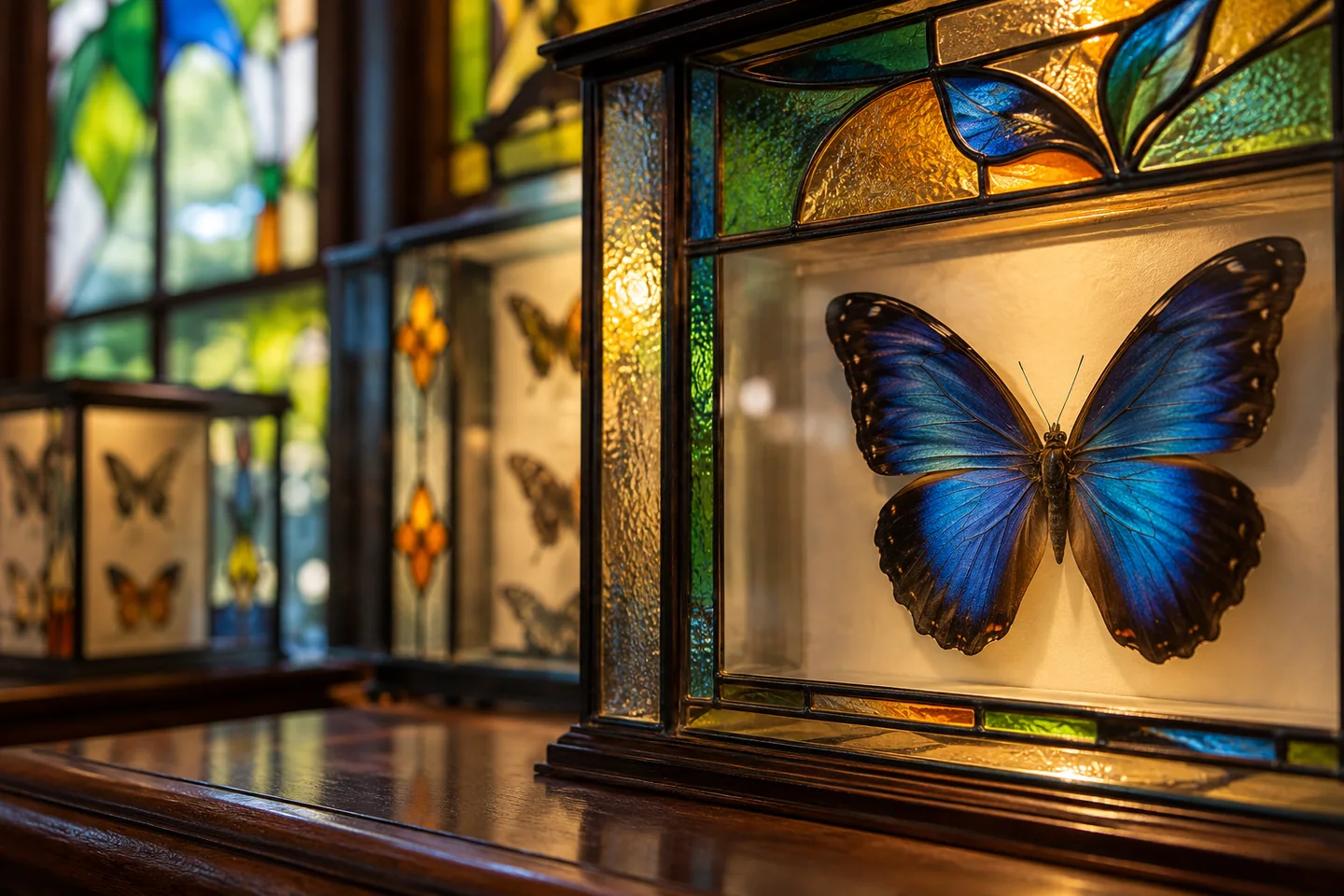
Maine Art Glass in Lisbon Falls brings stained glass and natural history into an unusually close relationship. Its Butterfly and Insect Museum displays specimens in cases made by Jim Nutting, who selects glass colors to complement the insects inside them. The cases are part of the visual experience rather than neutral containers. Look at a butterfly's pattern, then at the surrounding glass, and consider how one changes your attention to the other. This is a place where collecting, observation, and making meet under the same roof.
Nutting's own biography explains that combination of interests. He studied biology at Bates College, then took a stained glass class that led toward a different working life. After a career in the medical field, he joined his mentor Nel Bernard in the glass business. His designs draw on insects, flowers, and marine life, connecting detailed natural forms with the possibilities of cut and colored glass. That background makes the museum feel like an extension of an artist's long curiosity rather than an unrelated display attached to a shop.
Elizabeth Wilson's original visit account finds the amount to see almost overwhelming. Rather than photograph immediately, she first passes through the building to absorb the scene, then returns for a second look with her camera. She enjoys Nutting's enthusiastic welcome and the surprising mixture of shells, glass, butterflies, and other creatures. Her approach offers a useful idea for a visit: give the overall arrangement time before selecting individual details. A collection assembled through many years of personal interest can reward more than one way of looking.
The Maine Art Education Association's account of Nutting's teaching adds another dimension. His practice includes restoration as well as new commissions, and his classes have explored several glass techniques. In one described workshop, participants design and construct a panel through cutting, grinding, foiling, soldering, and finishing. The sequence makes clear how many decisions and practical skills stand behind a finished object. Consult the studio's current program separately if making something interests you; viewing the work and joining a class are different arrangements.
Kristen Wheatley's original group-visit account particularly enjoys the contrast between the former church setting, the stained glass, and the insect collection. A prearranged session gives her group an opportunity to learn from Nutting about live invertebrates. Her enthusiasm is accompanied by a personal preference for the slower-moving creatures, a reminder that visitors can respond differently to the same encounter. Treat that as one group's experience, without assuming that animal handling or a guided session will form part of an ordinary drop-in visit.
The museum's own introduction includes butterflies, beetles, moths, and a seashell collection, alongside changing live-invertebrate interests. It also specifies advance arrangements for special school and group tours. Confirm present opening and tour details, and ask directly about access needs in the multilevel building. Follow the host's guidance around living creatures and fragile displays. The visit can remain satisfying through careful observation alone, especially when the artistry of the cases and the natural forms within them receive equally patient attention.
Before you go
- Give the overall collection time before selecting individual details.
Visitor perspectives
- Wilson enjoys the collection’s unusual variety and Nutting’s welcome, taking a first pass before returning to photograph details.
- Wheatley enjoys a prearranged group visit, particularly the stained glass and live-creature interpretation, while preferring slower insects.
Capture
- Ask before photographing people, artwork, or a live-animal encounter.
 Sanford Mills Historic District
 Salmon Falls (West) Historic District
 Stroudwater Historic District
Social
Glass colors and specimen displays are designed to complement one another.
Jim Nutting’s biology background informs his glass work.
Wilson first absorbs the collection, then returns to choose photographs.
Teaching and restoration reveal the skills behind finished glass art.
A group visitor enjoys the unusual combination while preferring slower creatures.
The way an object is displayed can become part of its story.
Curiosity can connect subjects that initially seem unrelated.
A patient second look can reveal something the first pass missed.
Hashtags