 Cre8Travel
CRE8TRAVEL · MAINE PLACES
Sanford Mills Historic District
Sanford Mills: Read Industry from the Public Street
Discover
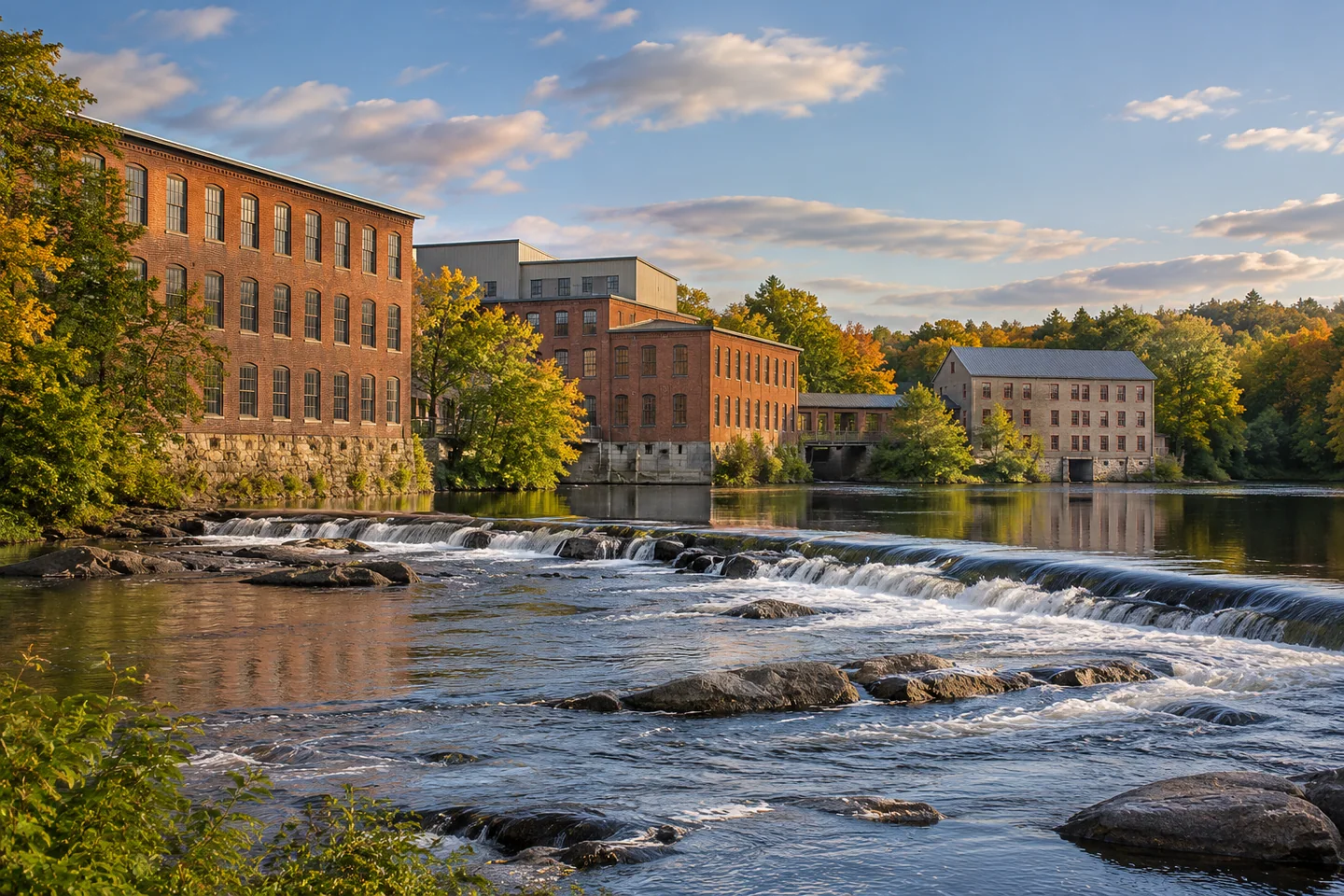
Sanford Mills Historic District makes the industrial scale of a Maine town visible beside the Mousam River. The preservation commission describes a group of former textile buildings, offices, bridges, and service structures made from several materials. Instead of treating a mill as one picturesque brick facade, look at the complex as a collection of connected functions. Production, administration, water, and power each required space. View the buildings from public streets, respecting current occupants, signs, barriers, and work areas rather than entering a former industrial yard to explore.
The Maine Historical Society's illustrated railway account shows how far those functions extended beyond the mill walls. The Goodall family needed to move raw materials from the railway depot to the factories and return finished textiles for shipment. When an existing railroad would not provide the service, the family established an electric railway. A factory's location beside water was only one part of its geography. Its success also depended on connections that brought materials in and carried finished goods toward customers elsewhere.
For an interpreted public walk, Sanford Trails identifies a signed historic route through downtown. It begins at Central Park near School and Washington Streets, with historical panels designed to be read from the sidewalk. Archival photographs by Fred Philpot help explain former buildings and uses. Check the current route information and choose a comfortable section to combine with exterior views of the mill district. The signed walk offers a way to connect industrial history with the streets where the broader town developed.
Thomas Goodall's textile enterprise grew here during the nineteenth century, with successive generations of construction changing the appearance of the complex. Wood, brick, concrete, and metal record different building approaches rather than one uniform architectural moment. The river supplied power, while later buildings expanded the space available for manufacture. Compare the size and organization of the structures that can be seen safely from public ground. Industrial architecture often communicates through repetition and scale as much as through ornamental detail, making the relationship between buildings particularly important.
The railway account also keeps workers in view. Electric cars carried people to mill jobs, while the transport system itself required operators, conductors, mechanics, and maintenance workers. Coal arrived by connections with coastal shipping and the regional railroad, then had to be moved into the enormous boilers by hand. That labor gives the imposing buildings a human dimension. Imagine a working day organized around travel, materials, machinery, and fuel, while remembering that the surviving architecture represents only part of the effort that supported it.
The historic walk extends that perspective to the Goodall family's civic legacy, with the library, city hall, park, and former homes among its subjects. You do not need to enter each building to appreciate how industrial employment and town life were connected. Read several panels rather than trying to cover every stop, and use the public route to keep the outing clear and manageable. The mill district becomes more meaningful when it is seen alongside the places associated with learning, recreation, public business, and everyday residence.
Before you go
- Keep the visit on public routes and follow current barriers and signs.
Capture
- Choose a legal public viewpoint that shows how several buildings relate.
 Alfred Historic District
 The Butterfly & Insect Museum
 Salmon Falls (West) Historic District
Social
Sanford’s former textile complex brought several industrial functions together.
Rail connections moved materials, finished textiles, fuel, and workers.
The signed historic walk uses archival photographs on sidewalk-readable panels.
Different building materials record successive phases of mill construction.
Industrial scale becomes more interesting when the work behind it stays in view.
A facade can be the beginning of a story rather than its whole subject.
Leave enough time to read a few panels carefully.
Connect a landmark with the streets and lives around it.
Hashtags