 Cre8Travel
CRE8TRAVEL · MAINE PLACES
Ragged Lake
Ragged Lake: Water, Camps and a History of Looking
Discover
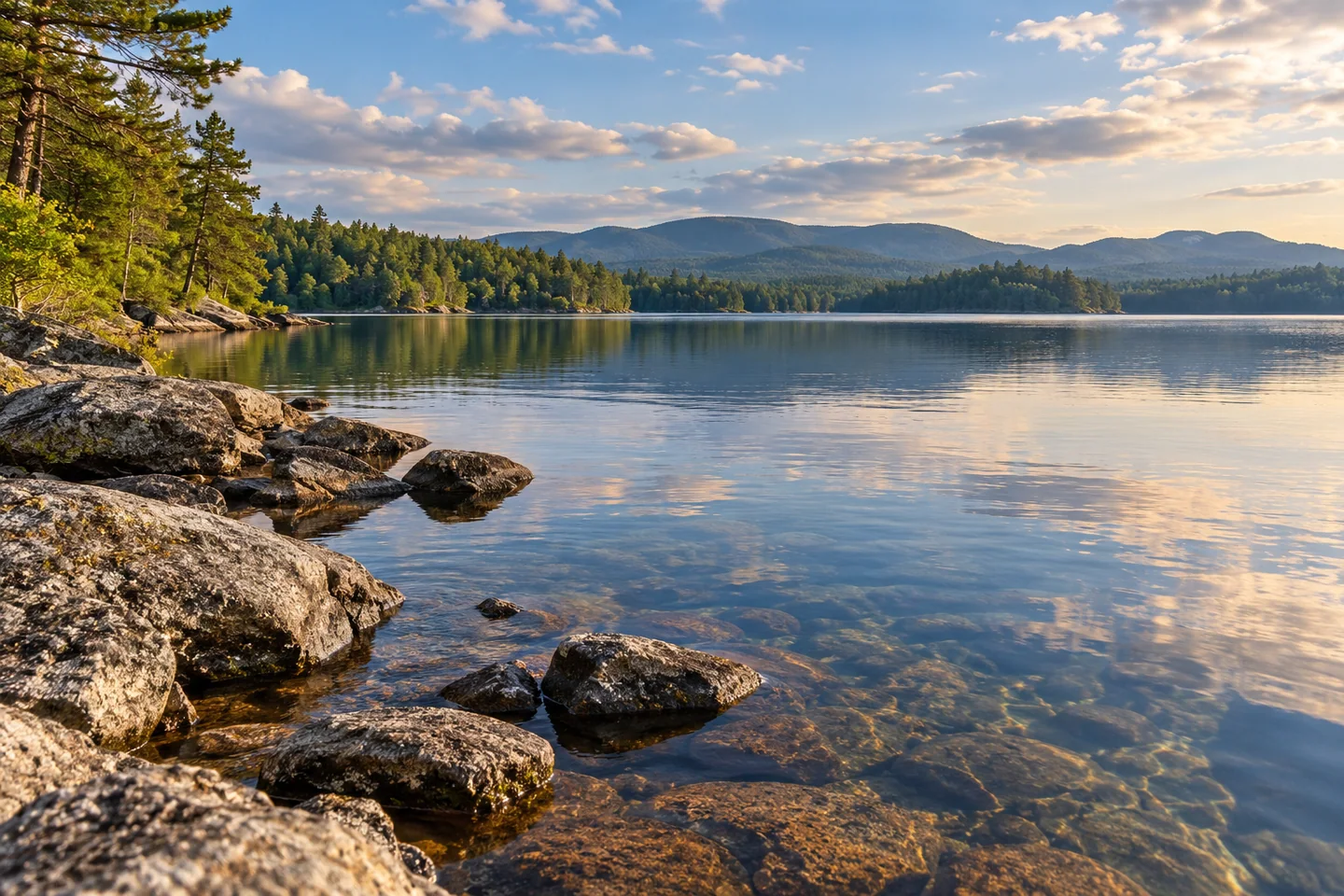
Ragged Lake in Piscataquis County offers a northern water outing with a story that reaches beyond the first wooded view. The regional state fishing guide identifies an improved boat approach on Sias Hill Road. Confirm the actual entrance and present road conditions before traveling, then organize a return to the same authorized access. The lake's combination of physical contrasts, fisheries experiments and a long photographic history can give even a modest section of water plenty of substance.
The historical state survey describes deeper basins at the lake's two ends, separated by shallower water. Ledge, boulders and gravel give the shore different textures. It also explains how a log-driving dam below the natural lake created a broad shallow flowage with bog vegetation, dead trees and stumps. These are observations from a report revised in 2003, rather than a present obstacle chart. They suggest why the visible shoreline should be read as a changed working landscape as well as a natural basin.
The same report records a sequence of management decisions. Salmon stocking ended in 1977, while a later lake-trout program was discontinued after poor survival. Splake stocking began in 1997. The sequence is useful historical context: adding fish was an experiment to evaluate, not an assurance of success. Read current rules separately before fishing, and leave nursery margins undisturbed. What happens beneath a lake's attractive surface can be a long story of changing conditions and careful observation.
A Maine Historical Society exhibition supplies a different kind of record. John Dunn photographed visits around Ragged Lake and the Moosehead region in the late nineteenth century, carrying a bulky camera and a heavy wooden tripod with guides' help. The collection includes dated images of lake camps and fishing parties. Those pictures make the act of recording an outing part of the place's history. Today's small camera or notebook can invite a similar attention, without reproducing an earlier visitor's expectations about hunting, fishing or access.
The exhibition also describes the effort of reaching remote camps: steamer travel to Lily Bay, horse-drawn transport and, depending on the destination, further canoe travel. Treat that account as historical context rather than modern directions. Its importance is the preparation and support behind the apparently simple camp scene. A view of someone resting beside water can conceal a considerable journey, and the people who made it possible deserve a place in the story.
Ben Richard's July 2012 personal blog recalls another kind of continuity. His family and friends returned to a private Ragged Lake camp for a sixteenth annual stay, having first visited in 1997. The short account includes walking beside the lake and photographs of camp life. It conveys attachment through repetition rather than a list of attractions. The private cabin belongs to that individual experience; it is not a public facility or an arrival option to add to an itinerary.
For your own record, consider a broad shore composition alongside one closer study of rock and water. Work from a stable permitted position and let the actual weather shape the photographs. Give the visit time to register before deciding it needs another destination. Ragged's history of observation offers a useful invitation: notice what makes this particular outing worth remembering.
Fun facts
- The historical survey describes deeper basins at both ends of the lake.
- A state report records splake stocking beginning in 1997.
Before you go
- Confirm the Sias Hill Road approach and current entrance conditions.
- Use present fishing rules alongside historical ecological background.
- Respect private camps and leave nursery margins undisturbed.
Visitor perspectives
- Ben Richard’s July 2012 blog recalls a sixteenth annual family-and-friends stay at a private Ragged Lake camp, with shoreline walks and photographs of camp life.
Capture
- Pair a broad shore composition with a closer study of rock and water from a stable permitted position.
 Rainbow Lake
 First and Second Musquacook Lakes
 Harrington Lake
Social
Ragged Lake offers more than a wooded surface view.
A historical survey describes contrasting deep and shallow parts of the basin.
Past fisheries programs were experiments with different outcomes.
Old camp photographs can reveal the work behind a recreational journey.
A bulky camera and tripod once accompanied guided visits in this region.
A personal family account finds meaning in returning over many years.
Respect the difference between a private camp story and public access.
What would make one part of a lake worth remembering?
Hashtags