 Cre8Travel
CRE8TRAVEL · MAINE PLACES
Hammond Forest
Hammond Forest: Reading the Traces in a Rome Woodland
Discover
Hammond Forest in Rome offers a woodland outing organized around traces rather than a summit. Maine Woodland Owners describes a gently sloping property east of Watson Pond Road, with Beaver Brook Estates Road along its northern and eastern sides. The organization welcomes recreation on its properties. Obtain the current property information and establish a suitable entrance before arriving; the description is not a promise of a signed circuit or a particular parking facility.
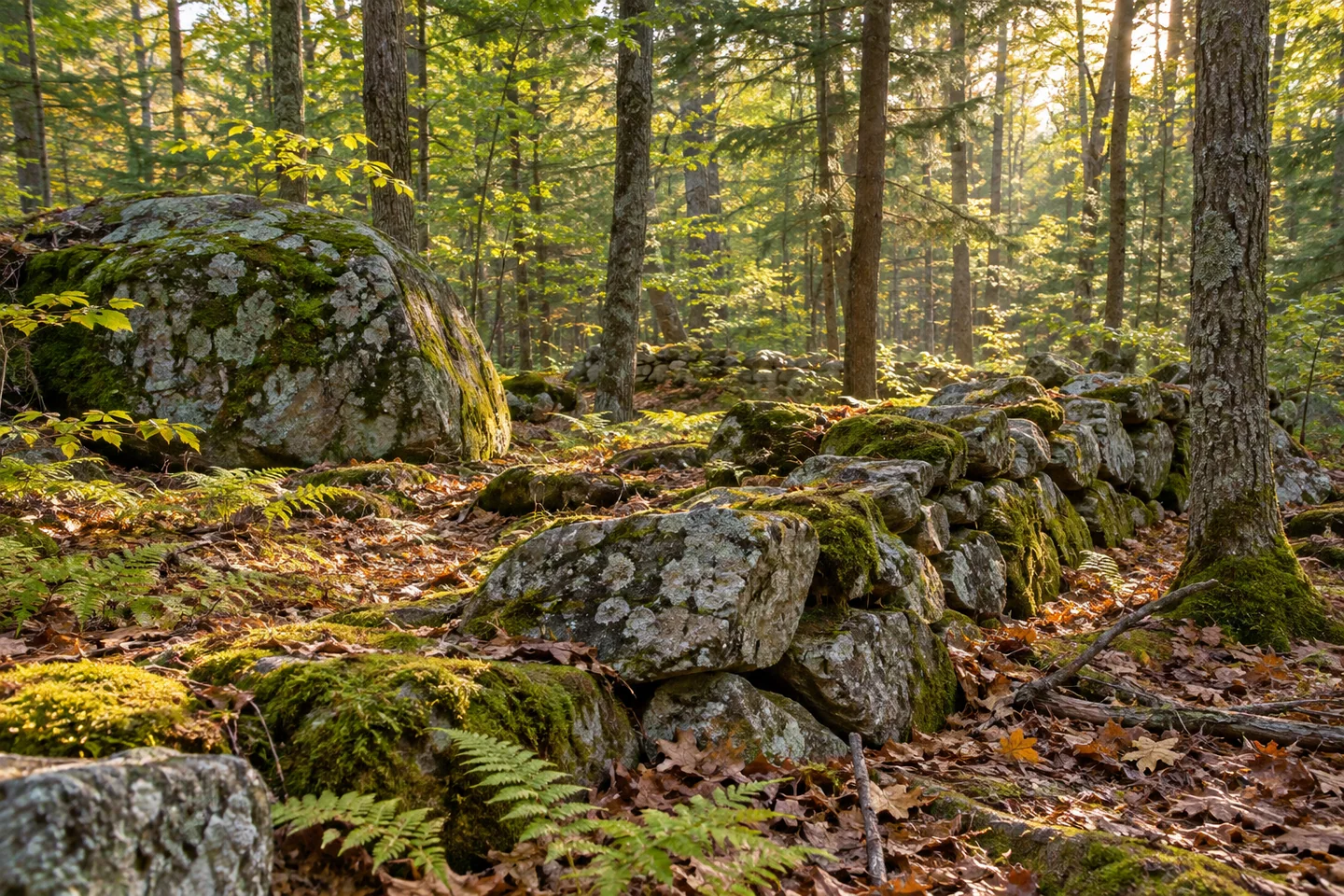
The owner records Paul and Emily Hammond's gift in 2000. Its account suggests agriculture continued into the early twentieth century, followed by forest regrowth. Rock walls and old cellar holes survive among hardwoods, white pine and red oak. These are clues to a change in land use, rather than a restored farm attraction. Leave walls intact and view depressions from stable ground. A good question for the walk is how a place that once needed open space can become a setting defined by trees.
An older local dispatch adds a working-forest chapter. In October 2010, the Portland Press Herald reported planned firewood harvesting here to improve growing conditions in dense young woods. The notice connected those sales with support for the woodland owners' organization and permanent land protection. It is evidence of a historical management activity, rather than an invitation to buy wood or watch harvesting today. Conservation and forest work can belong to the same property's story, even when their relationship is less immediately visible than a stone wall.
The property description also identifies glacial erratics. Maine Geological Survey explains the wider process: moving ice eroded rock and transported debris across the landscape, leaving a mixture of deposits as it melted. A boulder in the woods can therefore prompt a much longer view of time than the farm remains nearby. The state's general geological account does not establish the origin, age or precise travel path of any individual stone at Hammond. Treat those as questions to investigate rather than details to invent from appearance.
Try making two kinds of observation. First describe what is physically present: the direction of a wall, the outline of a depression, or the relation between a boulder and nearby trunks. Then distinguish that description from an interpretation. A feature may suggest a former boundary without revealing what was kept on either side. Writing down an uncertainty can sharpen a visit as much as naming a tree correctly. There is no need to turn every object into an explanation.
For photographs, pair a wider view that gives a feature its woodland setting with a closer study of texture. Keep both images possible from ordinary, stable ground, without climbing a wall, entering a cellar hole or moving stones. Include enough context that a viewer can understand the scale without needing a person to stand on a fragile feature. Hammond's appeal is the chance to notice overlapping stories: a glacial landscape, a former farm, a growing forest and a gift intended to keep the land protected. A modest outing can hold all four without requiring a long route or a dramatic viewpoint.
Fun facts
- Paul and Emily Hammond donated the property in 2000.
Before you go
- Establish the current entrance and access arrangements before arriving.
- Leave walls and cellar holes undisturbed.
- Record observations separately from uncertain interpretations.
Capture
- Pair a contextual woodland frame with a closer texture study, without climbing walls or entering depressions.
 The Ticonic Sculpture
 Tyler Pond Wildlife Management Area
 Carleton Pond and Watershed Trail
Social
A woodland visit can begin with a question rather than a mileage target.
Stone walls can invite attention without revealing every detail of a former farm.
An old forestry notice records one chapter of land management, rather than current operations.
Moving ice helps explain why transported boulders occur in Maine landscapes.
Describe what you can see before deciding what it means.
A photograph gains meaning when it includes a feature’s setting.
Leave fragile traces intact for the next curious visitor.
Which would draw your eye first: a boulder, a wall or the trees around it?
Hashtags