 Cre8Travel
CRE8TRAVEL · MAINE PLACES
Eartha
Eartha: A Familiar World at an Unfamiliar Scale
Discover
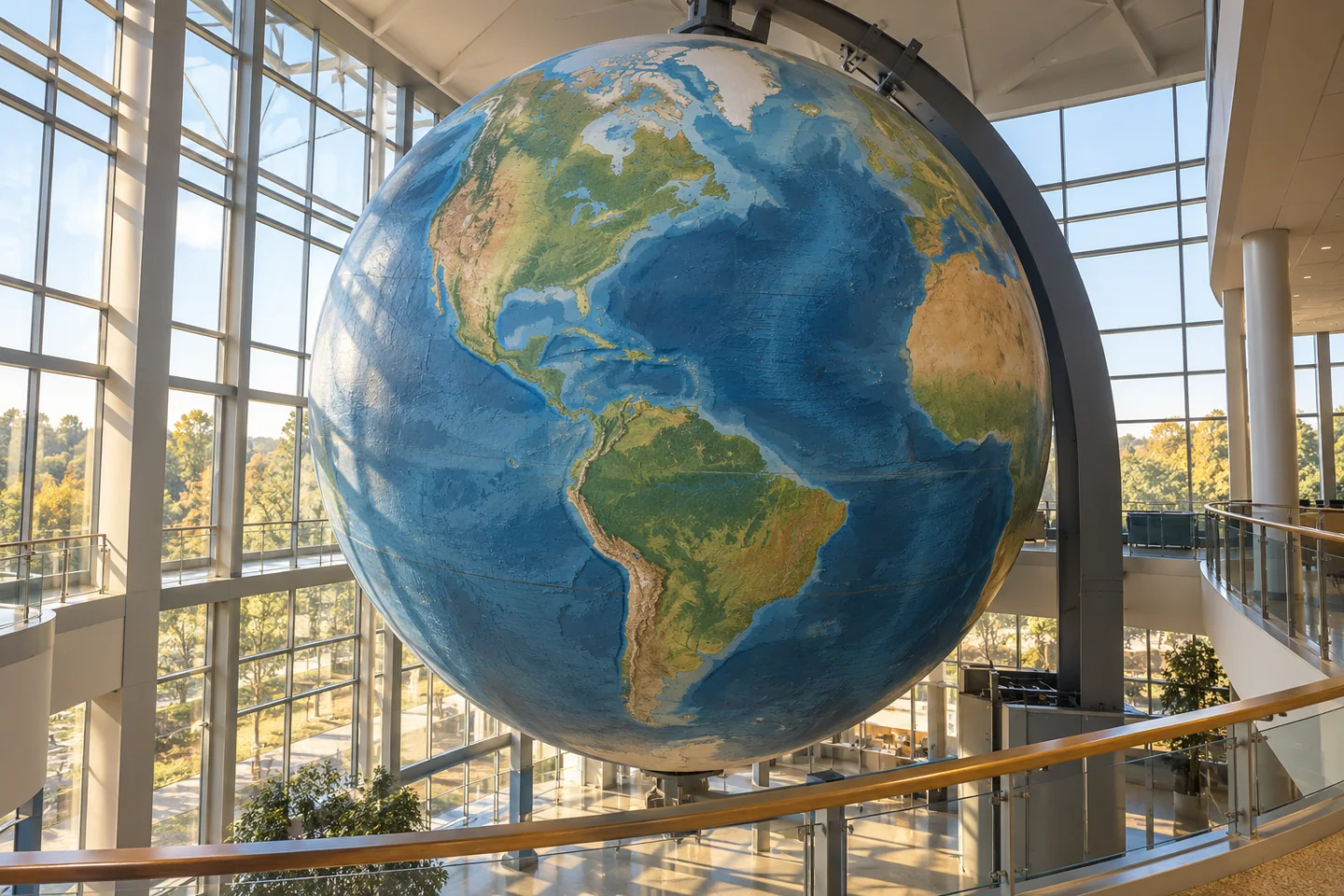
Eartha gives a familiar classroom object an unfamiliar scale. Inside a glass atrium in Yarmouth, a vast globe turns above visitors, making geography something to stand beside rather than hold in a hand. Its own website welcomes visits and highlights the structure beneath the mapped surface: a system of sturdy but lightweight geometric supports, fitted panels, and the maps themselves. Begin with that combination of image and construction. The attraction is both a representation of a planet and a carefully assembled object occupying a real building.
Guinness World Records identifies Eartha as the largest revolving globe and credits David DeLorme with its creation. Built over two years and completed in the late 1990s, the sphere weighs thousands of pounds and depends on computer-controlled electric motors and a specially designed cantilever arm. The glass enclosure matters to the experience, too. A model normally associated with a desk instead fills a three-storey atrium, so the surrounding architecture becomes a useful measure of its size.
Tripadvisor contributor NeoWasHere finds the globe bigger than expected and especially enjoys comparing it from the different viewing levels. Another contributor, Lisamarch, likes maps but considers this merely a brief stop and is unsure about recommending it. Those reactions help set a sensible expectation. Eartha can be a memorable curiosity without becoming an entire day's destination. Give yourself time to watch the movement, but choose a visit that fits your interest in maps rather than somebody else's enthusiasm for collecting roadside records.
The engineers who repaired Eartha's controls describe the practical systems behind that movement. Their account explains how programmable controllers and variable-frequency drives communicate with the owner's tablet, keeping the motors under control. Reading about that work adds another question to the visit: how does something this large move smoothly while keeping its support visually unobtrusive? The globe's effect depends on engineering as much as on the printed geography. Watching slowly can make the relationship between weight, motion, and apparent lightness more interesting.
The corporate setting also has a history of its own. Garmin's announcement of its acquisition of DeLorme describes a business combining traditional mapping with digital cartography and satellite communication devices. The company planned to retain the Yarmouth location as a research and development office. That context makes Eartha a particularly apt landmark: a large physical map remains associated with work on technologies that let people navigate and communicate far beyond this lobby. The old map shop is not the reason to plan a visit today.
Michael W's original family travel account enjoys seeing Eartha but encounters a closed lobby during the pandemic. The family can still appreciate the illuminated globe through the building's glass, yet the writer wishes they could have gone inside. That historical experience offers a lasting practical lesson without describing current closure: confirm the present visitor arrangements before making a special trip. Meander Maine's illustrated visit also emphasizes changing viewpoints and the detailed surface. Arrive ready to look closely, while treating the working office setting and its current visitor boundaries with courtesy.
Before you go
- Confirm the current visitor arrangements before making a special trip.
Visitor perspectives
- NeoWasHere enjoys the scale and several viewpoints; Lisamarch considers it a brief stop and is uncertain about recommending it.
- The family enjoys the globe through the glass but is disappointed that pandemic restrictions prevent an indoor visit.
Capture
- Stand clear of circulation routes and compare a full view with one carefully chosen detail.
 Vassalboro Town Forest and Red Brook Trails
 Spindleworks
 Alfred Historic District
Social
Eartha’s interpretation highlights maps, panels, and the supporting truss.
Guinness recognizes the giant revolving globe created by David DeLorme.
One visitor enjoys the changing perspectives; another finds it only a brief stop.
The moving globe depends on motors and carefully managed controls.
The Yarmouth location connects traditional cartography with navigation technology.
A familiar object can become surprising when its scale changes.
Let a curiosity fit the day rather than dictate the whole itinerary.
Look long enough for slow movement to become part of the experience.
Hashtags