 Cre8Travel
CRE8TRAVEL · NEW YORK PLACES
Stuyvesant Square
Stuyvesant Square: Two Gardens and a Long View of Manhattan
Discover
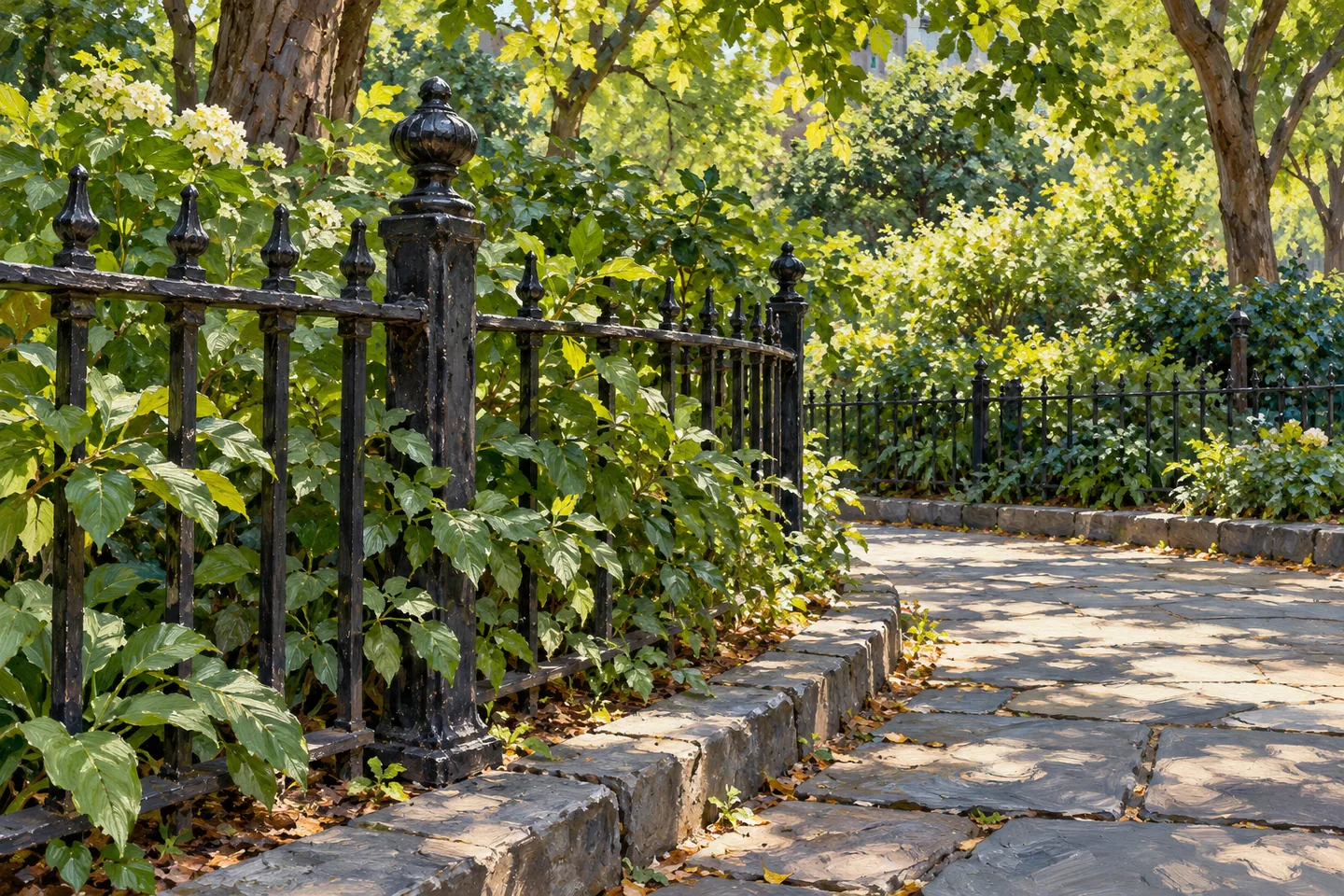
Second Avenue gives Stuyvesant Square an unusual rhythm: a garden, a street crossing, then another garden. Between East 15th and East 17th Streets, the two halves create a sequence of planted borders, paths and benches within a busy Manhattan neighborhood. The park is compact enough for a short pause, yet its ironwork, fountains and trees reward a slower look.
Its beginnings lie in a family farm. In 1836, Peter Gerard Stuyvesant and his wife Helen Rutherfurd reserved four acres and sold them to the city for five dollars, intending the land for a public park. The gesture did not produce an immediate garden. Stuyvesant brought a lawsuit in 1839 to press for improvements, and construction of the cast-iron fence finally began in 1847.
The park opened in 1850 with its landscaping completed. That history gives the fence a role beyond decoration: it belongs to the process by which a vacant site became an organized public space. Look at the relationship between the iron boundary and the paths within. The garden offers places to sit while maintaining a clear edge against the surrounding streets.
The nineteenth-century layout has been revised and restored several times. Landscape architect Gilmore D. Clarke modified the plan during the 1930s, and the park reopened in 1937 with new amenities. Work in 1982 addressed the two fountains, dating from 1884, the iron fence and the original bluestone sidewalks. Later renovations between 2006 and 2016 added benches and restored decorative fencing. Today's setting carries several periods of care in its small details.
Sculpture adds another layer to a walk through the gardens. Gertrude Vanderbilt Whitney's statue of Peter Stuyvesant was created for the 1939 New York World's Fair and installed here in 1941. In the northeastern part of the park, Ivan Mestrovic's statue of composer Antonin Dvorak has a different journey: made for Lincoln Center in 1963, it moved to the square in 1997. Dvorak once lived across the street, where he composed his From the New World Symphony.
A tree provides a quieter connection with the past. NYC Parks identifies the English elm by the western gate as one of its Great Trees and believes it may predate the 1836 transfer of the land. Its presence invites a change of scale, from the planned lines of paths and ironwork to the growth of a living canopy. Give the roots and planted areas space as you look.
The Stuyvesant Park Neighborhood Association helps sustain the park's everyday life through gardening and community activities. Its calendar has included music, volunteer planting and walking tours; the association also maintains a small free library. These activities belong to a neighborhood setting where sitting with a book can be as satisfying as following a historical route.
Plan to explore the two halves at an unhurried pace, using the street crossing to move between them. Check the association's current calendar for a scheduled activity and follow posted rules around planted beds and the dog area. For a simple visit, choose a bench and notice how the old iron boundary, restored fountain details and foliage frame the city around you.
Fun facts
- The land was sold to the city for a public park in 1836.
- The park opened to the public in 1850.
- Second Avenue divides its two garden sections.
- The Dvorak statue moved here from Lincoln Center in 1997.
Before you go
- Allow time for both halves and use the designated street crossing.
- Look for the English elm near the western gate without entering planted beds.
- Check the neighborhood association’s calendar for current walks and gardening activities.
Visitor perspectives
On an October 2023 solo visit, Tripadvisor reviewer Lalsic Tharrid appreciated the paths, planted borders and many benches for a restful break.
Capture
- Use the iron fence and planting to frame a view from a public path.
- Photograph fountain details or the relationship between canopy and paths while keeping benches available to visitors.
 Williamsbridge Oval
 Powell's Cove Park
 Henry Hudson Park
Social
Stuyvesant Square offers two Manhattan gardens on either side of Second Avenue. #Cre8Travel
The park’s land transfer dates to 1836, and its public opening to 1850.
Cast-iron fencing and bluestone paths give a small space a strong architectural edge.
The gardens were reshaped in the 1930s and restored in later decades.
Ivan Mestrovic’s Dvorak statue moved to the park in 1997.
An English elm near the western gate is listed among NYC Parks’ Great Trees.
Check the neighborhood association’s calendar for music, gardening and walks.
Would you explore the sculpture first or settle on a bench beneath the trees?
Hashtags