 Cre8Travel
CRE8TRAVEL · NEW YORK PLACES
Kabob Wildlife Management Area
Kabob Wildlife Management Area: Habitat Management on a Small Scale
Discover
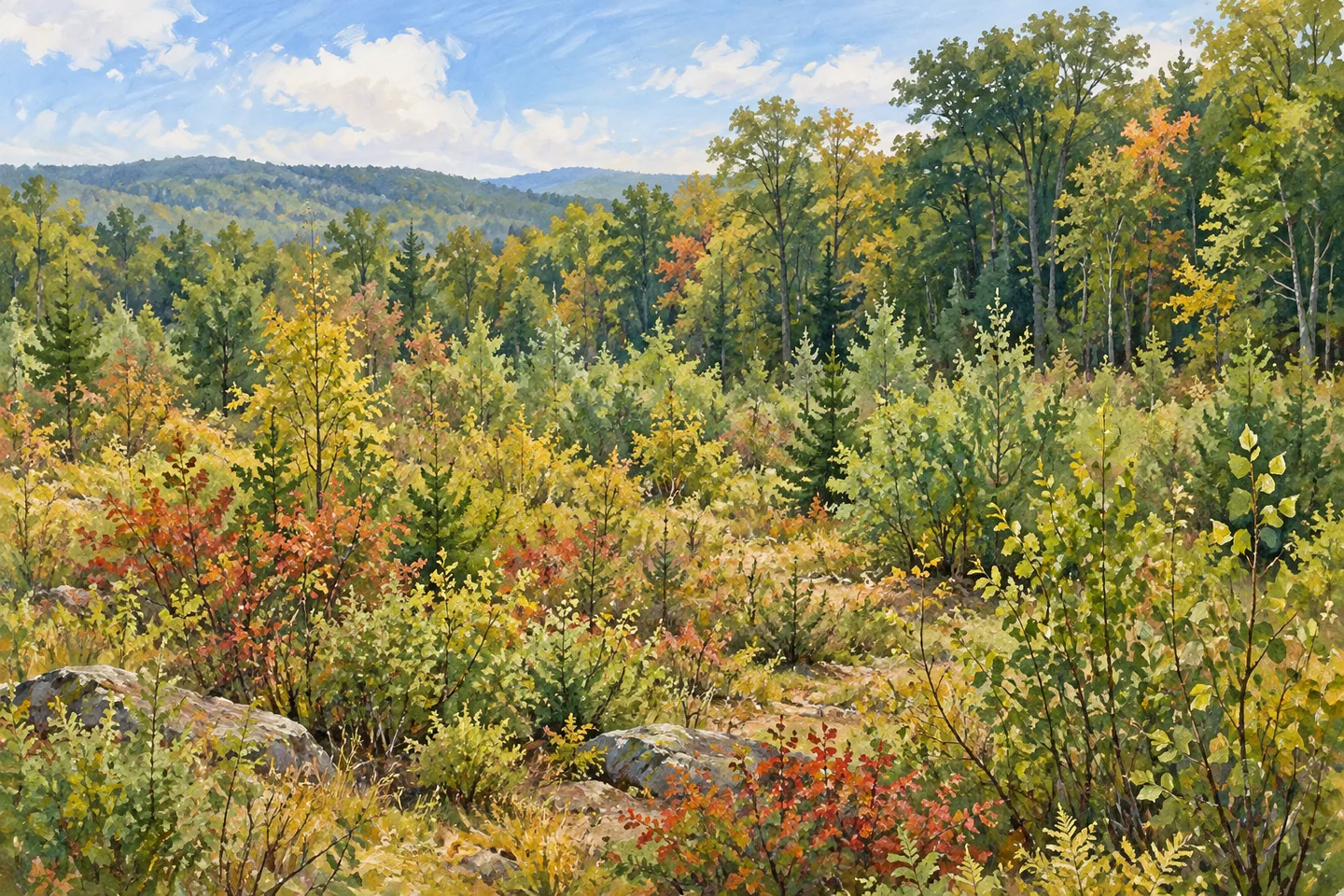
Kabob Wildlife Management Area shows how a small property can have a specific conservation purpose. Located in Stockton, Chautauqua County, about 15 miles north of Jamestown, it was given to New York in 1978. DEC describes wetlands, brushland and woodland here, with wildlife-dependent recreation forming part of the area's role. The useful question for a visit is how those habitats are managed, rather than how many facilities a small site can fit.
Its particular emphasis is demonstration. DEC identifies an objective of showing private landowners forest-habitat management techniques suited to relatively small acreages, especially for ruffed grouse and woodcock. That practical connection makes Kabob more than an anonymous patch of woodland. The property is used to consider how decisions about tree cover and habitat structure can operate at a scale that private owners may recognize.
The agency's 2017–2026 habitat plan provides historical context for that objective. It explains the relationship between young forest and nearby mature cover for the target birds, and sets goals for maintaining different habitat types. Read those as planning aims, not as a checklist of works completed or birds certain to appear. A management plan can explain why an area looks different from an imagined untouched preserve without promising what you will find on a particular day.
The same plan describes forested wetlands as part of the woodland accounting. That is a useful distinction when interpreting the more general wetland description: the site should not automatically be pictured as a large open pond with a convenient shoreline walk. The public information supports varied habitat, but not an invented boardwalk, viewing platform or paddling circuit. Let the current map and actual access guide where you stand and what you observe.
Deer, turkey, squirrels and songbirds appear in DEC's wildlife description. The agency links both bird and vertebrate checklists as viewing aids. Use them to direct attention toward habitat and identification rather than to build a list of guaranteed encounters. Photography can begin with brush and woodland textures even when no animal is visible. A wider frame and a closer study of vegetation can make a useful pair without requiring a dramatic open-water scene.
The documented approach from Cassadaga follows County Route 71 south and Waterman Road west to an unpaved parking area. Confirm the current map and access information before setting out. No particular trail length or marked walking loop is established by the property description, so plan around the access and boundaries actually shown rather than a presumed circuit. DEC recommends appropriate outdoor-safety practices and considering a guide when woodland experience is limited.
Kabob is managed by DEC's Division of Fish and Wildlife. The public description discusses wildlife-associated uses such as viewing, photography, hunting and trapping under the applicable rules. Consult current WMA guidance and seasonal requirements for the activity you intend, respecting other lawful users. Follow Leave No Trace principles and leave plants and habitat features undisturbed.
Stockton State Forest appears in the agency's nearby-land list and can be planned as a separate stop. At Kabob, allow the small scale to focus your attention: a property given to the state, habitat-management questions relevant to private landowners, and the patient observation of woodland and brush.
Fun facts
- Kabob WMA was given to New York in 1978.
- The property is in Stockton, Chautauqua County, about 15 miles north of Jamestown.
- Its habitats include wetland, brushland and woodland.
- DEC identifies habitat-management demonstration for private landowners as a specific objective.
- Ruffed grouse and woodcock are focal species in that management objective.
Before you go
- Review the current WMA map and boundaries before assuming a marked walking circuit.
- Use the Cassadaga–County Route 71–Waterman Road approach to locate the unpaved parking area.
- Use DEC bird and vertebrate checklists as observation aids, not a promise of sightings.
- Check the current WMA rules for your chosen activity and respect other lawful users.
- Follow Leave No Trace and DEC outdoor-safety guidance.
Capture
- Frame brush and woodland textures to express the variety of habitat without inventing a large open pond.
- Pair a wider vegetation study with a close detail, leaving plants undisturbed.
- If a bird is actually present, photograph from a respectful distance rather than arranging a wildlife encounter.
 Black Rock Forest
 Mount Pleasant State Forest
 Panama State Forest
Social
Kabob WMA lies in Stockton, Chautauqua County, about 15 miles north of Jamestown. The property was given to New York in 1978. #Cre8Travel
Kabob’s particular role includes demonstrating habitat-management techniques for relatively small acreages to private landowners. #Cre8Travel
Ruffed grouse and woodcock are focal species in Kabob’s habitat-management objective. A target species is not a guaranteed visitor sighting. #Cre8Travel
DEC describes wetland, brushland and woodland at Kabob WMA. A small site can reward close attention to changes in vegetation. #Cre8Travel
The 2017–2026 Kabob habitat plan sets management aims. It helps explain the landscape without proving that every proposed project is complete. #Cre8Travel
Approach Kabob from Cassadaga via County Route 71 and Waterman Road. Check the current map for the unpaved parking area and public boundaries. #Cre8Travel
Try photographing woodland and brush texture at Kabob before depending on wildlife or an open-water scene to complete the composition. #Cre8Travel
A property gift, habitat demonstration and patient observation meet at Kabob. Which small landscape detail would you notice first? #Cre8Travel
Hashtags