 Cre8Travel
CRE8TRAVEL · NEW YORK PLACES
Humes Preserve
Humes Preserve: Where an Estate Opens into Meadow
Discover
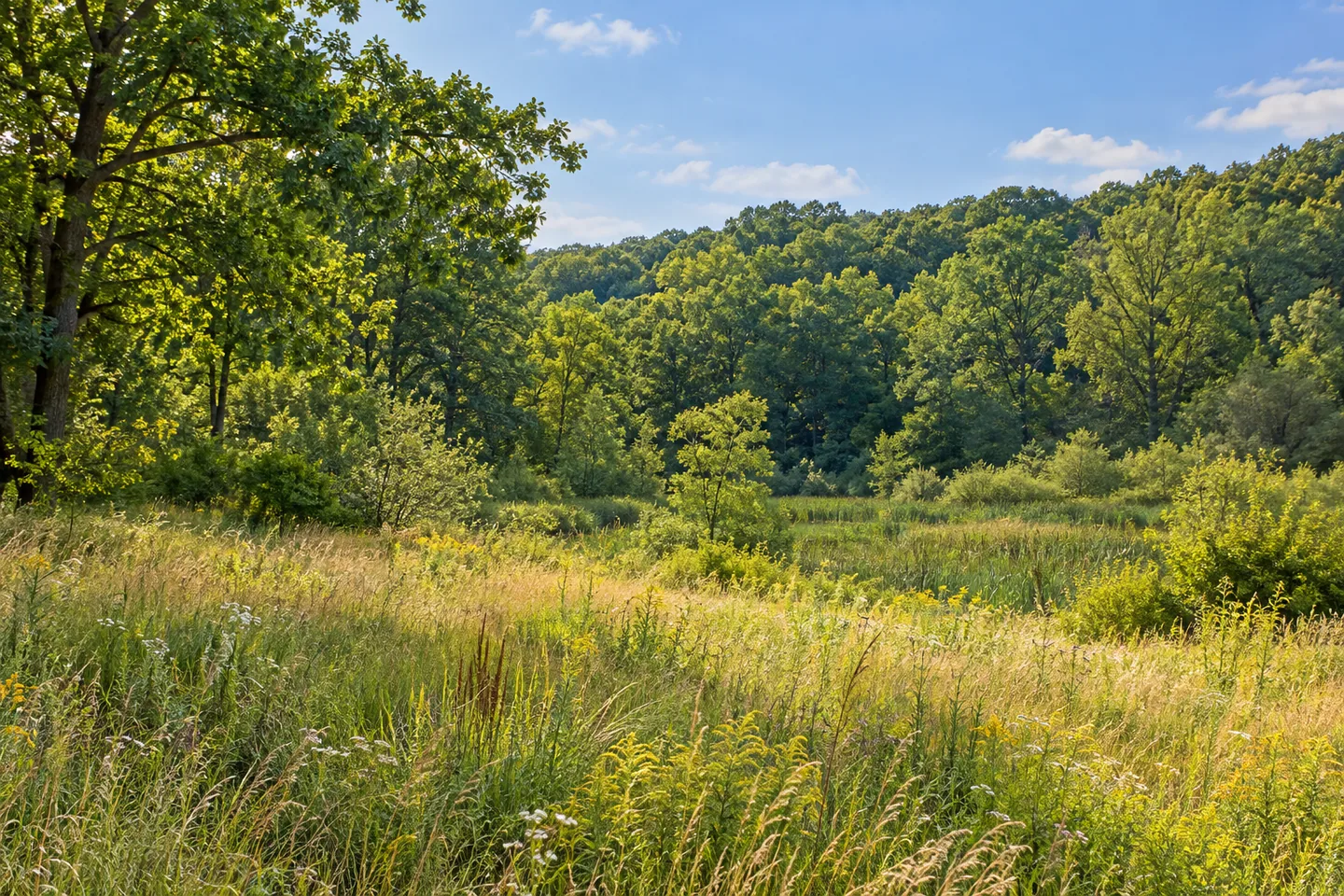
A meadow is a good place to begin looking at Humes Preserve. Open ground, woodland and freshwater wetlands meet within this 27-acre property in Mill Neck, on Long Island's North Shore. The North Shore Land Alliance protected it in 2015. Its interest reaches beyond a single clearing: Humes sits at the heart of a much larger, connected landscape, while traces of a former country estate give the walk a second story to follow.
The preserve belongs to a corridor of roughly 150 protected contiguous acres, together with adjoining Shu Swamp, Francis Pond conservation areas and the Humes Japanese Stroll Garden. These are neighboring parts of a conservation network, rather than names for the same parcel. The waterways beginning in this landscape eventually connect with Oyster Bay National Wildlife Refuge and Long Island Sound. Meadow and wet woodland here therefore form part of a larger relationship between upland ground, freshwater and the coast.
That connection offers a useful way of looking without needing to turn a walk into a checklist. Notice where an open meadow gives way to taller vegetation, and how a woodland edge changes the light. The Land Alliance describes undulating woodland and meadow trails, spring ephemeral plants such as rue anemone and red trillium, and a diversity of woodpeckers. Treat those plants and birds as part of the preserve's habitat story; the particular season and an individual encounter will shape what is actually visible.
The country-estate layer began in the early 1920s. In its dated history of the property, the Land Alliance describes Carl Schmidlapp's real-estate transactions between 1924 and 1927 and a landscape shaped by architects and garden designers. Peabody, Wilson & Brown designed buildings; Ellen Biddle Shipman and Vitale and Geiffert contributed gardens. This was the Country Place Era, when city families commissioned rural retreats. A natural-looking setting could also be carefully arranged, planted and maintained.
The estate subsequently changed through family use. In 1952, Frances and Carl Schmidlapp engaged Alfred Shaknis to remodel and enlarge the Tavern House. The following year, their daughter Jean Schmidlapp-Humes received a cottage and land. Later projects, guided by Shaknis and the landscape firm Innocenti & Webel, developed the Humes family compound. These are historical stages, rather than a claim that every former estate feature is a visitor attraction today. They help explain why a preserved landscape may contain both ecological communities and the imprint of domestic design.
For a visit now, the Land Alliance identifies on-site parking at 349 Oyster Bay Road, between Dogwood Lane and Frost Mill Road. Its preserve description includes a formal garden, a visitors' hut, a nature play area and Adirondack chairs alongside the walking landscape. Choose a pace that leaves room for the meadow as well as the woods. The neighboring Stroll Garden has its own identity and visiting arrangements, so plan it separately if it forms part of the day.
Humes is especially interesting when its layers remain in view together. A former estate, a meadow, a wetland connection and a public conservation purpose all occupy the same setting. Rather than looking for one grand viewpoint, let those changes in scale guide your attention: a plant near the path, the shape of an opening, and the much wider network of protected land beyond.
Fun facts
- Humes Preserve protects 27 acres in Mill Neck; the surrounding connected conservation corridor totals roughly 150 acres.
- The Land Alliance protected the property in 2015.
- Meadow, woodland and freshwater wetlands form part of a headwaters landscape linked to Oyster Bay and Long Island Sound.
Before you go
- Use the operator-listed preserve parking at 349 Oyster Bay Road.
- Allow time for both meadow and woodland rather than treating them as the same scene.
- Check separate arrangements for the neighboring Japanese Stroll Garden.
Capture
- Frame the transition between meadow vegetation and taller woodland.
- Try a close study of seasonal plant shapes without moving vegetation.
- Use the changing light of an opening and a shaded woodland edge as contrasting compositions.
 Sargent Ponds Wild Forest
 Henry Morgenthau Preserve
 Hickory Ridge
Social
Humes Preserve brings meadow, woodland and freshwater wetlands together in Mill Neck. #Cre8Travel
The preserve protects 27 acres within a much larger connected conservation corridor.
The Land Alliance protected Humes in 2015; the estate landscape has a much longer story.
Country-estate development began in the early 1920s, adding designed gardens to the landscape.
The Tavern House remodelling of 1952 forms one chapter in the property’s changing family use.
A meadow edge can reveal more than a single panoramic view: notice light, vegetation and scale.
Humes and the neighboring Japanese Stroll Garden have distinct visiting arrangements.
What would you notice first at Humes: the open meadow, the woods or the estate’s garden traces?
Hashtags