 Cre8Travel
CRE8TRAVEL · NEW YORK PLACES
Henry Morgenthau Preserve
Henry Morgenthau Preserve: Four Forests beside a Lake
Discover
At the Henry Morgenthau Preserve, a short change in woodland can become the main event. Sugar maples, oak and hickory, red-maple swamp and pine plantings give this Pound Ridge property several different characters. The 36-acre preserve lies along Blue Heron Lake, with boundaries that include part of the water and a small offshore island. Its landscape invites attention to transitions: dry ground and wet ground, open-grown trees and woodland, a path and the history beside it.
The preserve was founded in 1972 through a gift from Ruth Morgenthau Knight, her daughter Ellin N. London and son-in-law Robert D. London. Eight additional acres were purchased in 1973, and an adjacent four-acre parcel was donated in 1994. These additions are stages in its history, not figures to add again to the present acreage. In 2017, the preserve became an independent nonprofit after an earlier affiliation with Bedford Audubon Society. Local volunteers continue its conservation and environmental-education work.
The operator's woodland guide begins with sugar maples along the Blue Trail from the entrance toward the Jerome J. Lawton Crossroads. Their five-lobed leaves and paired, winged seeds offer recognizable details for a closer look. Elsewhere along the Blue Trail, oak and hickory introduce another set of textures. Shagbark hickory is especially distinctive for bark that loosens in long plates. Looking at a trunk can be as rewarding as trying to identify everything in the canopy at once.
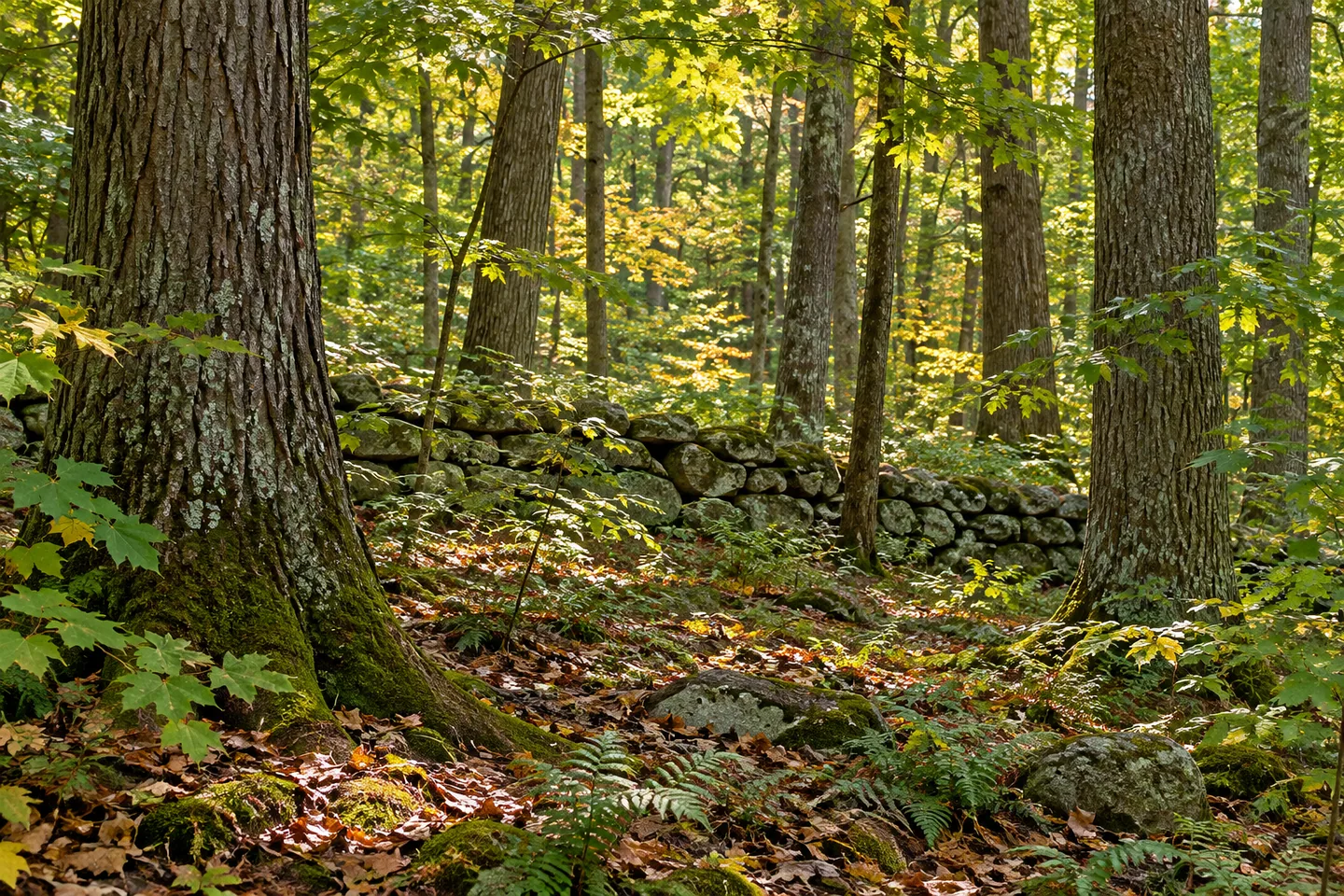
Along the Yellow Trail, red maple dominates wetter ground. The same trail also passes a broad-crowned white oak described by the preserve as a wolf oak. An open-grown crown can hint at a landscape that was once more open than the woods surrounding it. Historic stone walls provide another connection to former farming. The operator describes a restoration and rebuilding project in 2008 and identifies livestock-pen divisions along the White Trail. Together, tree shape and stonework make earlier land use visible within the present forest.
Pine plantings add a different chapter. White pines occur where the Blue and White Trails meet; the operator also identifies introduced Scotch pines beside the lake. Instead of treating every evergreen as interchangeable, compare the needle groupings and bark described in the preserve's guide. These planted and naturally growing communities form part of a managed landscape, alongside wetlands, vernal pools and small streams. Deer exclosures are another sign of active efforts to support vegetation beneath the canopy.
Blue Heron Lake supplies a broader opening after the close textures of trees and walls. The operator describes its enlargement from a marshy pond in the early 1920s. Enjoy the relationship between the wooded edge and open water from the preserve's paths. The lake is privately owned, and the preserve provides no boat access; fishing is also prohibited. Its role in a visit is observation, rather than a launch point for a separate water outing.
The preserve is open from dawn to dusk on the south side of Route 172 near Tatomuck Road. Dogs are not permitted. Use the operator's trail map to choose a route, then let the different forest communities provide a theme for the walk. The most memorable discovery may be an ordinary one: a maple seed, a strip of hickory bark, or an old wall carrying the story of an earlier field through today's woodland.
Fun facts
- The 36-acre preserve was founded in 1972 and later expanded through purchase and donation.
- Four described forest communities include maple, oak-hickory, red-maple swamp and pine plantings.
- Historic stone walls were restored and rebuilt in a 2008 project.
- The preserve became an independent nonprofit in 2017.
Before you go
- Use the operator trail map to connect the Blue, White and Yellow Trail settings.
- Plan a walking and observation visit; the preserve has no boat access to the privately owned lake.
- Leave dogs at home under the preserve’s rules.
Capture
- Compare maple leaves and hickory bark in close compositions.
- Frame a stone wall against the woodland that now surrounds it.
- Use the contrast between wooded shore and open water without entering private shoreline.
 Humes Preserve
 Hickory Ridge
 Jane B. Francke Bird Sanctuary
Social
Four forest communities give the Henry Morgenthau Preserve several distinct characters. #Cre8Travel
A 1972 family gift began the preserve’s story; later additions expanded the protected land.
Sugar maples line part of the Blue Trail, offering leaf and seed details for a closer look.
Shagbark hickory brings a striking bark texture to the oak-hickory woodland.
Historic walls and broad-crowned oaks hint at earlier farm use.
Pine plantings add another layer beside the lake and wetlands.
The lake is an observation setting here: no fishing or boat access from the preserve.
Would you build your walk around tree textures, old walls or the change from woods to water?
Hashtags