 Cre8Travel
CRE8TRAVEL · NEW YORK PLACES
Domino Park
Domino Park: Reading a Refinery along the Waterfront
Discover
At Domino Park, the industrial past has not disappeared behind the landscaping. It rises above the trees, stands beside the paths and provides the structure for an elevated walk. This six-acre public park on Williamsburg's East River waterfront occupies part of the former Domino Sugar Refinery site. Its most interesting conversation is between present-day recreation and the large pieces of machinery that once made this a working waterfront.
The refinery's history reaches back to 1856. It closed in 2004, after a long period in which sugar production helped shape the surrounding neighborhood and related waterfront industries. The park's operator presents the landscape as a tribute to generations of workers, their families and Williamsburg. That is a useful starting point for a visit: the artifacts are more than an unusual backdrop. They give scale and physical form to work that once took place here.
More than 30 large salvaged artifacts are incorporated into the park. Start by distinguishing their jobs. Mooring bollards secured ships at the waterfront. Bucket conveyors, a hoist bridge and screw conveyors moved sugar through different parts of the refinery. Seeing those different forms together can turn an ordinary walk into a study of movement: materials arrived by water, passed through machinery and became part of a much larger production process. The objects remain historical exhibits, rather than equipment for visitors to use.
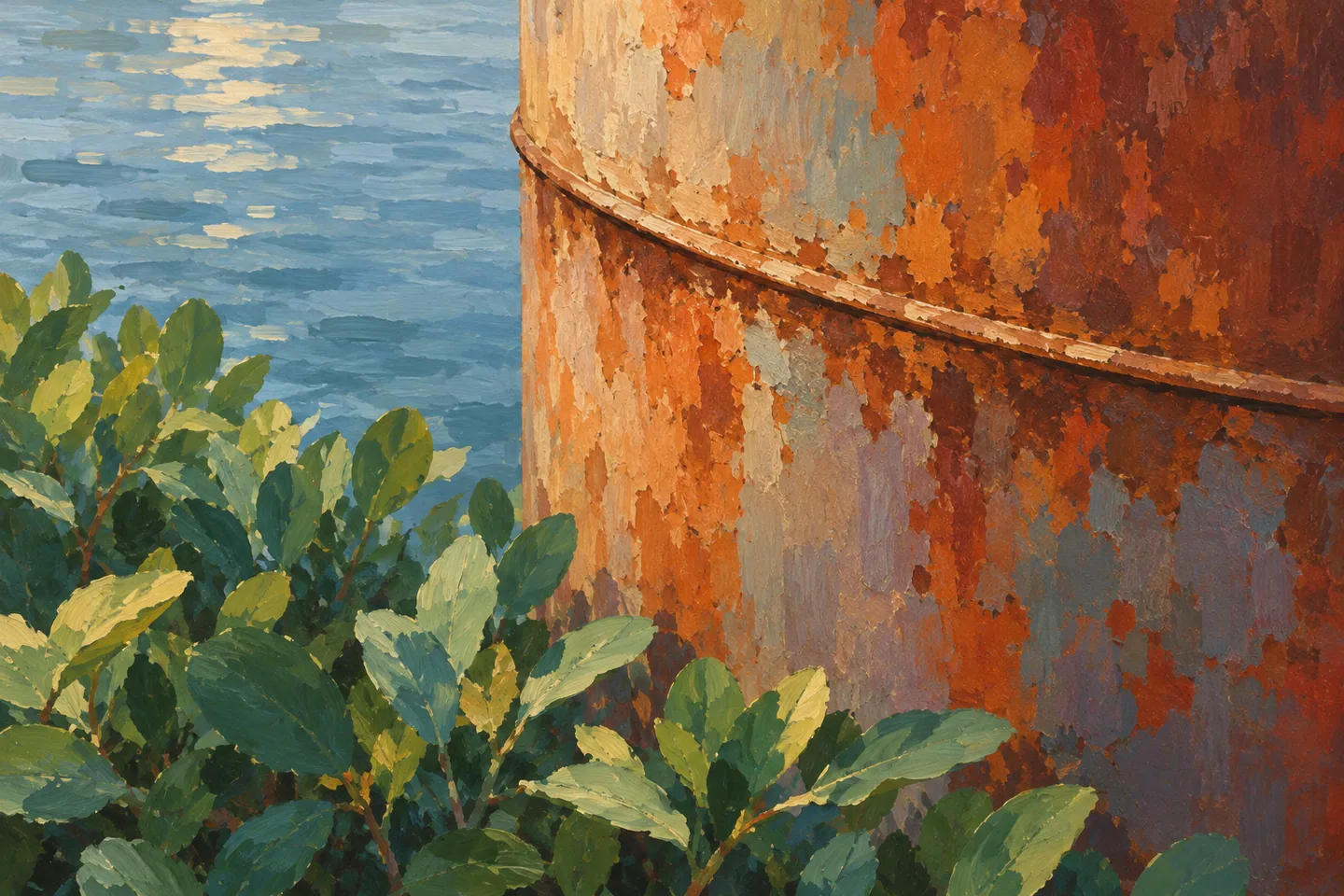
The syrup tanks offer another chapter. The four displayed tanks date from the 1950s and were part of a larger group of fourteen that collected liquid sweetener generated in processing. At the north end, two 80-foot gantry cranes recall the unloading of freight ships for the Raw Sugar Warehouse. Their height makes them easy to notice, but the quieter details can be just as informative. A bollard close to the water tells a different part of the same industrial story from machinery standing farther inland.
One of the clearest connections between old structure and new public use is the Elevated Walkway. Twenty-one columns from the Raw Sugar Warehouse remain in their original positions and support the pedestrian experience. The walkway extends from the park's north end toward the platform above Tacocina, giving a different relationship to the river, skyline and park below. It is an architectural reuse story that can be understood while moving through the landscape, without entering the former factory itself.
The preserved refinery facade and reinstated yellow sign provide a larger visual anchor. Closer to ground level, the waterfront walkway keeps the East River in view. The playground translates sugar-processing ideas into a different language, with features named the Sugar Cane Cabin, Sweetwater Silo and Sugarcube Centrifuge. Here, interpretation is built into play as well as into the display of original machinery. The park's current green spaces and recreation areas give those historical pieces a new setting.
Choose a few subjects rather than trying to absorb everything at once. A visit might follow the waterfront first, then look at the different roles of conveyors, tanks and warehouse columns. For photographs, compare a small industrial detail with the much broader river setting. Consult the operator for current hours and any seasonal programming. The enduring attraction is the relationship between things that have changed function and a waterfront that now welcomes public use.
Fun facts
- Domino Park covers six acres along the East River in Williamsburg.
- The refinery’s history dates to 1856; it closed in 2004.
- The park incorporates more than 30 large salvaged industrial artifacts.
- Twenty-one Raw Sugar Warehouse columns remain in their original positions along the Elevated Walkway.
Before you go
- Use the operator map to distinguish artifacts and recreation areas.
- Compare machinery with different functions rather than treating every object as the same kind of exhibit.
- Check current hours and seasonal programming separately.
Capture
- Pair a small industrial detail with the broader waterfront in separate compositions.
- Study the rhythm of the preserved warehouse columns.
- Use the contrast between machinery, vegetation and river without staging a climbing scene.
 Jane B. Francke Bird Sanctuary
 Highland Park
 Ellison Park
Social
Domino Park brings industrial artifacts and public waterfront space together in Williamsburg. #Cre8Travel
The former refinery dates to 1856 and closed in 2004.
More than 30 salvaged artifacts help tell the site’s working history.
Mooring bollards, conveyors and syrup tanks once had very different jobs.
The displayed syrup tanks are four of a larger historical group of fourteen.
Twenty-one original warehouse columns connect past structure with the Elevated Walkway.
The playground interprets sugar refining through features such as the Sweetwater Silo.
Would you follow the river first, or begin by looking at the refinery machinery?
Hashtags