 Cre8Travel
CRE8TRAVEL · MAINE PLACES
Turner Cattle Pound
Turner Cattle Pound: A Small Enclosure with a Public Purpose
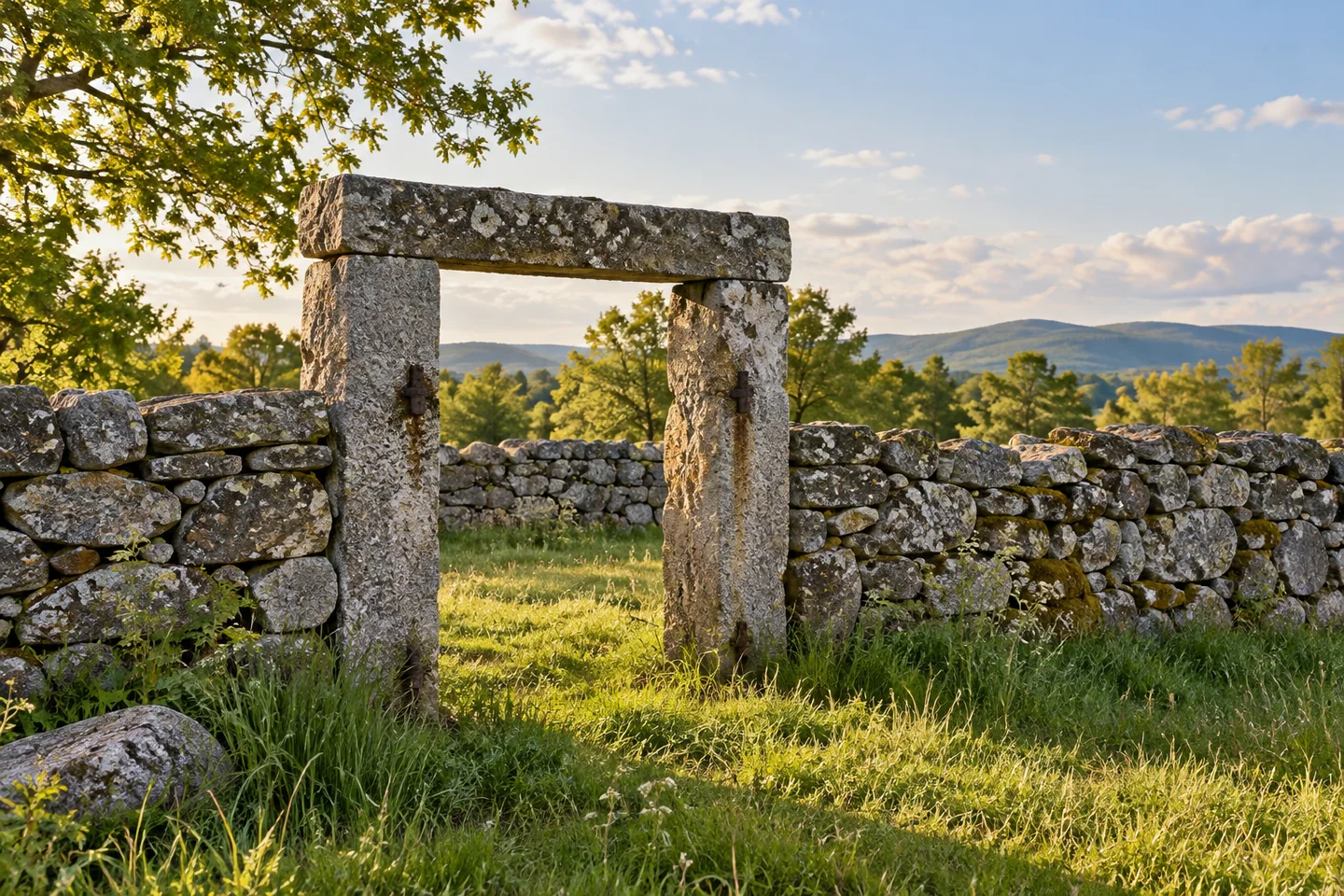
Discover
Turner Cattle Pound gives a small roadside structure an unusually clear civic purpose. Built in 1816, it stands at the southwest corner of General Turner Hill Road and Kennebec Trail. The town's property records still identify the parcel as the cattle pound. Before traveling, ask the town about a lawful stopping place and present viewing conditions. Keep the visit to permitted exterior observation; ownership by a municipality does not establish parking on a shoulder, safe entry through the opening, or permission to climb a wall.
The most useful detail to study is the opening. Two upright granite posts support a stone lintel, with iron fittings recording where a gate was attached. Compare those deliberately arranged pieces with the irregular fieldstones around them. A gate is a point where an enclosure has to perform two opposing tasks: permit passage at the right moment and prevent it at another. The surviving form makes that relationship understandable without installing animals, reconstructing a gate, or inventing a demonstration of how a particular keeper worked.
The National Register account connects the structure with a town decision to build a substantial stone impoundment and identifies Moses Merrill as its builder. It records pound keepers continuing to be appointed through 1918. Think of the stonework as the physical part of an arrangement that also required somebody to act, keep track of animals, and deal with owners. A wall alone could not settle the matter. The object becomes more interesting when the practical relationship between a public decision, an assigned task, and a neighboring farm is considered alongside its construction.
The nomination also preserves an older person's recollection rather than relying only on administrative records. Harriet Ricker Lovejoy, daughter of the last pound keeper, recalled animals driven toward market sometimes spending the night in the pound or neighboring fields. Her account was published in 1984. It supplies a remembered use of the surrounding road, while the nomination distinguishes recollection from the basic facts in town records. Keep that difference in mind: a personal memory can widen a place's meaning without resolving every detail of its chronology or operation.
Later documentation helps explain why such a modest structure remains worth noticing. The local historical society contributed a dated 2009 photograph to Maine Memory Network, and the town's published museum report includes the pound within its historical stewardship. Those records concern identification and care, rather than the original handling of livestock. A place once maintained for a practical regulation can later require attention because the practice has disappeared. Looking closely is therefore partly an exercise in recognizing useful structures whose purpose is no longer obvious from a passing car.
For photographs, choose a standing position that makes the portal and a section of wall legible without stepping into the road. A wider view can establish the small enclosure's relationship to its setting; a separate detail can concentrate on the contrast between worked granite and irregular stone. Leave masonry and ironwork undisturbed. Take a note about the difference between a documented appointment and a remembered episode as well as taking a picture. Turner rewards a short, attentive stop that turns a seemingly simple boundary into questions about work, responsibility, movement, and the local decisions once needed to manage them.
Fun facts
- The stone cattle pound was built in 1816.
- Granite gateposts and a lintel mark its entrance.
Before you go
- Ask the town about lawful stopping and current viewing conditions.
- Keep to permitted exterior observation and do not climb the walls.
- Distinguish recorded civic decisions from later personal recollections.
Capture
- From a lawful standing position, show the portal together with adjoining stonework.
- Study the contrast between worked granite and irregular stones without touching masonry or fittings.
 Denmark Civil War Monument
 Albany Town House
 Emerson-Wilcox House Museum
Social
Turner’s cattle pound preserves an old civic task in stone.
The enclosure dates to 1816.
Its entrance has granite posts and a lintel.
A named keeper made the enclosure part of an administrative system.
A later recollection links the pound with animals being driven toward market.
A local photograph documents the structure in 2009.
Ask about a lawful stopping place before planning the roadside visit.
An everyday practical structure can become difficult to read when its original work disappears.
Hashtags