 Cre8Travel
CRE8TRAVEL · MAINE PLACES
The Armillary
Portland’s Armillary: A Globe Made from Maine
Discover
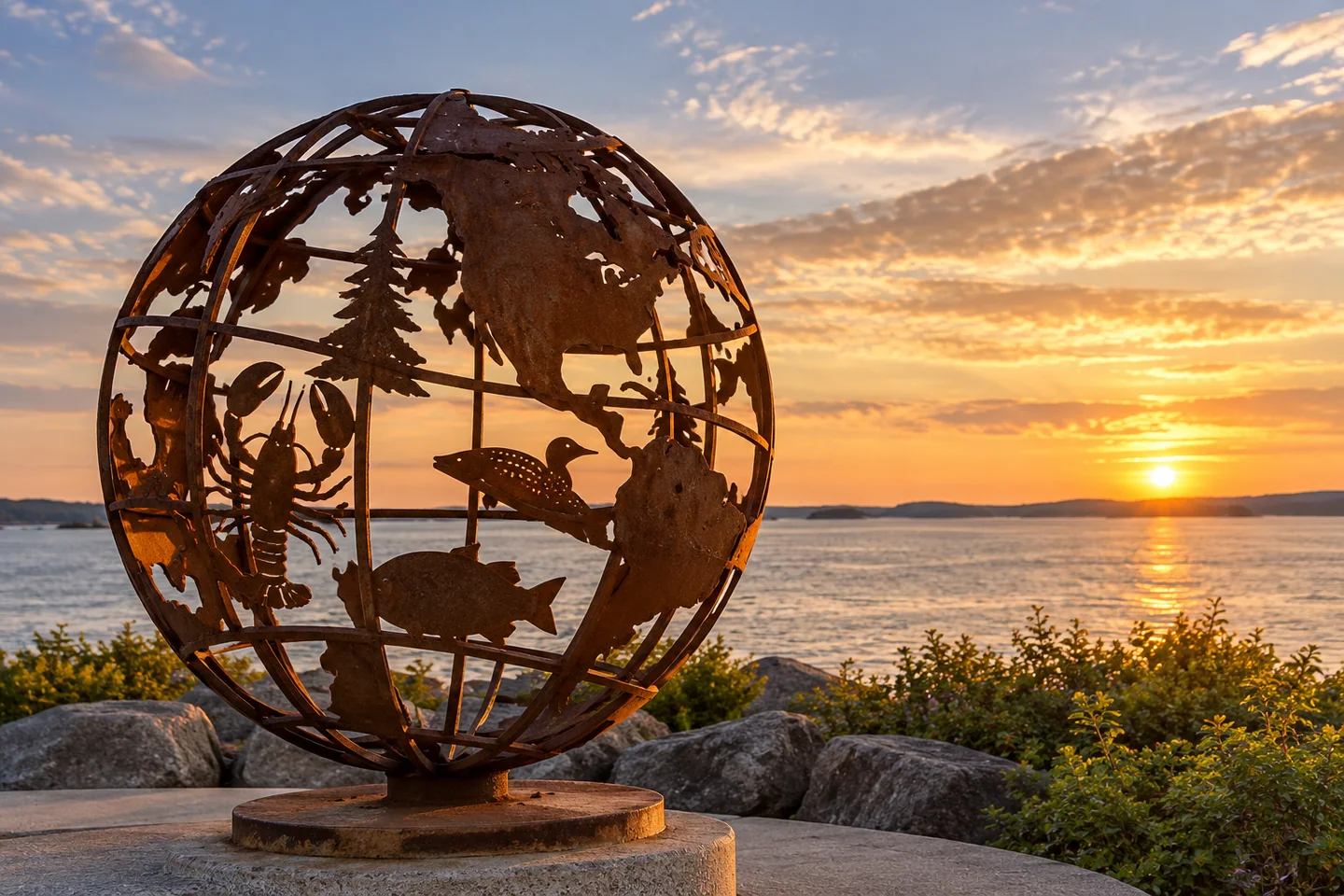
At the Eastern Promenade trailhead near Maine State Pier, Patrick Plourde's Untitled-Armillary turns the globe into a collection of Maine images. The Portland Public Art Committee records the Cor-ten steel work as a 1999 gift from Portland Trails to the city, supported by donors led by Casco Bay Sunrise Rotary Club. Make the sculpture itself the subject of a waterfront stop. Look first for the overall sphere, then move your attention to the shapes within it. The two views ask you to recognize different things: a world and a set of local associations.
The municipal account describes an idea that changed during development. An initial proposal put a large compass into the concrete walkway. Support then grew for a more visible sculpture marking the start of the trail. Plourde proposed an armillary, and discussions with the advisory committee led toward a globe with continents. That sequence provides a useful way to read the result. An object placed upright enters a pedestrian's line of sight differently from a design beneath the feet. Consider what it means for a trail beginning to be marked by a world-shaped object rather than a directional symbol alone.
The continents contain recognizable figures rather than uninterrupted sheets of metal. The committee's inventory includes lobsters, a crab, fish, loons, a pine tree, a lighthouse, a skier, a canoeist, and a boot among other elements. Try finding a few without treating the exercise as a race to complete a checklist. Then step back within the public walkway and see whether the larger land forms reappear. An image that feels familiar on its own must also contribute to another shape. That tension between individual figure and overall outline gives a close look a purpose beyond simply identifying decorative details.
The work has prompted different responses. A May 2014 Maine magazine feature admired its rust-red appearance and read its local imagery as a distinctively Maine way of imagining the world. An earlier critical survey led by Bob Keyes recorded a less favorable judgment from Phil Isaacson, who found the globe concept unadventurous and thought its rusted, open construction looked neglected. These are attributed aesthetic opinions rather than instructions about what you should enjoy. Compare the views against the work in front of you: does the openness make the separate images easier to notice, or does it weaken the object as a whole?
Plourde's artist statement, published by his representing gallery, describes a practice that includes sculpture, furniture, railings, lighting, and other metalwork. It offers context for an artwork that sits between a decorative public object and a practical marker of place. That range need not turn the stop into a survey of everything the artist has made. Instead, ask where usefulness ends and imagery begins here. The sculpture can orient attention toward a trail while making a more imaginative claim about the place from which that trail starts.
Keep pedestrian movement clear and inspect the forms without climbing or handling the metal. A photograph can emphasize the sphere's silhouette, followed by a closer composition in which an animal or human activity becomes legible within the larger outline. Allow gaps and background to remain part of the picture. Leave with a few shapes remembered and a position of your own on the work's use of local symbols; agreement with every admirer or critic is unnecessary.
Fun facts
- The project evolved from a compass in the walkway toward a more visible globe sculpture.
- Maine animals, activities, and other recognizable icons help form the continents.
- Portland Trails donated the work to the city in 1999.
Before you go
- Look at the whole sphere before searching for smaller figures.
- Keep pedestrian space clear while changing your viewpoint.
- Observe the metalwork without climbing or handling it.
Capture
- Compare the overall silhouette with a closer image of one recognizable figure.
- Use the spaces between forms as part of the composition.
 Luminous Arbor
 Soldiers' Monument
 Historic Marine Hospital
Social
Portland’s Untitled-Armillary builds a globe from local associations.
Patrick Plourde’s 1999 work stands near the Maine State Pier trailhead.
The idea began with a compass designed for the walkway.
Find a few figures, then step back to recover the larger land forms.
A 2014 feature admired its distinctly Maine view of the world.
Phil Isaacson’s earlier critique offered a less favorable reading of the steel and open form.
The artist’s practice ranges across sculpture and functional metalwork.
Would you notice the globe first, or the smaller images that build it?
Hashtags