 Cre8Travel
CRE8TRAVEL · MAINE PLACES
Luminous Arbor
Luminous Arbor: Streetlights Becoming a Tree
Discover
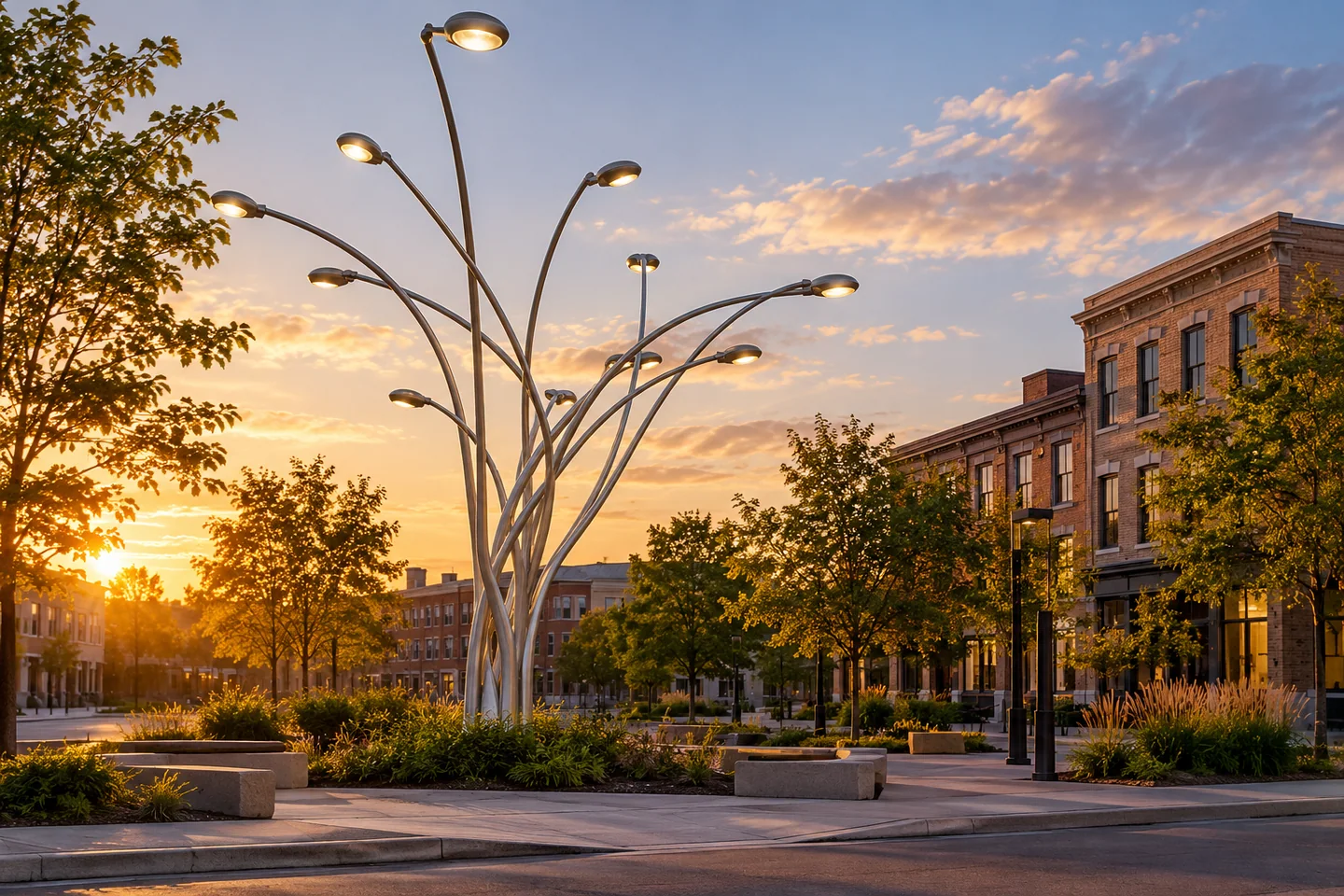
Luminous Arbor stands at Woodfords Corner in Portland, where an ordinary piece of street equipment becomes an unexpected sculptural subject. Aaron T Stephan's 2018 work uses aluminum poles and streetlights, but their branching, intertwining paths depart from the regular alignment of a conventional lighting installation. The Portland Public Art Committee suggests several possible associations: a tree, a swarm, or movement arranged like a dance. Start with the single foundation and follow the paths upward from a safe pedestrian position. There is no need to choose only one resemblance before the visit can become interesting.
An original October 2018 studio report by Randy Billings records the artist's intentions before installation. Stephan wanted grace and mindfulness at the busy meeting of Forest Avenue, Woodford Street, and Deering Avenue. He also connected the intertwined forms with the way an intersection joins people from different neighborhoods. That gives the work a relationship with this particular corner, beyond the usefulness of its lights. Compare the idea of connection with the individual routes you can follow through the sculpture. The same group of lines can suggest both an entanglement and a coordinated whole.
The work's arrival belonged to a wider redesign of the junction. Greater Portland Landmarks described the completed neighborhood improvements in its Winter 2019 magazine, including pedestrian and bicycle crossings, public spaces, transit arrangements, and street furnishings. It identified Luminous Arbor as the centerpiece of a new pocket park in front of the Odd Fellows Block. This context gives a reason to look beyond the metalwork without turning the outing into a traffic survey. The small public space and surrounding building establish a scale against which the lifted forms can be read.
Stephan's own public-commission portfolio places Luminous Arbor among projects made by transforming familiar materials. It lists other works using altered light poles, alongside pieces involving wood, signs, glass, and other materials. His artist statement describes a process beginning with research into the information carried by everyday objects. For this visit, consider what expectations a streetlight brings before it becomes art: orderly placement, repeated form, and a straightforward relationship to a route. The sculptural change becomes easier to see when those ordinary expectations remain in mind rather than disappearing behind an unusual silhouette.
A November 2018 follow-up report documented the work illuminated in front of the Odd Fellows Hall and its clock tower. That historical confirmation distinguishes the completed piece from the installation still anticipated in the earlier studio report. Daylight can make the arrangement of poles the central subject, while a view with the lamps illuminated adds another relationship between equipment and sculpture. Neither approach requires standing in a roadway or waiting where a crossing must remain clear. Use the public pedestrian space and make the artwork's connection with the corner visible from there.
For photographs, first give the complete branching structure room within the frame; then try relating one crossing of lines to the larger arrangement. Include the surrounding streetscape only where you can compose without obstructing others. Avoid expecting the work to remove the sound and movement of a city junction. Its setting supplies part of the question: how can a small gesture of imaginative design change the attention we give to a familiar public place?
Fun facts
- Aaron T Stephan’s Luminous Arbor dates to 2018.
- Its aluminum poles rise from a shared foundation into intertwining paths.
- The sculpture became a centerpiece of a pocket park in front of the Odd Fellows Block.
Before you go
- Look upward only after stopping clear of crossings and moving pedestrian traffic.
- Compare a single line with the full branching arrangement.
- Use public pedestrian space for views of the sculpture and its urban setting.
Capture
- Frame the complete branching structure before making a closer line study.
- Relate the sculpture to its streetscape without stepping into a road.
 Cloud Couch
 The Armillary
 Soldiers' Monument
Social
Luminous Arbor transforms streetlights into a sculptural meeting of paths.
At Woodfords Corner, familiar public equipment becomes an unexpected subject.
A tree, a swarm, or a dance: which association arrives first?
Stephan linked the work with connections between neighborhoods.
The piece joined a wider redesign of the intersection’s public spaces.
An artist’s research can begin with the ordinary objects around us.
A November 2018 report documented the completed work illuminated.
What makes you notice familiar street equipment: repetition, light, or a surprising change of form?
Hashtags