 Cre8Travel
CRE8TRAVEL · MAINE PLACES
Second, Third and Fourth Roach Ponds
Beyond First Roach: The Higher Roach Ponds
Discover
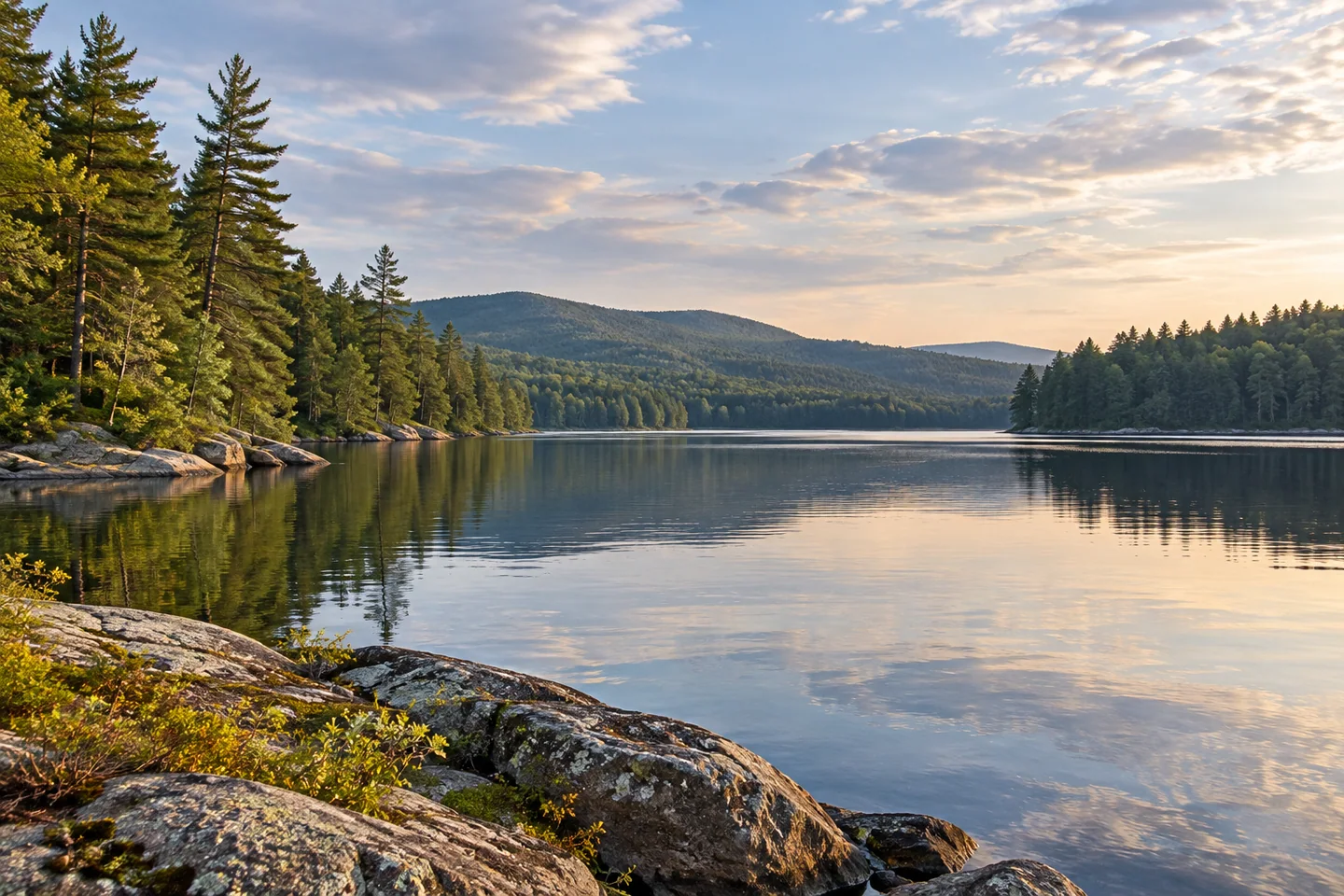
The higher-numbered Roach Ponds offer a different experience from the roadside scene at First Roach Pond. Second, Third and Fourth form a wooded paddling landscape east of Moosehead Lake, with the Appalachian Mountain Club's Medawisla lodge beside Second. Their appeal is the variety within a compact group: broad water, connecting channels, marshy corners and forested points. Treat them as one area to understand gradually, rather than three names that must all be collected on a single outing.
Begin with the land manager's own directions. AMC identifies the Second Roach Pond approach near Medawisla as the easiest entry to this group. Its public paddling information distinguishes equipment provided to lodge guests from public-use canoes located at selected remote ponds. Those are different arrangements, so confirm the exact boat location and what the group must bring before arriving. Neither the sight of a canoe rack nor an old trip report establishes that a particular boat is available for the day's visit. Medawisla's directions warn that logging roads can be rough and low-clearance vehicles are not recommended; download directions before losing reception.
The connections are part of the attraction and part of the planning. AMC describes small streams joining the ponds, with easier passage in spring and conditions that commonly require wading and pulling by midsummer. That is a general seasonal description, not a promise that a passage will work on a chosen date. A plan can remain on Second Roach, or begin elsewhere with an independently verified launch. Visiting the group does not require forcing a boat through shallow water to complete an imagined circuit.
Second Roach also carries a record of Maine's logging era. A state survey revised in 2003 describes a log-crib driving dam: gates removed in 1969, boards added in 1975 to improve access, then washed out in 1983. The sequence shows a lake edge changed by practical decisions. Read it as history, rather than present infrastructure guidance.
The same survey explains the influence of wind mixing and limited late-summer coldwater refuge on the fishery. Temperature, oxygen and tributary habitat complicate the apparently simple water view. That is worth remembering whether fishing or watching the shore. Verify current angling rules separately; historical management recommendations do not supply them.
A concrete visitor account appears in Austin Watts's illustrated record of boating on Maine lakes during 2024. In one outing he combined Trout, Fourth and Third Roach with short carries, then made a separate paddle on Second. His fishing was modest rather than spectacular. The account is useful precisely because it describes an individual sequence, with transport between different starts, instead of implying a seamless traverse or guaranteed catch. The experience belongs to his particular trip.
Choose the day's emphasis before loading: a manageable paddle from the lodge area, a researched carry-based outing or time studying the wooded water margins. For photographs, compare the shape of a point with a more enclosed channel, working from a secure authorized position. The Roach Ponds offer enough differences to reward a return visit. Understanding one pond well is a more satisfying beginning than hurrying through every connection.
Fun facts
- A log-crib driving dam once influenced Second Roach Pond’s water level.
- Its historical survey records gate removal in 1969 and later boards washing out in 1983.
- AMC identifies an approach to the pond group near Medawisla.
Before you go
- Confirm the exact launch and equipment arrangement with AMC.
- Treat inter-pond stream passage as dependent on actual water conditions.
- Choose a single-pond outing if connecting passages do not suit the group.
- Use historical fisheries information as context and current rules for angling decisions.
Visitor perspectives
- Austin Watts’s 2024 boating memoir describes carries between Trout, Fourth and Third Roach, then a separate Second Roach paddle, with modest fishing.
Capture
- Compare a wooded point with an enclosed channel from an authorized position.
- A low shoreline detail can give a broad pond view a sense of scale.
 Packard-Littlefield Farm
 Endless Lake
 Lake Wassookeag
Social
Second, Third and Fourth Roach Ponds offer a wooded landscape beyond First Roach.
One pond can be a complete outing; the group does not require a continuous traverse.
Check the exact launch and boat arrangement before relying on a canoe rack.
Historical dam changes help explain Second Roach’s working-forest past.
Water levels are part of the route, so reassess stream connections on the day.
A historical fishery survey adds an ecological layer to the lake view.
Plan time to look carefully instead of collecting pond names.
Would you begin with one pond or a researched carry-based outing?
Hashtags