 Cre8Travel
CRE8TRAVEL · MAINE PLACES
Rockport Historic District
Rockport Historic District: Beyond the Harbor View
Discover
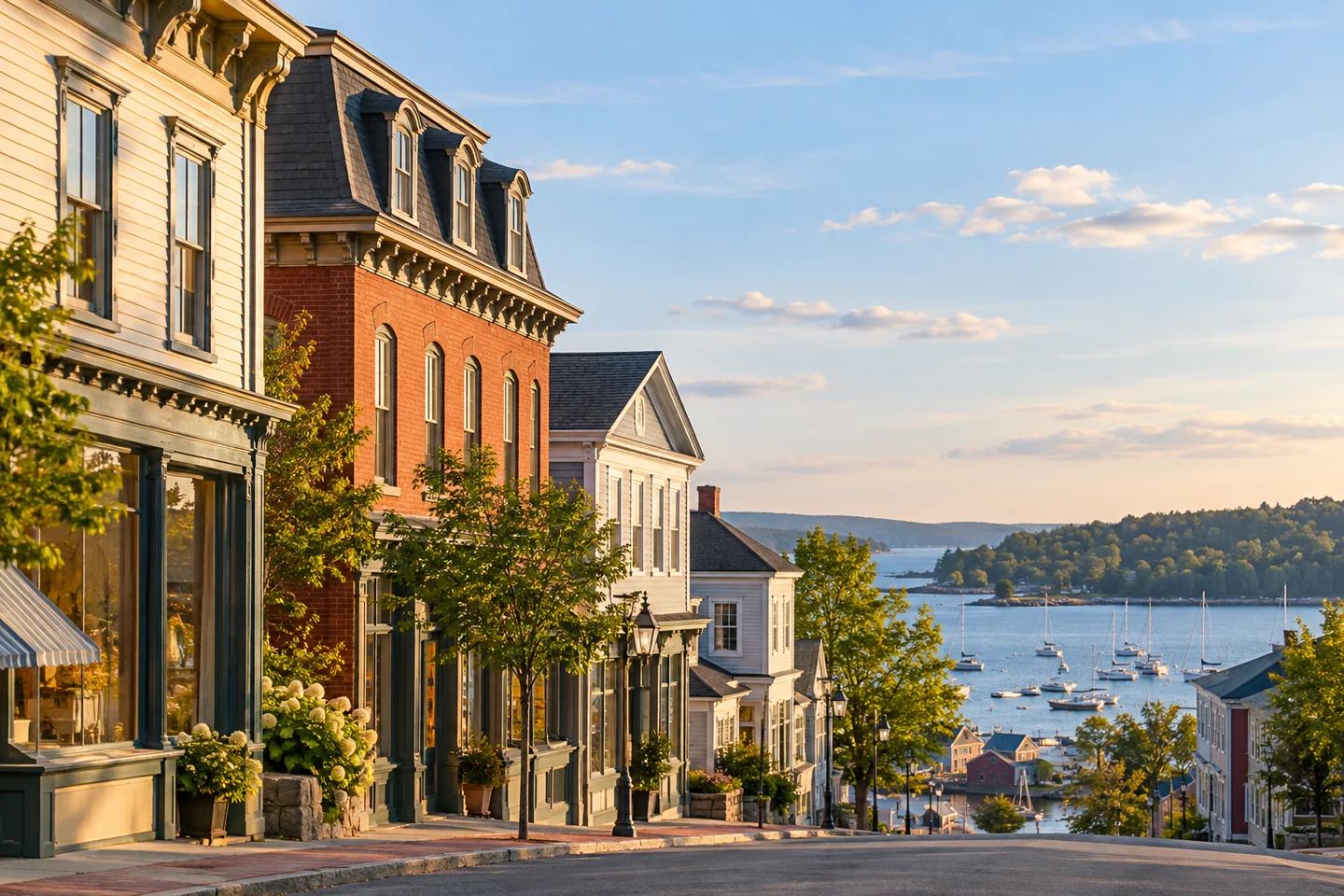
Rockport's historic village is more than the view down to the boats. The National Register recognizes a district where architecture, commerce and industry belong to the same story, with Greek Revival and Italianate buildings among its defining features. Look up from the harbor and the streets begin to explain how a working community became a place associated with art and performance. This is Rockport, Maine: similarly named places in Massachusetts and Texas have entirely different histories and landmarks.
The town's own history supplies a useful starting point. Once called Goose River Village, the settlement took the name Rockport in 1852. Shipbuilding, ice harvesting and lime manufacturing were important early industries. The town records lime sent to Washington in 1817 for rebuilding the U.S. Capitol after the War of 1812. Rockport later separated from Camden in 1891. Those facts make the surviving village fabric more legible: houses and commercial buildings were supported by an economy connected with material moving through the region, not created solely as a backdrop for holiday photographs.
The Opera House is a particularly good example of a building with several lives. According to the town, architect F. E. Gilkey designed it in Colonial Revival style, and it opened as the Town Hall in 1891. It subsequently accommodated civic meetings, a library, performances and a YMCA with bowling and basketball. When the building's future became uncertain in the 1970s, the Rockport Garden Club helped lead its preservation. Community support and later renovation gave it a continuing role. Looking at the exterior with that sequence in mind turns a seemingly fixed landmark into evidence of repeated decisions about what a town wants to keep using. Interior access belongs to the building's own arrangements, rather than to a general village walk.
Union Hall offers a commercial counterpart. Its owner dates the building to 1856 and describes a mansard roof characteristic of Second Empire architecture. Past uses included a post office, barrel factory and residence; Maine Media Workshops occupied the building from 1973 to 2011. The vertical arrangement of retail space, a hall and upper rooms reflects a building designed to do several jobs at once. Compare that layered purpose with the Opera House's civic role. The contrast gives the streetscape a little more substance than a checklist of architectural style names.
A firsthand account by Brittney Nickerson describes walking downhill toward the harbor after meeting a friend in the village. Her wider account moves through several coastal places, but that brief transition captures something useful about Rockport: the settlement and waterfront are physically and visually connected. You can appreciate the relationship without making the marine park the whole subject of the outing. Choose a few documented buildings, check the current pedestrian route, and allow time to see them from more than one public viewpoint.
For photographs, try pairing a broad street scene with a roofline or upper-story detail. Keep private homes and occupied venues at a respectful distance, and avoid standing in the roadway for a symmetrical composition. Rockport's most interesting story may be the one between the buildings: industry, civic life and creative reuse overlapping in a village that continues to change.
Fun facts
- Goose River Village became Rockport in 1852.
- The Opera House opened as the Town Hall in 1891.
- Union Hall dates to 1856 and has a Second Empire mansard roof.
Before you go
- Identify the Maine village and use its current pedestrian routes.
- Treat interior visits as separate arrangements with each venue.
- Observe architecture from public ways and avoid blocking roadways or entrances.
Visitor perspectives
- Brittney Nickerson described a relaxed stop with a friend followed by a walk down to Rockport’s harbor. Her account presents the village and waterfront as parts of one coastal outing.
Capture
- Pair a streetscape with an upper-story or roofline detail that can be seen from public space.
- Use the slope toward the harbor to explore visual relationships without standing in traffic.
 Wiscasset Historic District
 Sheepscot Historic District
 Spectacle Island Preserve, Sheepscot River
Social
Rockport’s historic district connects architecture with commerce and industry.
The name Goose River Village preceded Rockport.
Shipbuilding, lime and ice helped shape the early economy.
A former town hall, YMCA and performance space: the Opera House has had several lives.
Union Hall’s mansard roof brings a different architectural vocabulary to the village.
Maine Media Workshops once occupied Union Hall.
Look uphill as well as toward the boats when reading this streetscape.
Which interests you more: a building’s first purpose, or the uses it has found since? #Cre8Travel
Hashtags