 Cre8Travel
CRE8TRAVEL · MAINE PLACES
Quakish Lake
Quakish Lake: A Forest Legacy Beneath the Water
Discover
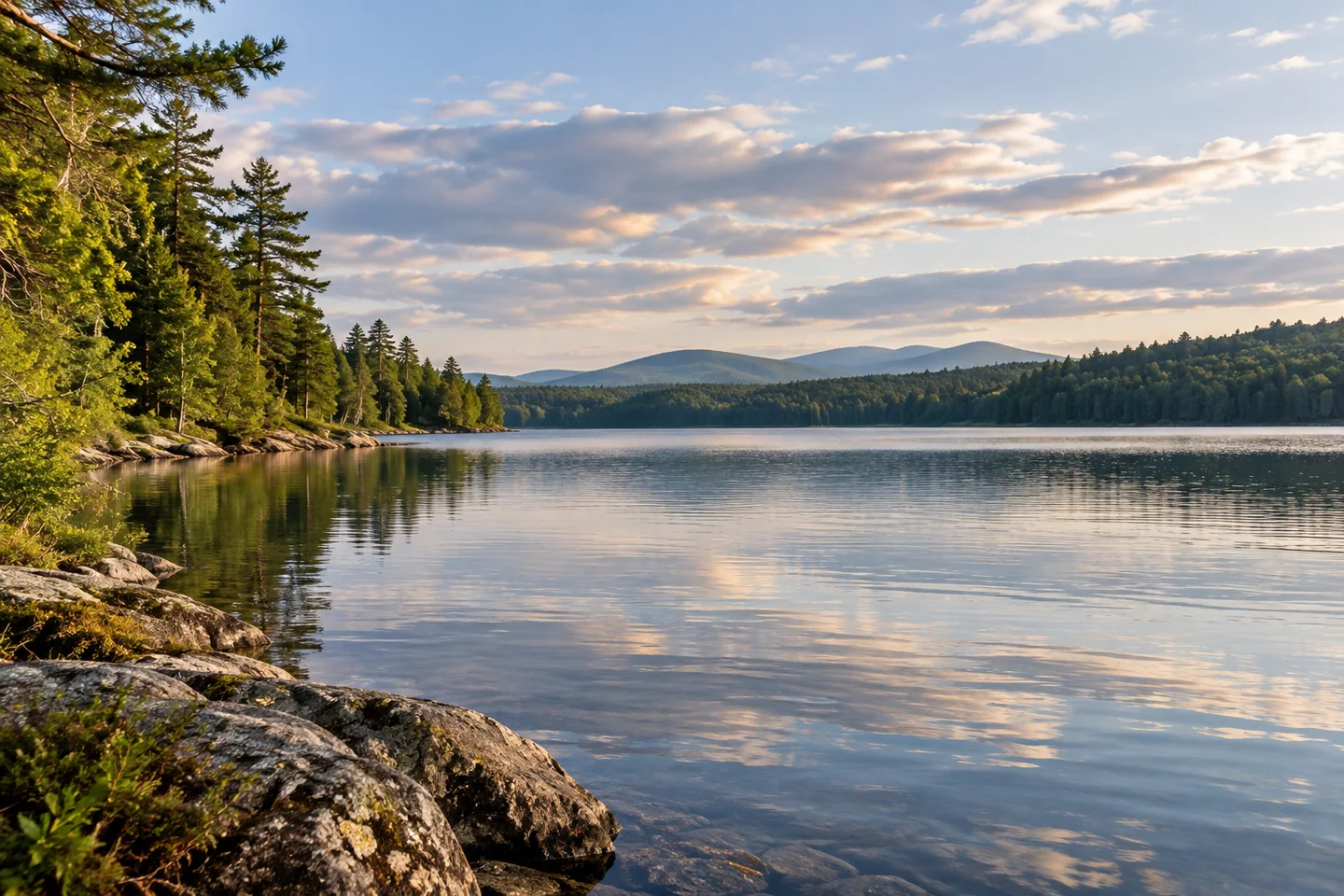
Quakish Lake offers a different way to look at Millinocket's waters. It is part of a river and power landscape, but it also holds a remarkable industrial legacy beneath its surface. A visitor can appreciate the wooded water while thinking about the logs once gathered for the paper mill and the later effort to recover them. The interest is not in finding an untouched lake. It is in understanding how a familiar-looking stretch of water can carry several periods of Maine history at once.
Use an established recreation approach. A 2025 recreation-management filing identifies Green Bridge Boat Launch as providing access to Quakish Lake, while noting that the operator can close the ramp during high flows. Confirm conditions before bringing a craft and obey any barrier. This is a managed river-connected setting, so a lake outing should remain within a researched plan rather than drifting toward dams or treating nearby moving water as an extension of a casual paddle.
Joe Rankin's Winter 2014 Northern Woodlands report describes Quakish as a holding pond for Great Northern Paper's mill. Some transported logs sank. Maine Heritage Timber formed in 2010 to recover underwater wood, giving that submerged material a new commercial use. Read the account as a historical business story rather than a present inventory. It makes the ordinary surface a starting point for imagining the lake's industrial connections.
Rankin describes barges and equipment, logs lifted into containers, then cleaning and milling ashore. A material once moved with the river could become another finished object. That transformation provides a useful theme for an informed lake visit. It also suggests looking closely at everyday materials after returning home: a finished board can conceal a long journey. Appreciate the reported process while respecting the boundaries of any working property.
An older federal water-supply report provides another perspective. Its account of the Millinocket system describes measuring water at Quakish Lake dam and calculating flows through the mill, over structures and through log sluices. This early engineering record shows how tightly water, timber transport and power production were connected. There is no need to reproduce its numerical discharge figures to grasp the point. Looking across the lake becomes more revealing when the water is also understood as part of a deliberately managed system.
Henry David Thoreau's first-person account in The Maine Woods supplies a contrasting historical view. Crossing Quakish, he noticed its irregular outline, forested shores, birds and a partial view of the mountains with the summit hidden in cloud. His attention to small details offers a useful reading companion. The account precedes later industrial changes and is not a description of the lake exactly as a visitor will find it now.
For photographs, frame the relation between wooded shore and open water from a permitted, secure position. Let an ordinary texture or reflected shape carry the image rather than staging a timber-recovery scene. Maine Heritage Timber's own materials describe reclaimed Penobscot wood becoming wall applications and custom work, extending the larger river story beyond the shore. Quakish Lake rewards that wider understanding: water to observe, history to read and a contemporary visit planned with respect for the setting's continuing management.
Fun facts
- Quakish served as a holding pond for timber headed to Great Northern Paper’s mill.
- A 2014 report describes recovering sunken timber from the lake.
- Thoreau wrote about crossing Quakish in The Maine Woods.
Before you go
- Confirm the Green Bridge recreation approach and obey high-flow barriers.
- Keep any paddle separate from unresearched dam or river passages.
- Observe working areas from authorized positions without approaching machinery.
- Read historical lake accounts as context rather than present navigation instructions.
Visitor perspectives
- In The Maine Woods, Thoreau recalls Quakish’s wooded outline, waterbirds and a mountain view partly concealed by cloud.
Capture
- Build a composition from wooded shore and open water from a secure public position.
- Use shoreline texture or reflection rather than staging a historic timber scene.
 Number Nine Lake
 Nesowadnehunk Lake
 Canada Falls Lake
Social
Quakish Lake carries a Millinocket story of water and timber.
A quiet-looking lake surface can hold a substantial industrial history beneath it.
Consider the journeys hidden in an ordinary piece of finished wood.
Material history can accompany a present-day lake view.
Historical engineering records connect the lake with power and log transport.
Thoreau’s lake passage offers a much older perspective on the wooded water.
Confirm the recreation approach and respect any high-flow closure.
Would you start with a lake view or a chapter of its working history?
Hashtags