 Cre8Travel
CRE8TRAVEL · MAINE PLACES
Parkman Hill Farm
Parkman Hill Farm: Fields, Forest and Shared Stewardship
Discover
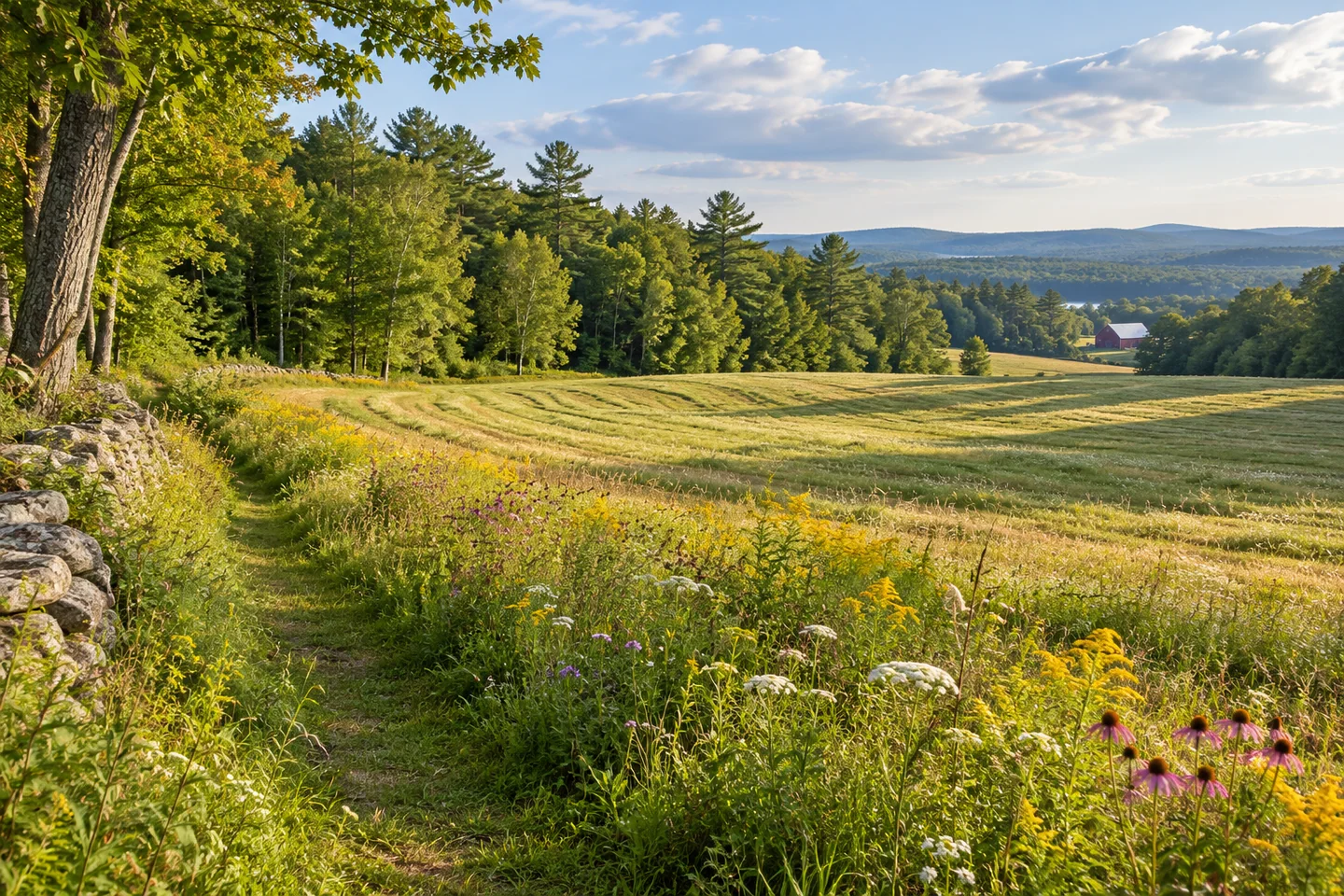
Parkman Hill Farm in Solon offers a view of conservation taking root in a lived-in rural landscape. Its 650 acres combine fields and forest, with a farmhouse and red barn anchoring the property. Somerset Woods Trustees identifies two marked trails and older woods roads for exploration. Begin by checking the current farm map and choosing a walk that suits the day; the acreage describes an extensive property rather than the length of a single circuit.
The farm became a conservation property through an anonymous landowner’s gift in January 2024. Somerset Woods explained that its previous steward had managed it for wildlife, birds and pollinators for decades. The donation was intended to continue that care while benefiting the Solon community. This history gives the open ground a meaning beyond the immediate view: the place represents a sustained choice about how land should be treated and who should share its benefits.
An early exploration report from the land trust describes stone walls, cellars and deteriorating structures amid varied ecological communities. Those traces prompted attention to the people who had farmed, hunted and made homes in the area. In July 2024, the team also described planting donated native flowers and beginning a meadow loop above the farmhouse. Read these as chapters in the farm’s conservation history; they explain the combination of human work and habitat that continues to shape its identity.
Sam Shirley’s original Maine by Foot account, published in April 2025, describes two complementary walks. The northern loop circled a hayfield beside the historic buildings, with views south and east. The southern McCarty Meadow Loop combined another field with woodland, including white pines. Shirley linked the walks using a short stretch of Parkman Hill Road. His account offers a useful impression of their contrast, while the current manager map should guide the actual route chosen today.
The paths also have a record of community participation. Marti Stevens Learning Center reported that students visited on November 7, 2025, helping define a section off McCarty Road with Somerset Woods staff and Skowhegan Outdoors. They learned to use trimming tools, cleared growth and worked on roots along the route. The school’s account makes the work behind a footpath tangible: a walkable line across the landscape can also be the outcome of shared effort and practical learning.
The land trust’s February 2026 trail-marking announcement describes further work on a bog route and a woodland connector between the farmhouse area and lower meadows. It also describes uneven, hilly ground. That development is a reason to arrive with the latest route information rather than treating an older mileage figure as a complete inventory. Choose the field walk for its open perspective, or a maintained woodland option for a closer look at the farm’s changing edges.
A rewarding way to approach Parkman Hill is to hold those different kinds of stewardship together. Notice where an open view invites you to stop and where a path draws attention inward. Consider the donor, the people maintaining routes and the students who helped make one section easier to follow. The visit can become a quiet encounter with the continuing decisions that keep a community landscape available to others.
Fun facts
- The farm was donated anonymously in January 2024.
- Students helped with trail stewardship here in November 2025.
Before you go
- Use the latest manager map when selecting a loop or connector.
- Check the farm’s mapped hunting areas and seasonal guidance before walking.
Visitor perspectives
- Sam Shirley describes peaceful walking, a hayfield loop with southward and eastward views, and a second route combining meadow and white-pine woods.
- The school reports that students learned trail-maintenance skills and enjoyed working together during their November visit.
Capture
- Compose the field edge as a meeting of open ground and forest.
- Use a maintained path to frame the relationship between buildings and meadow.
 Jacobs Pines
 Cambridge Woodlands Preserve
 Orbeton Stream Conservation Easement
Social
Parkman Hill’s donor wanted decades of careful stewardship to continue.
Stone walls and cellars helped the land trust read the farm’s history.
Native flower planting was part of the team’s early work in 2024.
Sam Shirley described contrasting field and woodland walks at Parkman Hill.
A school visit turned trail maintenance into practical outdoor learning.
Trail marking helps visitors understand a developing network.
Let an open view set the pace of a walk, rather than a mileage target.
Community conservation has many authors. A walk can be a way to notice their work.
Hashtags