 Cre8Travel
CRE8TRAVEL · MAINE PLACES
Jacobs Pines
Jacobs’ Pines: A Teacher’s Woodland Legacy
Discover
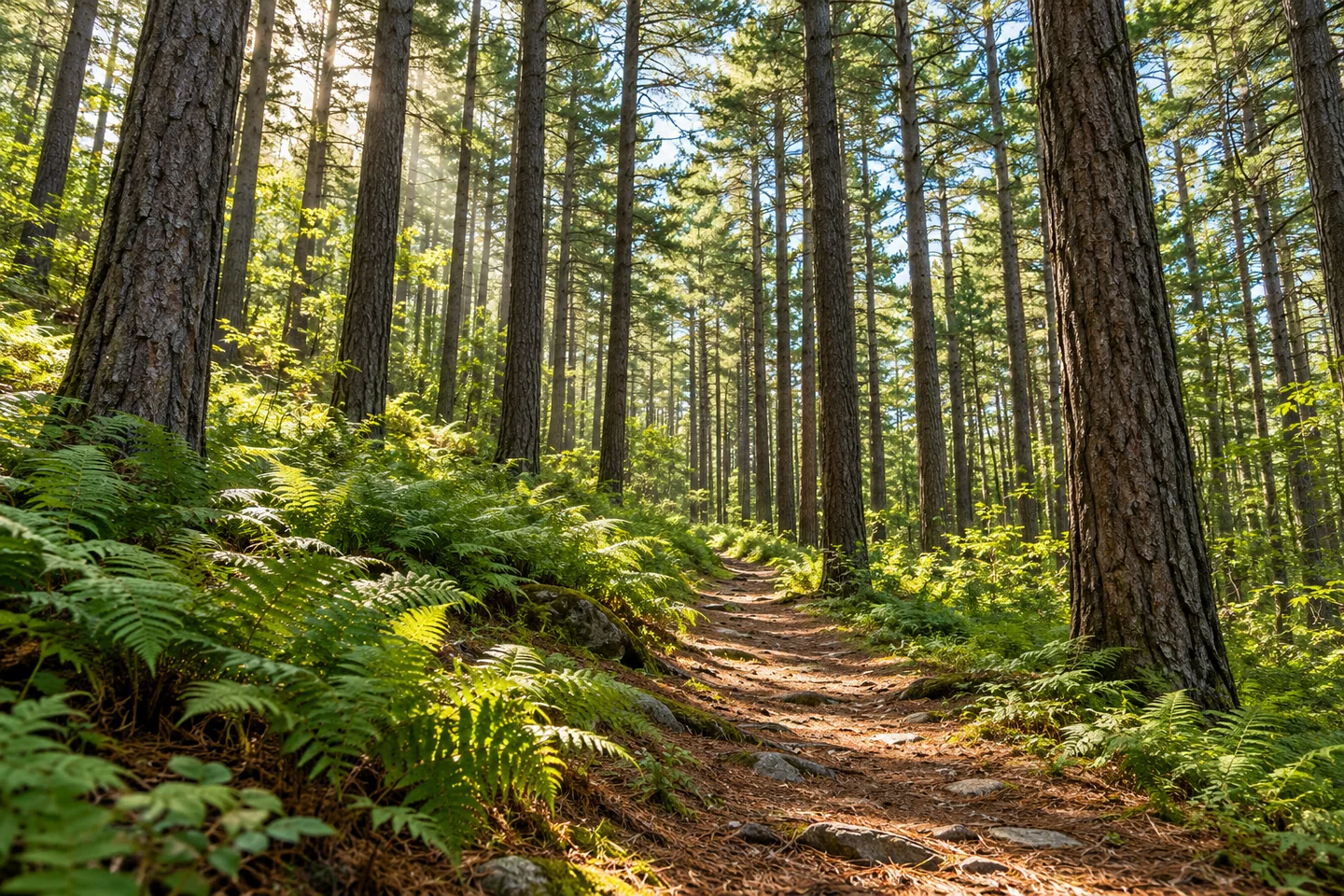
At Jacobs’ Pines in East Madison, a walk among trees carries the imprint of one teacher’s patience. George Jacobs raised pine seedlings from cones collected in the East Madison cemetery and planted them here annually between 1939 and 1946. The route also passes mixed hardwoods, conifers and cedar groves, offering several contrasting woodland communities alongside the planted pines. Thousands of those plantings helped create the tall pine plantation that gives this woodland its name. Looking upward becomes a way of reading a deliberately cultivated landscape.
The town’s recreation account adds a different detail to that legacy: Jacobs wanted the land used for making trails, especially by local Boy Scout and Girl Scout troops. That intention gives the paths a social history alongside their natural appeal. A woodland outing here belongs to a tradition of people learning through practical work outdoors, with a donor’s personal interest becoming a shared community resource.
The administrative history is equally revealing. In her report for 2018, Madison head librarian Julie Forbus explained that the library trustees, selectmen and town manager supported transferring Jacobs’ Pines to Somerset Woods Trustees. They considered conservation stewardship the best way to carry forward the donor’s intentions. This was land discussed in a library report because responsibility for its future had become part of the library’s work for its community.
For a walking plan, think in three colored loops. The blue Pines Loop follows established woods trails through the plantation; yellow Deer Run adds a more rugged section and a short rocky climb. Orange Fox Run offers another loop and connects with Deer Run. The manager’s trail listing gives the network as 1.6 miles. Marked paths matter here because nearby private trails do not carry public access.
Rebecca Goldfine’s Maine by Foot account supplies the texture of an individual visit. She describes a grassy approach, a turn toward a vernal pool and particularly thick fern groves on Fox Run. Her overall impression was of a peaceful, mostly level forest walk, interrupted by a short, steeper ledge section. Those observations suggest an outing that rewards attention to small changes underfoot and beside the path as much as progress around the outside loop.
Somerset Woods Trustees continues to identify Lower Mills Road as the access to this compact network. Use that named entrance to begin with the preserve itself in mind: an intentionally planted stand, connected woodland paths and a donor’s enduring invitation to walk. The scale lends itself to an unhurried visit, leaving room to choose a shorter circuit rather than making distance the measure of success.
Try carrying one question through the walk: what changes when a forest is also somebody’s long-term project? Compare the feeling of looking along a path with the experience of looking up into its surrounding trees. Then pause before taking the next junction. A sketch, a few written lines or a conversation about what caught your attention can give the outing a shape of its own, without requiring a dramatic viewpoint or a packed itinerary.
Fun facts
- Jacobs intended the woodland to support trail making by youth groups.
- A library report records the transfer to conservation stewardship.
Before you go
- Follow marked preserve trails; adjacent private paths are not public.
- Start from the Lower Mills Road entrance identified by Somerset Woods Trustees.
Visitor perspectives
- Rebecca Goldfine describes a peaceful forest outing, fern groves on Fox Run and a short steeper ledge section. Her account reflects her own visit.
Capture
- Frame an upward study of trunks and canopy from the established path.
- Make a close composition of fern patterns without stepping into them.
 Simard-Payne Memorial Park
 Parkman Hill Farm
 Cambridge Woodlands Preserve
Social
A teacher’s tree planting gives Jacobs’ Pines its living history.
Youth trail making was part of George Jacobs’ vision for this woodland.
A library’s responsibilities once included the future of these woods.
Conservation can carry a personal gift forward across generations.
Rebecca Goldfine noticed thick fern groves along Fox Run.
Lower Mills Road is the manager’s named entrance to Jacobs’ Pines.
Give a short woodland outing room for a sketch or a written observation.
Choose your own walking rhythm: pause, notice, then decide where to turn.
Hashtags