 Cre8Travel
CRE8TRAVEL · MAINE PLACES
Molasses Pond and Public Beach
Molasses Pond: A Public Beach and a Shared Lake
Discover
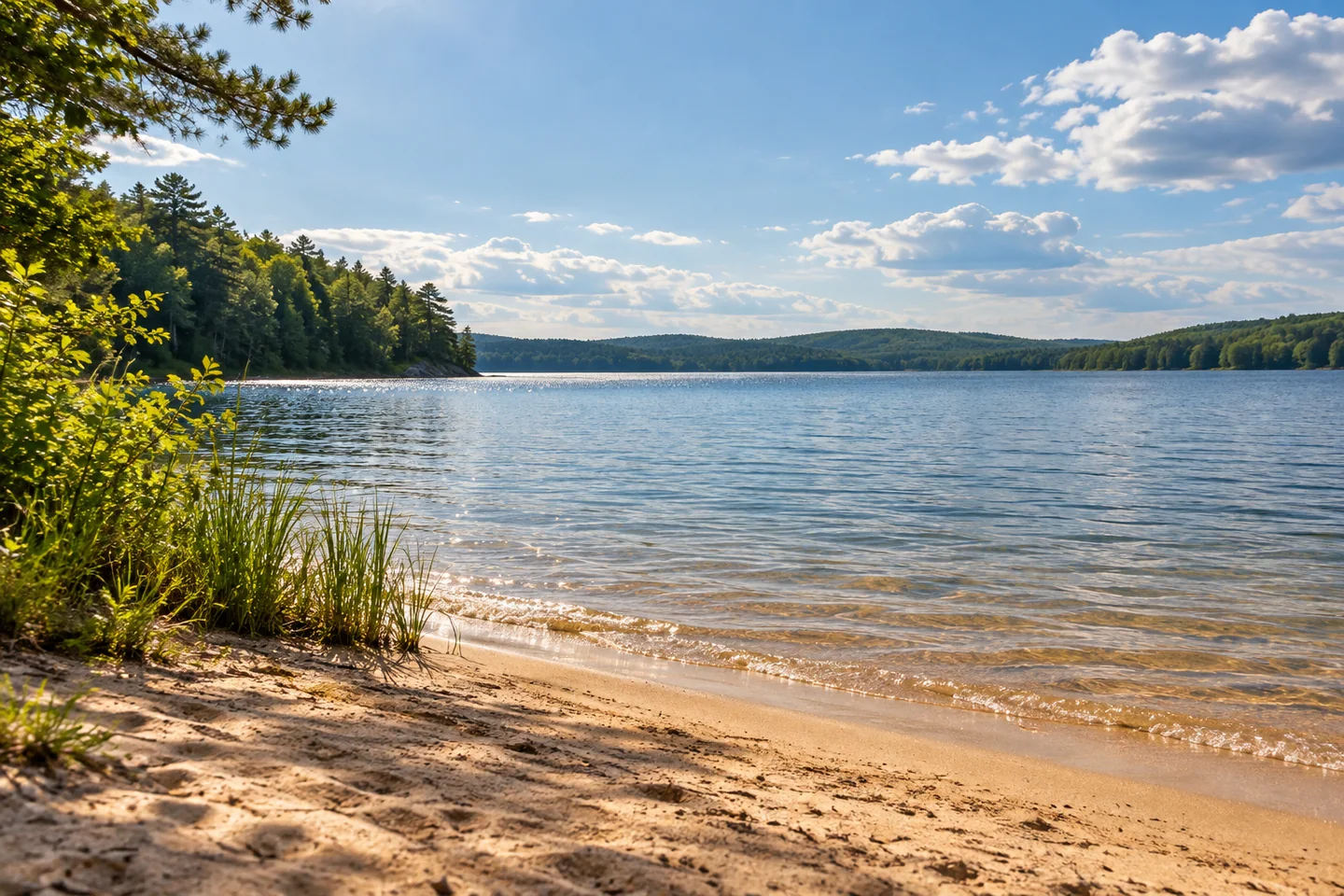
Molasses Pond's public beach offers a straightforward freshwater stop in Eastbrook, with a much longer community story behind the view. Emily Burnham's swimming guide identifies the sandy public swimming area at the northern end of the pond, reached from Molasses Pond Road. Her account places it within a generations-spanning summer community. That is a useful way to approach the shore: a place for an unhurried visit that is also part of local family memory. Use the designated public area and leave camp frontage to its owners. Choose your own swimming distance and companions for the conditions rather than taking an attractive photograph as a water-safety assessment.
The state fisheries survey, revised in 1999, adds a less visible story. It describes a 1,252-acre pond where the amount of cool, well-oxygenated summer water was limited. Salmon growth had declined in the early 1990s, and brown trout were introduced in 1996 as part of a management response. The same account records an unauthorized introduction of smallmouth bass, warning about competition for food within an existing fish community. These are historical findings, not a guarantee of a present catch or a substitute for current regulations. They show why a beach outing and fisheries stewardship concern the same body of water. A swimmer sees the surface, while the conditions supporting different fish extend through the water below.
Cathy Carter's first-person essay in the lake association's spring 2023 newsletter offers a more intimate seasonal perspective. She recalls her father John Quine's long connection with the pond and the family's practice of recording ice-out dates on an outhouse wall. Her account moves from winter light and the sounds of changing ice to the growing ribbons of open water around the edge. The recorded dates vary substantially across the decades, making the collection a family history of watching rather than a reliable calendar for a future trip. It is not an invitation to walk on ice. The same newsletter urges shoreland residents to retain vegetation and manage runoff, and asks boaters to avoid carrying invasive organisms between waters. Those practical concerns connect the remembered pond with the effort needed to care for it.
The Molasses Pond Lake Association describes its continuing purpose as protecting the environment, recreation and natural habitats. Its work includes studying conditions, encouraging water-quality practices, preventing invasive plants and cooperating with other groups. That local presence matters to the character of a public visit. The beach may be the most immediate point of contact, but the lake is also a shared resource for people whose involvement extends beyond a day in summer. Treat the ordinary details of your outing accordingly: leave room for other users at the access, take belongings and litter home, and avoid disturbing shore vegetation merely to improve a view.
For a photograph, stay within the public area and let the sandy edge lead toward open water. Avoid making nearby camps or other beachgoers the subject without permission. A composition that includes both shore texture and distant water can preserve the place without interrupting someone else's afternoon.
Fun facts
- A family ice-out record described in 2023 reaches back to the 1920s.
- The historical fisheries survey records brown-trout introduction in 1996.
Before you go
- Use designated public access and respect private camp frontage.
- Check and clean watercraft before moving them between waters.
Visitor perspectives
- Carter recalled her father’s connection with the pond and a family record of ice-out dates, describing seasonal changes from personal observation.
Capture
- From the public beach, use the sandy edge as a foreground line toward open water; exclude private camps and recognizable people unless permitted.
 Pleasant River Lake
 Lambert Lake
 Duckpuddle Pond
Social
The public swimming area is at the pond’s northern end.
Molasses Pond Road leads to the public beach.
The pond has a generations-spanning summer community.
Brown trout entered its fisheries-management history in 1996.
A family record preserves changing ice-out dates.
Local stewardship includes water quality and invasive-plant prevention.
Leave room for other users at the public access.
A sandy foreground can connect beach texture with the wider water view. #Cre8Travel
Hashtags