 Cre8Travel
CRE8TRAVEL · MAINE PLACES
Mill Park, Augusta
Mill Park, Augusta: A Public Place beside a Changed River
Discover
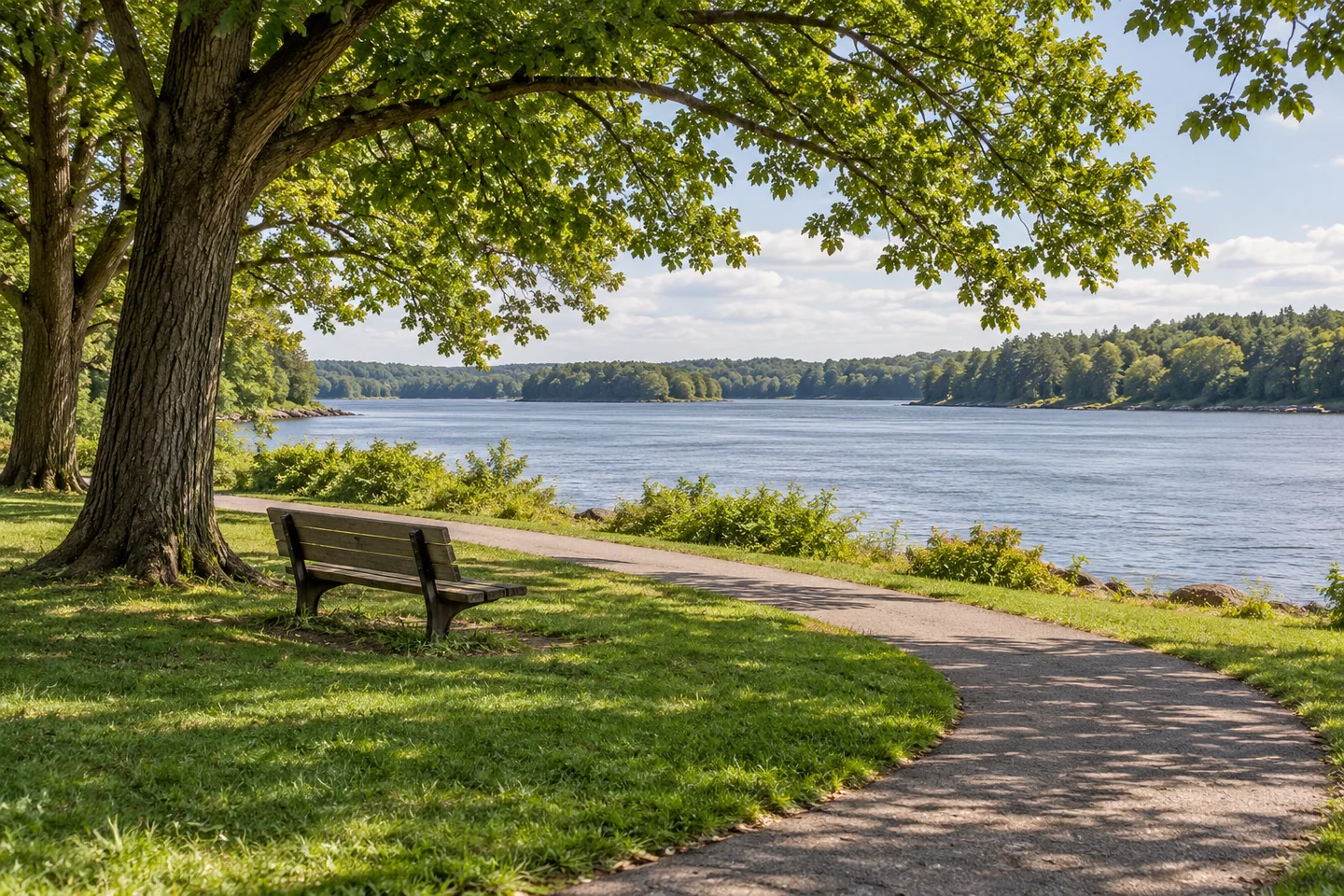
Augusta's Mill Park gives the Kennebec River a public setting for recreation and gatherings near the former Edwards mill site. The city's current park description identifies events, a petanque court, and the adjoining dog park. Choose whether the visit is a quiet walk or a separately scheduled occasion. The same place can serve both purposes without requiring a full programme to make the stop worthwhile.
Rebecca Goldfine's original account especially enjoys a stone path along the riverside fence. Her walk also notices a bilingual memorial to generations who passed this place on their way to work in Augusta's mills, factories, and shops. The combination is revealing: an attractive route beside the water also asks visitors to consider the people who once moved through an industrial neighborhood.
The river itself has undergone a profound change. The Natural Resources Council of Maine records Edwards Dam being breached in July 1999, restoring a free-flowing reach and reopening the way for migratory fish. Its fifteenth-anniversary account identifies the former dam and mill property as the site of Mill Park. Knowing that history makes the water more than a pleasant backdrop; the park belongs to a larger transformation in how the community relates to the river.
A more recent addition brings attention to a different kind of local work. Sara Coughlin's August 2026 report documents the unveiling of a memorial to Martha Ballard, the midwife and diarist whose writing preserves everyday life around the turn of the nineteenth century. Designed by Stanley Tupper, the sculpture depicts Ballard holding a baby and looking toward the Kennebec. The surrounding interpretation connects her remembered work with a place near her former home.
The farmers market gives the park another rhythm. Its organizer distinguishes a summer market at Mill Park from a winter market held at the Buker Center. The pavilion was created to support market days as well as other gatherings. Check the organizer's current arrangements if shopping is part of the plan, rather than assuming the park address hosts every seasonal edition.
An original on-site interview from the 2017 summer celebration makes the park's public role personal. Michelle Noiles appreciated its central location while watching her young son take part in the event. She valued a setting within walking distance for people she knew. Her experience belongs to that particular festival, but the reason she liked the location remains easy to understand: a gathering feels different when it belongs within familiar everyday geography.
Coughlin's account also describes the memorial's design developing beyond a conventional statue. Curved beams support the skirt, with vines intended to climb them over time, and an herb garden includes interpretation drawn from Ballard's diary. Observe what is actually present during the visit rather than expecting a mature planted form immediately. The historical garden is a subject for learning, not a guide to preparing or using remedies.
Goldfine's visit finds the park itself well cared for, while the lower riverbank needs attention. Preserving both observations gives a realistic sense of one walk rather than an idealized scene. Conditions can change, so keep to the public paths that suit the day and allow the river view, the workers' memorial, and the newer monument to become parts of one connected visit.
For a photographic record, place a memorial within the surrounding public space before choosing a closer detail. Leave other visitors room to sit or pass. A note about whose work the park helps remember can connect the picture with the history you came to understand.
Fun facts
- The park occupies the setting of the former Edwards dam and mill beside the restored river.
Before you go
- Check the market organizer’s current venue for the chosen season.
- Use public paths and leave room for gatherings and other visitors.
Visitor perspectives
- Goldfine particularly enjoys the riverside stone path and finds the park well cared for, while noting that the lower bank needs cleanup.
- Noiles appreciates the festival’s central location and its walking-distance connection with people she knows.
Capture
- Where permitted, show the Ballard memorial in relation to the river it overlooks.
 Mill Island Park
 Readfield Fairgrounds Community Park
 Whittier Woods
Social
A bilingual plaque recalls generations walking to Augusta’s industrial workplaces.
Removing Edwards Dam changed the river landscape beside the park.
The Ballard sculpture depicts a local midwife with a baby in her arms.
Summer and winter markets use different venues.
A festival visitor appreciated the park’s central location.
Whose everyday work does a public monument help you notice?
A quiet walk can hold several kinds of local history.
Let a present river view raise a question about the past.
Hashtags