 Cre8Travel
CRE8TRAVEL · MAINE PLACES
Maine Solar System Model
The Maine Solar System Model: Discovering the Space between Stops
Discover
The Maine Solar System Model turns a Route 1 journey into a lesson about space between things. Treat the Sun, planets and moons as parts of one large educational route, rather than expecting a single enclosed attraction. Start with the project's map and choose a section that fits your day. Its brochure asks visitors not to climb or hang from the models and not to park in emergency lanes. A smaller planned selection is preferable to an improvised stop wherever something catches the driver's eye.
The model uses one mile to represent one astronomical unit, the distance between Earth and the Sun. The project's brochure explains that the community built it between 1999 and 2003, contributing fabrication, posts, bases and installation work. Steel and fiberglass became celestial objects through ordinary skills applied at an unusual scale. That is part of the pleasure of looking closely: a planet can be both a representation of a remote world and an object made by neighbors who knew how to shape, paint and install it.
A university account from July 2026 shows that this community work continues. Teacher Jessica Goodwin helped paint Jupiter as a student; more than two decades later, her daughter joined students painting the model moon Io. The account describes a golf ball covered in fiberglass becoming the small moon, supported on a much larger post. That contrast between the object and the support is revealing. Space is difficult to represent in a useful landscape model because an accurately small body still needs a structure people can find and maintain.
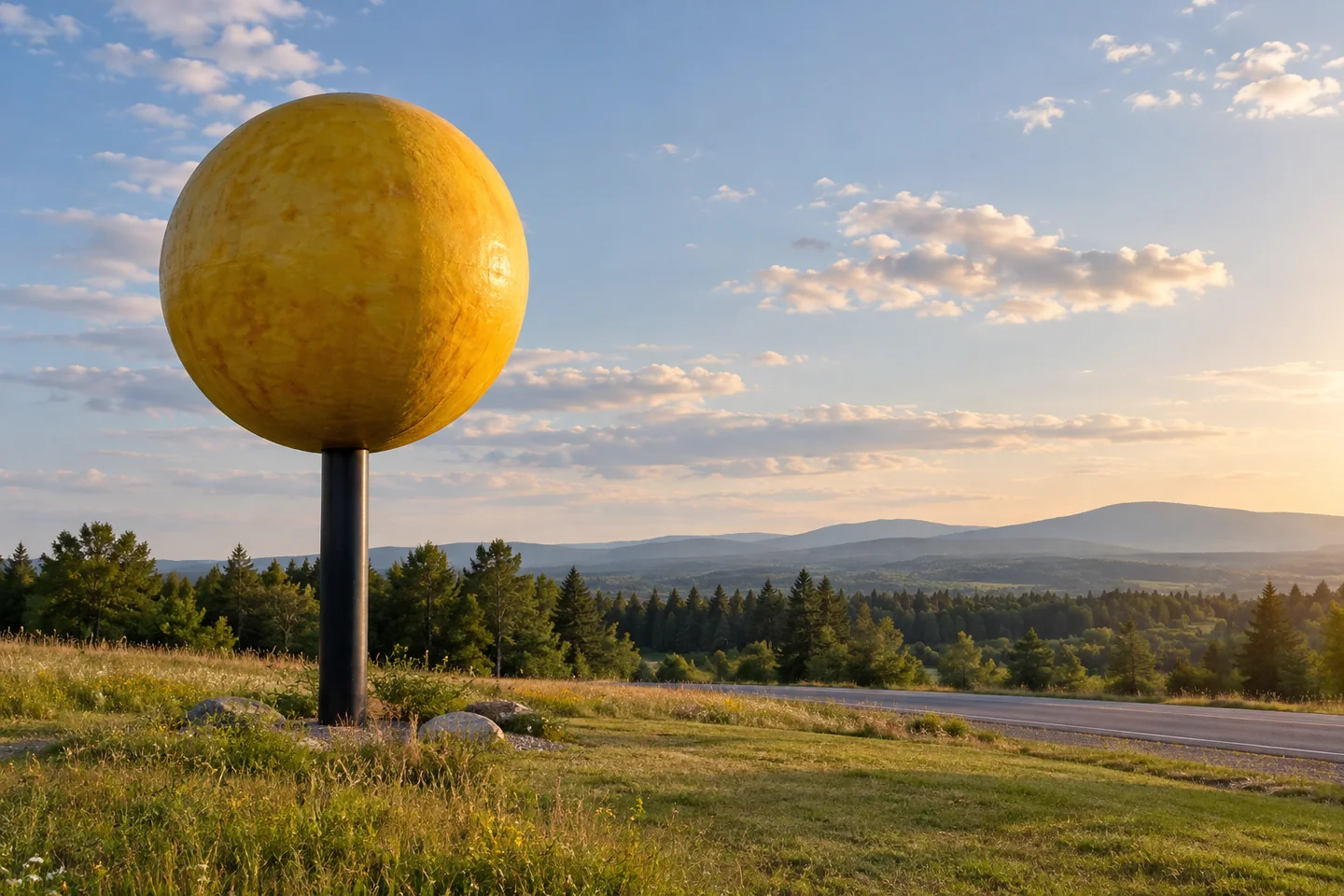
The Sun supplies a different visual anchor. Original reporting on its April 2024 unveiling describes the twenty-three-foot yellow model installed outside on the university's Presque Isle campus. Previously, visitors had to locate an indoor depiction, prompting the recurring question of where the Sun was. The new form made that starting point more visible. Older accounts of being unable to enter a building therefore describe a previous arrangement, not a reason to assume the present outdoor model is hidden. Check current campus access and parking separately before visiting.
Jeff Parsons's September 2020 first-person account recalls making the journey with his girlfriend, Michele, who had long wanted to see the planets. They set out to stop at each one. He also noticed an important practical limitation: some locations did not offer a straightforward place to park. Keep the enthusiasm and the caution, while leaving his dated roadside-stopping advice behind. Use lawful designated parking and move on if an approach is unsuitable. A successful science outing does not require collecting every object in a single attempt.
For a photographic record, show one model in its actual landscape rather than trying to make it resemble a spacecraft image. From a permitted position, include enough of its support and surroundings to explain its human scale. Then compare the distance to the next object on the project map with the size of the one you have just seen. The interval is part of the exhibit. Let the journey create a question to discuss with a companion: what is harder to imagine, the relative size of a planet or the empty space around it?
Fun facts
- The route uses one mile to represent the Earth–Sun distance.
- The community-built model was developed between 1999 and 2003.
- An outdoor Sun model was unveiled on the university campus in 2024.
Before you go
- Choose a manageable route section using the project map.
- Do not climb models or park in emergency lanes.
- Check campus access and lawful parking before stopping.
Visitor perspectives
- Jeff Parsons’s September 2020 personal account recalls a long-anticipated planet outing with his girlfriend and notes that some roadside locations lacked straightforward parking.
Capture
- Show a model with its support and landscape from a permitted standing position; convey its scale without climbing or distracting a driver.
 Skowhegan Indian Sculpture
 Isaac Farrar Mansion
 Colburn House State Historic Site
Social
Northern Maine’s solar-system model makes distance part of the exhibit.
One mile along the model represents one astronomical unit.
Community contributors fabricated and installed the objects, posts and bases.
A student-painted moon can carry a family connection across two generations.
The outdoor Sun became a new campus landmark in 2024.
A personal 2020 account pairs enthusiasm with a useful parking caution.
Plan stops deliberately and leave emergency lanes clear.
Which is harder to imagine: a planet’s size or the space around it?
Hashtags