 Cre8Travel
CRE8TRAVEL · MAINE PLACES
Green Lake National Fish Hatchery
Green Lake Hatchery: A Visit inside Salmon Conservation
Discover
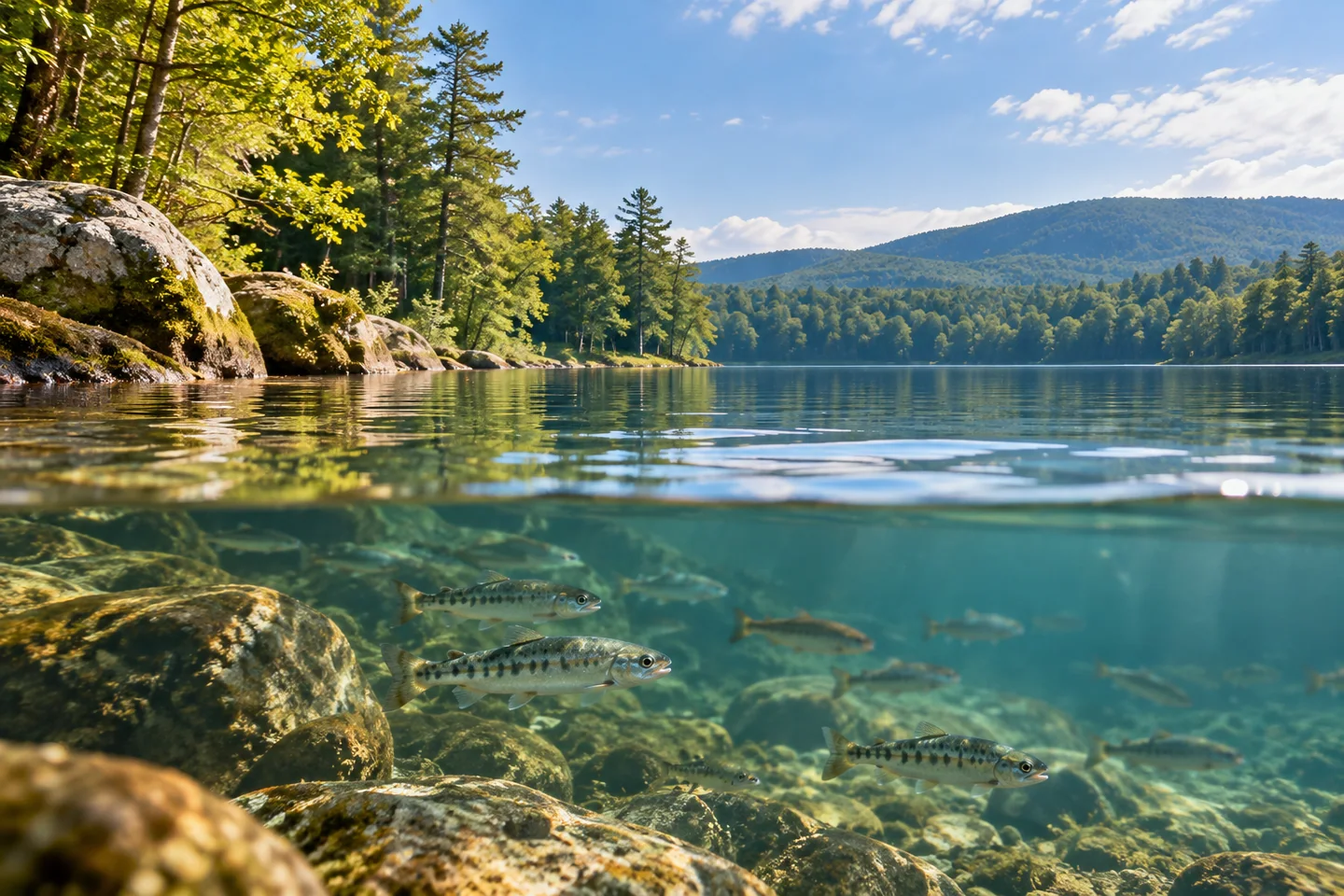
Green Lake National Fish Hatchery in Ellsworth brings Atlantic salmon conservation into view at a working facility. The U.S. Fish and Wildlife Service welcomes visitors for self-guided viewing, with access arrangements worth checking before a long journey. Juvenile fish at different stages give the visit a subject that changes through the year, connecting a small animal in a tank with a much larger restoration effort.
Built in 1973, Green Lake evolved from supplying sport fish for New England to raising river-specific strains of Atlantic salmon for endangered populations in Gulf of Maine rivers. That change in purpose is central to understanding the place. The hatchery's work involves conserving distinct populations and genetic diversity, alongside producing fish that will eventually face the conditions of a river and the ocean.
An original account by the Lincoln School describes a quiet Sunday visit to the covered viewing area. The writers saw adult salmon and tanks of small fry, then watched an employee feed the fish. Their pleasure came from encountering a practical activity seldom visible in everyday life. That individual staff interaction was part of their visit, rather than a demonstration included with every arrival.
Volunteer Mark, writing on Mark & Teri's Travels in June 2018, explains the sustained work behind such a scene. When they arrived, tanks held tiny young salmon whose feeding combined automatic equipment with hand distribution. Biologists monitored growth and adjusted food, water flow, and temperature. The account makes the apparently repetitive work of rearing fish easier to appreciate.
Hand-feeding had a particular purpose in Mark's account: spreading food across the tank helped reach fish away from the automatic feeder's drop point. He remembers learning the task on the volunteers' first day, along with the smell of fish food and the cool building. These concrete details give conservation an everyday human scale, connecting careful routines with living animals.
The public outing can also include the Ed Hastings Memorial Trail. The Service describes a wooded route with green diamond markers, interpretive signs, glacial erratics, vernal pools, old cellar holes, and a bench overlooking Green Lake. Recreational visitors should park before the entrance gate so that a closed gate cannot trap their vehicle. Keep staff-only areas clear when moving between the public trail and viewing spaces.
Rebecca Goldfine's firsthand trail account draws attention to a woodland approach rather than simply the destination at the water. She found rocky, rooty footing and a lakeside bench beside interpretation about native-fish decline and conservation hatcheries. The setting gives the indoor subject an outdoor counterpart: after looking closely at reared fish, a visitor can consider the larger environment their survival depends on.
The Lincoln School writers had a less successful walk. They lost the route early and turned back amid heavy mosquitoes. Their account is a useful reminder to make the woodland portion a choice that fits the day, rather than assuming that every visitor will have the same experience. Fish viewing alone still gave them an unusual and worthwhile stop.
Try leaving with one clear question instead of a list of numbers: which part of an animal's life can a facility support, and which part must unfold beyond it? A visit that makes that distinction more tangible has offered something substantial, even when the most memorable moment is a small fish moving through the water.
Before you go
- Check visitor access before traveling and use designated public areas.
- Park before the gate for a trail visit.
- Treat an informal staff encounter as a bonus rather than a scheduled demonstration.
Visitor perspectives
- The Lincoln School writers enjoyed the covered fish-viewing area and an informal feeding encounter, but cut their trail walk short after losing the route amid mosquitoes.
- Volunteer Mark describes hand-feeding young salmon and learning how staff adjusted food and water conditions.
- Rebecca Goldfine describes a rocky woodland route to Green Lake and a bench beside conservation interpretation.
Capture
- Look for a composition that shows the relationship between fish and their rearing environment.
- At the lake, include the wooded approach in the story of the visit.
 Monhegan Wildlands
 Preble-Marr Historical Museum
 Hadley Point Beach
Social
Green Lake’s mission developed from sport-fish production into Atlantic salmon conservation.
A volunteer’s account reveals the care behind feeding young salmon.
One Sunday visitor valued seeing a working hatchery at close range.
The Ed Hastings Memorial Trail adds an outdoor dimension to the visit.
A lakeside bench gave one walker a place to consider fish conservation.
Which question would you bring to a working conservation facility?
Sometimes a practical process makes the strongest travel memory.
Follow your curiosity from a close view toward a larger story.
Hashtags