 Cre8Travel
CRE8TRAVEL · MAINE PLACES
Fighting Black Bear Statue, Orono
The Fighting Black Bear: A Campus Symbol in Bronze
Discover
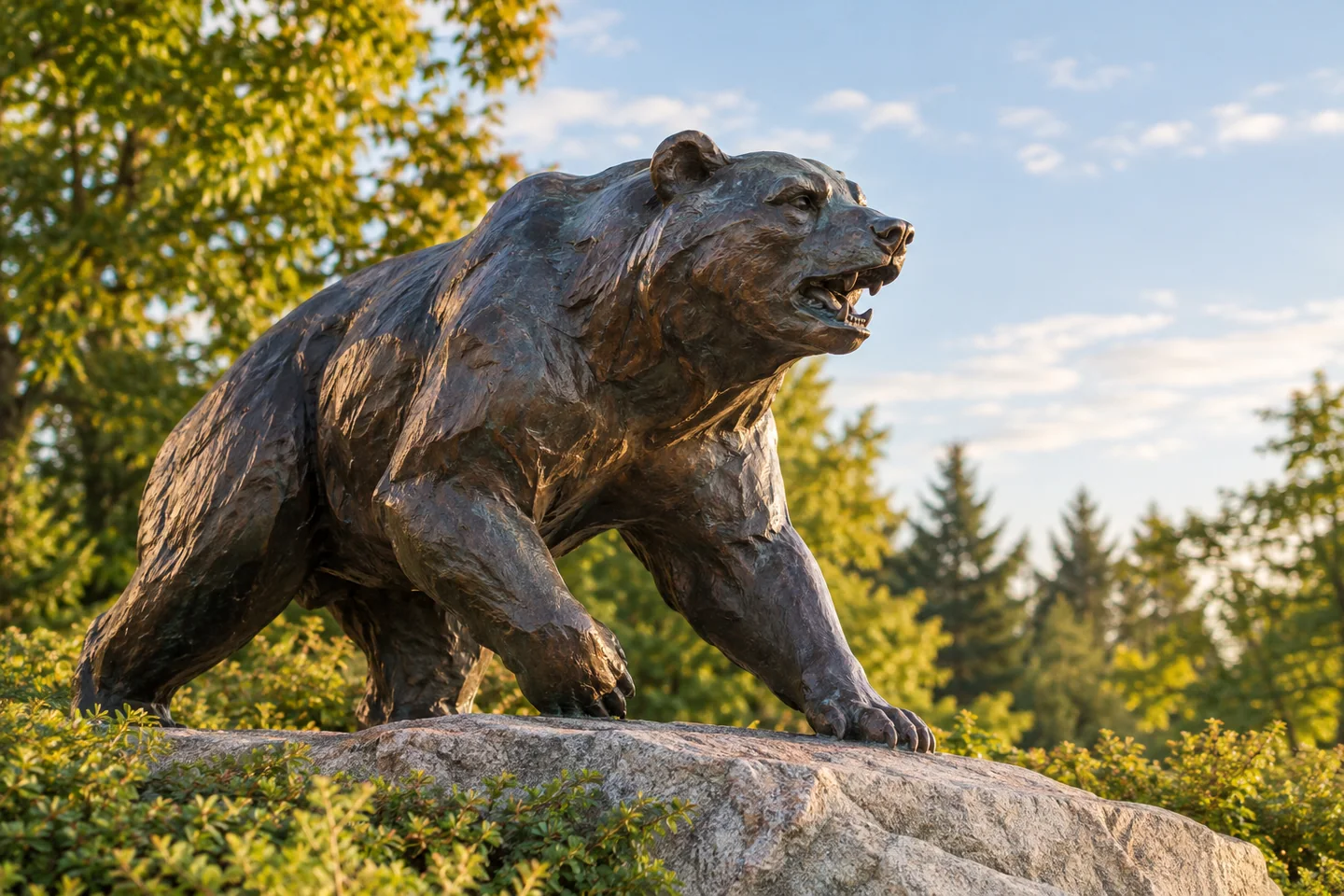
The Fighting Black Bear gives the University of Maine campus in Orono an outdoor art stop with an unusually strong institutional identity. Patricia Lewis Verani's bronze stands in front of Memorial Gym on Long Road, where the university includes it in its self-guided walking tours. Approach from the established pedestrian routes and leave circulation around the gym clear. Begin with the animal's stance rather than immediately making a souvenir portrait. A sculpture representing a mascot can still ask to be seen as an artist's deliberate arrangement of mass, gesture and expression.
The university records the work as a 1979 gift from alumni Wallace and Virginia Humphrey. It replaced a larger white-pine bear given by the Class of 1962. That change of material is part of the story: the campus symbol continued while the object embodying it changed. Consider the difference between a carved wooden predecessor and the bronze before you, without assuming that the old statue remains available to inspect. A familiar institutional image can have a history of replacement, donation and renewed interpretation rather than a single permanent physical form.
Verani's own account adds a useful way of looking. In a 1987 interview with numismatic reporter Burnett Anderson, later reproduced in a reference work, she identified this bear as her first monumental bronze. She described a partly crouched animal whose form was stylized while remaining unmistakably recognizable. The distinction is worth testing visually. Look at how the pose suggests gathered energy, then at the broad shapes that make the animal legible from farther away. A work need not reproduce every natural detail to communicate its subject forcefully. The artist's explanation gives context without deciding whether you should find the result imposing, playful or both.
Her career also crossed a striking difference in scale. The U.S. Mint's 1987 annual report credits Verani with designing that year's Constitution Bicentennial silver dollar. Its account describes a quill and papers on one face and a procession of Americans on the other. The connection is the sculptor, not an exhibit of coins at the bear. Thinking about a small relief and a monumental animal together can sharpen attention to the problems each solves: how much information to include, what remains readable at a distance, and how a silhouette or a raised edge can carry meaning.
The mascot itself has a longer history than this bronze. The university's account traces the bear tradition to a cub named Jeff in 1914 and describes later live mascots followed by people performing in bear costumes. Read that as a history of changing representation, rather than a wildlife encounter available today. An institution can carry the same recognizable symbol through an animal, a performance, an image and a sculpture. The bronze is one particular expression of that wider tradition.
For a photograph, compare a broad side view of the stance with a closer frame concentrating on the relationship of head and shoulders. Stay on permitted ground and keep other campus users outside intrusive close-ups. There is no need to climb or handle the work to understand its scale. The bear rewards a short pause that connects university memory with an artist's decisions, leaving the live-animal history, the wooden predecessor and the coin designs as context for looking more carefully at the bronze in front of you.
Fun facts
- The bronze was an alumni gift in 1979.
- It replaced a white-pine bear associated with the Class of 1962.
- Verani also designed the 1987 Constitution Bicentennial silver dollar.
Before you go
- Use established campus pedestrian routes and follow current visitor-parking instructions.
- Compare the full stance with the relationship of head and shoulders.
- Observe without climbing or handling the sculpture.
Capture
- Compare a broad side view of the bear’s stance with a closer head-and-shoulders composition from permitted ground.
 Long, Caribou and Egg Ponds, Lincoln
 Big Lake
 Courthouse Gallery Fine Art and Art Park
Social
UMaine’s Fighting Black Bear can be appreciated as sculpture as well as a campus symbol.
Patricia Lewis Verani created the bronze given in 1979.
A white-pine predecessor belonged to an earlier chapter of the campus.
The artist described a recognizable animal shaped through stylization.
The same sculptor worked at the very different scale of a commemorative coin.
The bear mascot tradition predates the bronze by decades.
Leave gym circulation clear while stopping to look.
What communicates an animal’s character most strongly in sculpture: detail, posture or scale?
Hashtags