 Cre8Travel
CRE8TRAVEL · MAINE PLACES
Echo Lake on Mount Desert Island
Echo Lake: Beach, Basin and Brook Trout
Discover
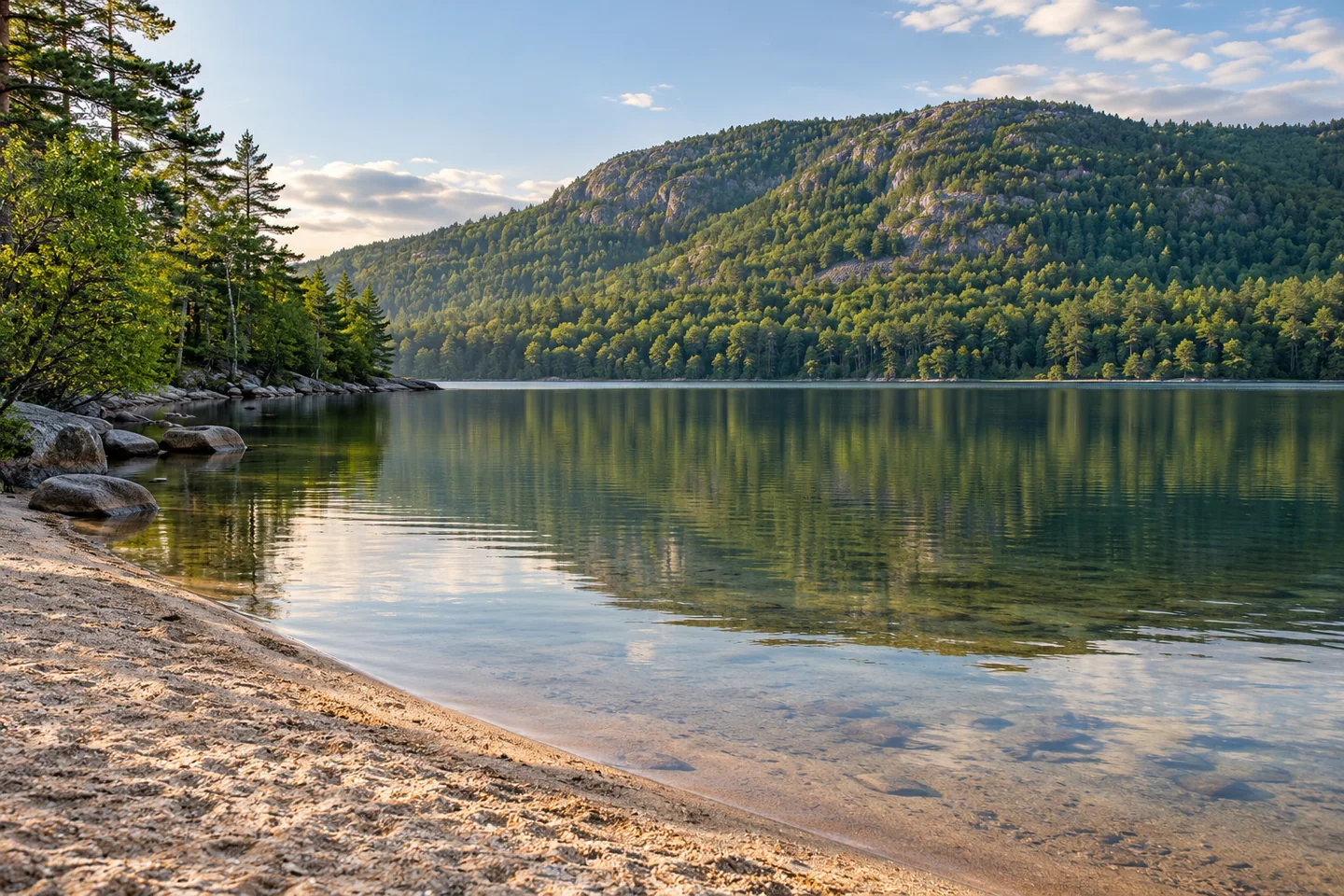
Echo Lake brings a freshwater beach and small-boat recreation into the same western Mount Desert Island landscape. Acadia's current place description distinguishes the beach approach from the launch at Ikes Point on Route 102. Choose the entry that fits the activity rather than carrying a boat toward the swimming shore by assumption. At the beach, a paved approach descends from the parking area toward changing facilities and a wooden walkway across the sand. The park explicitly states that there is no lifeguard on duty. These details make the shore a place to assess carefully before entering the water, even when other visitors are enjoying an apparently relaxed day.
Beneath that familiar recreational setting is a distinctive food web. The state's fisheries survey, revised in 1999, records a maximum depth of sixty-six feet and describes a well-established population of small aquatic isopods, Asellus. These crustaceans provided important food for brook trout and young salmon; some examined trout had consumed them in large numbers. The report also identifies wild trout from Lurvey Brook as a meaningful contribution alongside hatchery fish. Its historical management discussion emphasizes trout while keeping salmon stocking relatively low to avoid excessive competition for food. Read that as an account of ecological relationships and past management, not as a current stocking timetable or a promise about the fish an angler will catch.
The developed shore also belongs to the national park's twentieth-century design history. Acadia's own building history places Echo Lake among the substantial projects associated with Mission 66, the National Park Service modernization program begun in 1956 ahead of its fiftieth anniversary. The same history notes planning for swimming-area improvements and restroom and changing facilities during the 1960s. This does not mean every visible structure dates from that decade. It does explain why a seemingly simple lake visit includes a designed sequence from vehicle access to pedestrian approach and shore. The visitor landscape was deliberately adapted as recreation increased, rather than appearing fully formed around the natural basin.
Scott Cannon's original August 2010 account recalls choosing Echo Lake with friends after a morning hike left some of the group ready for a gentler afternoon. The writer remembers initially entering the chilly water cautiously, then becoming absorbed in the view beneath the surface. Visible rocks and underwater vegetation gave way to deeper water where the bottom could no longer be seen. His personal sense of accomplishment belonged to a first open-water swim. Parts of the historical account describe leaving the designated swimming area; they should not be copied as a visitor route. Its useful observation is the contrast between a welcoming-looking shore and water whose depth quickly changed beyond his immediate view.
For a shore photograph, hold the sandy foreground and the opposite wooded slope in the same frame, then make a tighter version that emphasizes their reflection. Keep people recognizable only with their agreement. The change of scale can express a beach outing and a lake landscape without photographing from the water or interrupting the route other visitors use to reach it.
Fun facts
- A historical fisheries survey describes aquatic isopods as important trout food.
- Echo Lake improvements formed part of Acadia’s Mission 66 planning.
Before you go
- Use Ikes Point for the park’s identified small-watercraft access.
- The park states that no lifeguard is on duty at the beach.
Visitor perspectives
- Scott Cannon remembered cautious entry into chilly water, underwater views and the personal milestone of a first open-water swim with friends.
Capture
- From the shore, include sand, water and the opposite wooded slope, then tighten the framing around reflections.
 Seal Cove Pond
 Jordan Pond
 Bubble Pond
Social
Echo Lake’s boat launch and beach approach serve different activities.
Ikes Point is the park’s identified small-watercraft entry.
There is no lifeguard on duty at the beach.
The lake’s underwater story includes small aquatic isopods.
Wild trout from Lurvey Brook contributed to the historical fishery.
Mission 66 planning helped shape Echo Lake’s visitor facilities.
A 2010 swimmer recalled the changing underwater view as depth increased.
A sand-and-water foreground can connect a beach photograph with the wider lake. #Cre8Travel
Hashtags