 Cre8Travel
CRE8TRAVEL · MAINE PLACES
Corundel Lake
Corundel Lake: Water, Reeds and Corinna’s Renewal
Discover
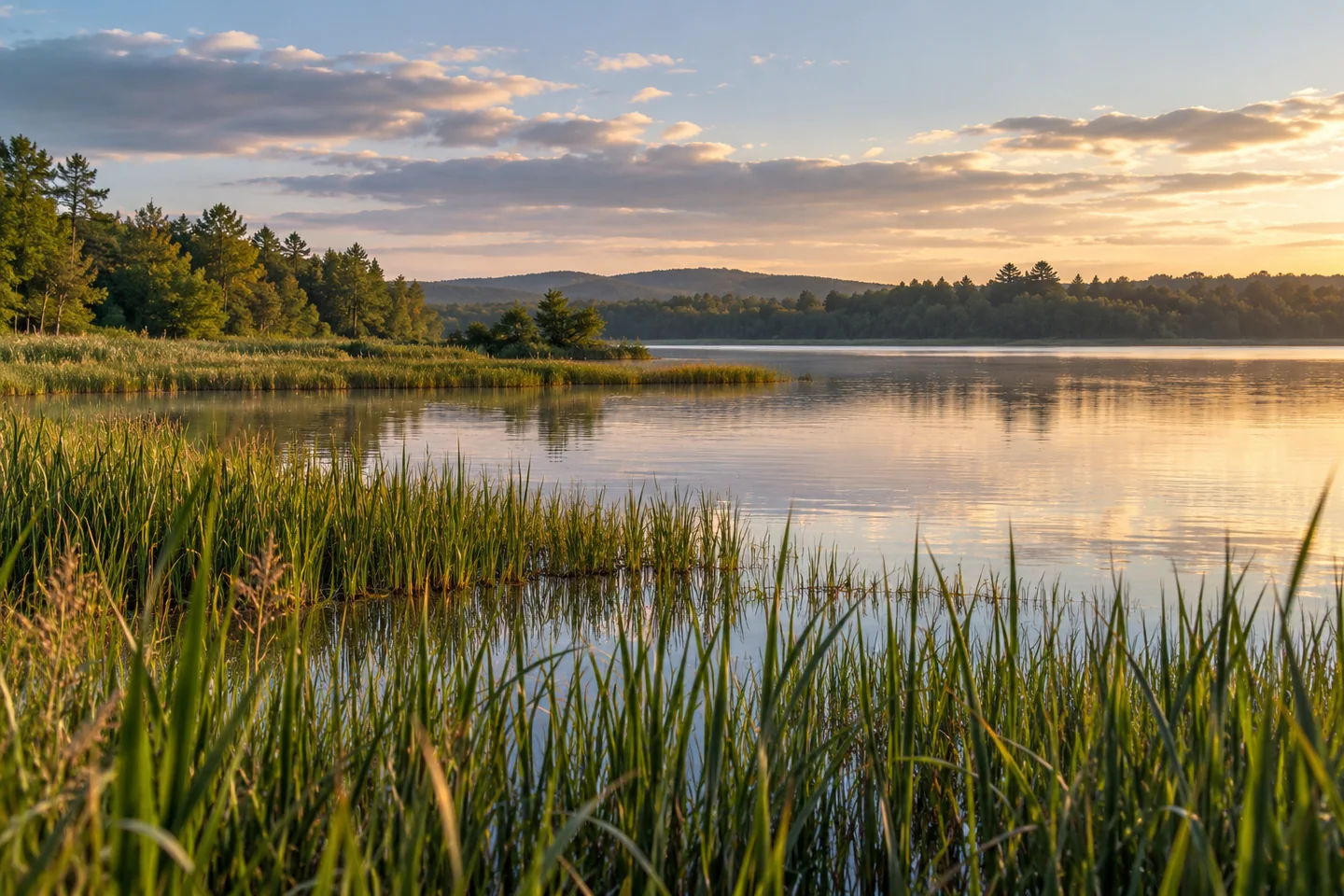
Corundel Lake in Corinna is a place where a quiet water view opens into a much larger community story. It also appears as Corundel Bog and East Branch Sebasticook River Reservoir. Maine’s environmental department specifically connects those names in its waterbody documentation. Recognizing them helps when matching a map, a local description and a planning document: they describe the same water, with different labels emphasizing different aspects of its character.
Start with the village setting. The Sebasticook Valley Chamber identifies a boardwalk loop leading toward the lake and bog, along with boating, fishing and birdwatching opportunities in Corinna. It also lists water access for Corundel. A visit can therefore focus on the view from land, or begin with a conversation about the present launch arrangement before bringing a boat. Choose the approach that gives your party time to appreciate the water’s edge.
The landscape is inseparable from the town’s textile history. EPA records the Eastland Woolen Mill’s operation from 1909 to 1996 and the contamination left in soil, groundwater and river sediments. The site entered the Superfund program in 1999. Its closure created both an economic loss and a difficult environmental task. That background gives the present waterfront a meaning beyond a pleasant scene.
EPA’s account describes cooperation between the town, state, federal agencies and local stakeholders to connect cleanup with reuse. The resulting village improvements included green space, river access, a boardwalk, memorials, housing and a bandstand. Read the open spaces as part of that sustained community effort. Environmental recovery and redevelopment have a history here; a scenic appearance should not substitute for current advice about water contact or eating fish.
There is also a distinct wetland perspective. Maine DEP’s monitoring record identifies the Corundel station as a wetland site, with sampling recorded in 2002, 2012 and 2017. Those dated observations are a reminder that studying water involves repeated visits and different forms of evidence. While looking across the surface, consider how much of the place’s life and condition cannot be judged from a single attractive reflection.
Brian Swartz’s 2013 account of the neighboring rail corridor describes tall reeds beside Corundel and a wooded, tunnel-like stretch to its north. His attention to changing morning light provides an appealing way to look at this shoreline. Watch how vegetation breaks up the view, how a patch of water catches light and how the nearby village gradually enters or leaves the frame. Keep any walk centered on the lake area and the access actually available.
A rewarding stop can be simple. Spend a little time orienting yourself, choose one comfortable viewing place and then look again after a few minutes. The first impression may be mostly water; the next may be reeds, buildings or the relationship between them. Giving attention to those connections can make an ordinary-looking village waterfront feel much more specific.
Leave with room for both sides of the story: a living wetland and a town that has worked to rebuild around it. Neither requires a dramatic discovery to hold your interest. The value of the visit lies in seeing how natural processes, industrial history and daily community life occupy the same landscape.
Fun facts
- Corundel Bog and East Branch Sebasticook River Reservoir are names for the same water.
- DEP monitors a wetland station at Corundel.
- Eastland’s mill history is part of the waterfront’s redevelopment story.
Before you go
- Ask locally about current launch arrangements before bringing a boat.
- Consult present environmental advice before water contact or consuming fish.
Visitor perspectives
- Doug Spalding recalls otters and birds during a canoe outing on Corundel Pond.
Capture
- Use reeds to divide a broad water view into smaller layers.
 Plymouth Pond
 The Octagon House
 Hollywood Casino
Social
Corundel’s different names describe the same water landscape.
Corinna’s boardwalk offers a land-based way to approach the view.
The former mill site connects recreation with a complex industrial past.
Wetland monitoring adds a perspective beyond the surface view.
Swartz’s shoreline account notices reeds and changing light.
Let the village enter the frame alongside the water.
Return to the same viewpoint after a few minutes and notice what changes.
A small waterfront stop can reveal a substantial community story.
Hashtags