 Cre8Travel
CRE8TRAVEL · MAINE PLACES
The Octagon House
Farmington’s Octagon House and a Living Historical Society
Discover
Farmington’s Octagon House offers an inviting architectural puzzle: an eight-sided home whose unusual outline changes the way you imagine familiar rooms. It belongs to the Farmington Historical Society, along with the Titcomb House Museum and North Church. Consider these places together as an introduction to the town’s domestic, documentary and community history. A planned visit can move between a striking building and the quieter work of preserving what happened inside a community.
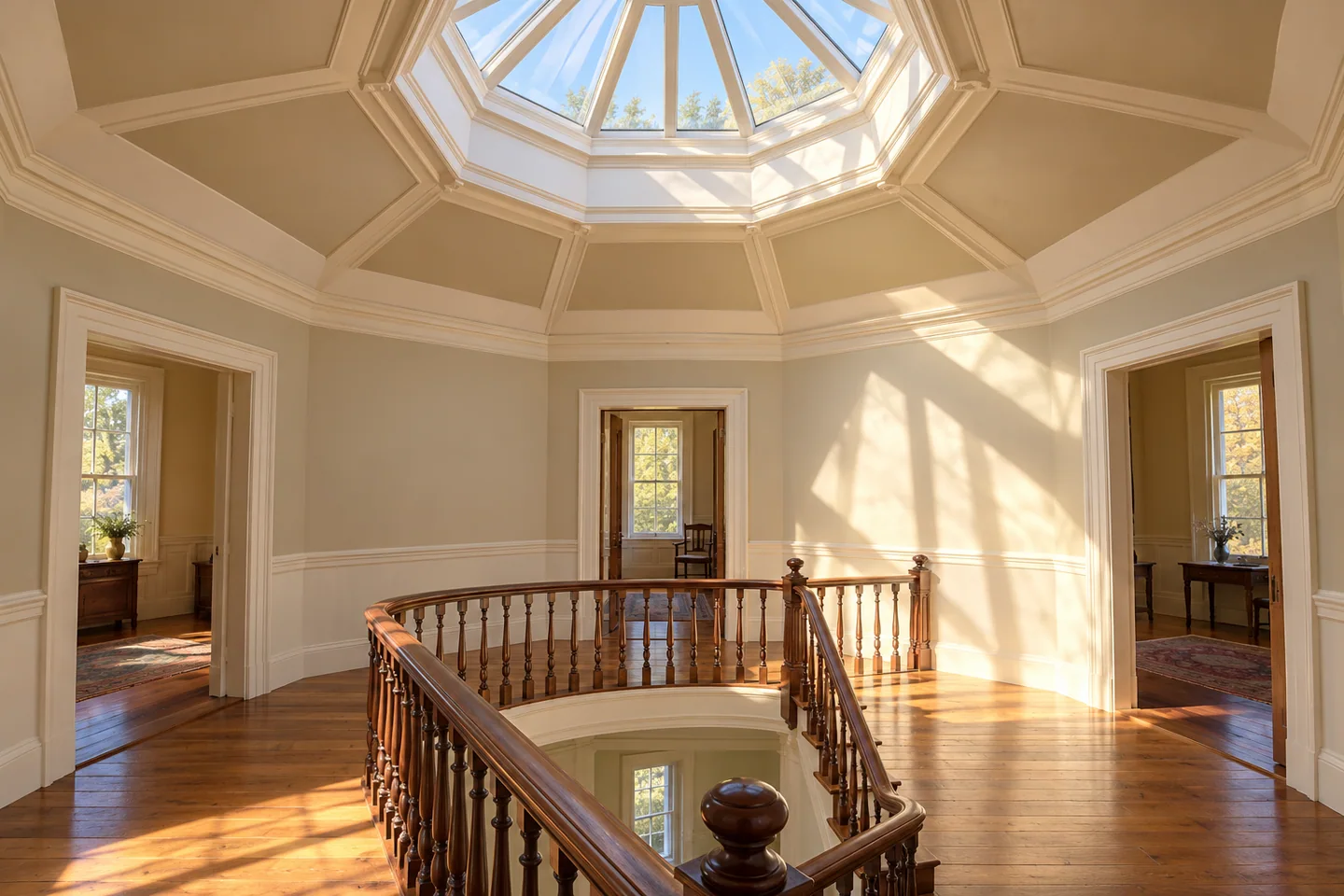
The 1858 house is also known as the Hiram Ramsdell House. Bobbie Hanstein’s original reporting explains the influence of Orson Squire Fowler’s enthusiasm for octagonal homes and describes a glass cupola sending light down the central stairwell. Downstairs rooms connect in a circular arrangement; upstairs, conventional room shapes leave extra corners concealed in closets. That combination makes the interior more interesting than a quick exterior glance might suggest.
Hanstein’s account also follows the Mallett family’s long connection with the house. Wilbert G. Mallett bought it in 1912, beginning a century of family care before the historical society’s acquisition. The report’s view of parlors, music room and later enclosed porch helps explain why the property attracted preservation interest. The building carries both a distinctive nineteenth-century idea and the adjustments of people who actually lived there.
In Hanstein’s report, a Mallett family member recalled a Christmas tree illuminated in the cupola. That personal memory adds a domestic dimension to the architectural feature.
The society’s other properties broaden the picture. The Titcomb House, dating to about 1846, is its museum and research base, with photographs, maps, documents and other artifacts. North Church dates to 1873 and survived Farmington’s 1886 fire. Its former sanctuary and community meeting spaces connect architectural preservation with continuing local use. Ask which buildings or programs can be included when arranging your visit.
Preservation here includes much more than looking after walls. In its 2026 newsletter, the society describes receiving more than a hundred bound newspaper volumes, expanding its holdings of Farmington newspapers from 1843 through 2022. Local technical-school students helped produce additional shelving. Storing that expanding collection helps future visitors investigate local people and events.
The same newsletter recounts winter work gatherings at the Titcomb House. Volunteers compiled militia lists, organized maps and articles, polished silver and made small repairs. It also describes pupils visiting the museum with teachers for age-appropriate history work. These details make the institution feel active: a historic house is also a place where information is sorted, questions are asked and different generations learn how to handle the past.
The society describes its house tours as self-guided, with docents available to provide details and answer questions. Plan ahead for seasonal opening arrangements, then let your interests guide your pace. Architecture, family history and the work of preservation offer different starting points for conversation.
Inside the Octagon House, follow the relationship between movement and light. Notice how a doorway changes the view and how the next room relates to the last. At the museum, choose one document or object to consider just as closely. The two exercises complement each other: one asks how people arranged space, the other how a community remembers the lives that filled it.
Fun facts
- The Octagon House dates to 1858.
- North Church survived Farmington’s 1886 fire.
- The society’s newspaper holdings reach from 1843 into the twenty-first century.
Before you go
- Contact the society about seasonal tours and research appointments.
- Ask which of the three properties can be included in your visit.
- Look for the relationship between the cupola and central stairwell.
Capture
- From an agreed visitor position, show how light links the cupola and stairwell. Ask before photographing interiors.
 Corundel Lake
 Hollywood Casino
 William Sewall House
Social
An eight-sided house invites a closer look at familiar domestic space.
The Titcomb Museum adds documents and artifacts to the architectural story.
North Church connects preservation with community use.
Bound newspapers preserve changing details of everyday Farmington.
Volunteer work includes organizing maps and historical records.
Choose a question before exploring the collections.
Follow a sequence of doorways and notice how the view changes.
A thoughtful house visit can connect buildings with the lives they held.
Hashtags