 Cre8Travel
CRE8TRAVEL · MAINE PLACES
Chickawaukie Pond and Johnson Memorial Park
Chickawaukie Pond: Recreation, Water and a Winter Harvest
Discover
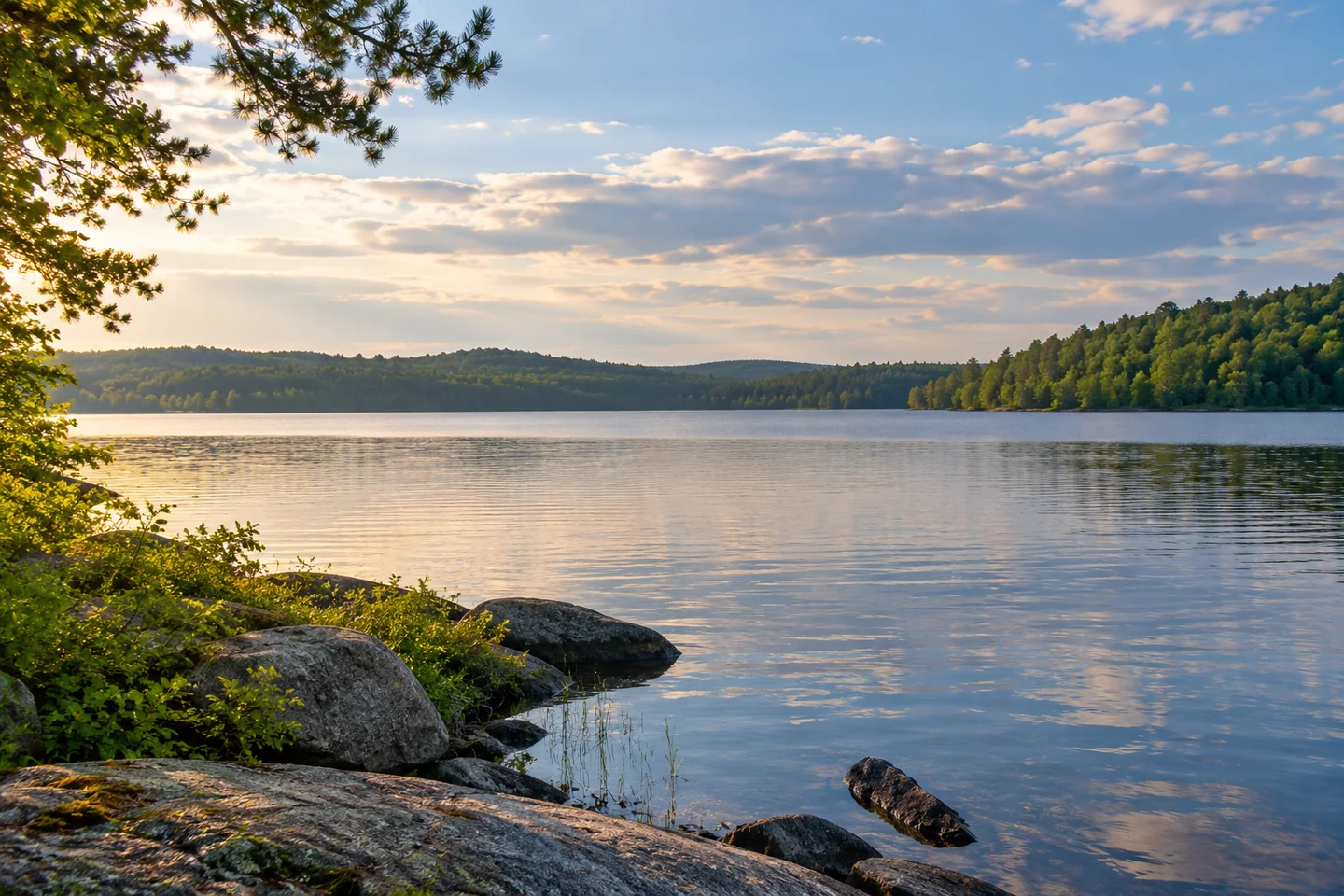
Chickawaukie Pond has a public point of entry at Johnson Memorial Park, on Lake View Drive in Rockland. The city identifies a boat launch, picnic area and swimming area along the shore. Start with the purpose that suits your party: sitting beside the water, launching a boat, or considering a swim after checking current conditions. Those choices share a location but need different preparation. Keep the launch clear while assembling equipment and give other users room to pass. The park offers a practical way to encounter the pond without treating the rest of its shoreline as public land.
A July 2022 report prepared by Robert Kennedy for the Rockport Conservation Commission describes the lake as a relatively shallow water body shared by Rockland and Rockport. Its watershed includes Maces Pond to the north, and the lake has also served as an auxiliary water supply. Water-quality concerns did not begin with a single modern advisory: the report traces worries about clarity and summer algal blooms back decades. It explains how excessive nutrients, especially phosphorus carried from the surrounding land, can impair a lake. That longer record rewards a different kind of attention from simply admiring a clear surface. A pleasant view and a satisfactory swimming test answer different questions.
William H. Bunting's historical photograph commentary, reproduced in Fishermen's Voice, connects the pond with a working landscape of farms, fishing vessels and icehouses. Ice helped preserve milk, cream and butter from the nearby agricultural district, while commercial operators supplied other customers. Bunting describes the expansion of the trade and its eventual disappearance, with commercial harvesting continuing into the 1950s. This was a resource people cut, lifted, stored and transported long before household refrigeration became commonplace. Looking across the pond, imagine the work involved in moving a heavy, perishable harvest toward its users. The historical account describes old winter labor; it offers no assessment of whether today's ice can carry a person.
The writer Tilar J. Mazzeo supplies another connection between water and memory. In an essay about researching the Pattens' Maine, she recalls moving as a child to a farmhouse near the lake's northern end and knowing the outlet area because it was close to the public beach. Her local familiarity became part of the process of investigating an earlier family's story. The personal recollection is useful without turning her childhood surroundings into a public walking route. It suggests that a destination can hold several overlapping maps: a child's familiar places, a historian's questions and the access points available to a visitor now.
For your own record, make one image that establishes the relationship between shore and water, then write a caption that separates what you observed from what you learned in a historical source. If you notice a feature whose purpose is uncertain, leave that uncertainty visible in the caption. A question can be more useful than an invented explanation, particularly when returning to a place whose past uses differed so much from your own. Bring that question to a later reading session.
Fun facts
- Natural ice from the pond once served dairy products, fishing businesses and other customers.
- The lake’s watershed includes Maces Pond to the north.
Before you go
- Check the city’s latest swimming guidance separately from the general park listing.
- Use the designated public access at Johnson Memorial Park.
Visitor perspectives
- Tilar J. Mazzeo recalls childhood familiarity with the lake’s outlet near the public beach while describing research into the Patten family’s Maine. It is a personal historical essay, not a current access guide.
Capture
- Caption one shoreline photograph with separate observations and historical notes; preserve any uncertainty about a feature’s purpose.
 Knickerbocker Lake
 Stevens Pond
 Lower Patten Pond
Social
Johnson Memorial Park provides a public boat launch and recreation area beside Chickawaukie Pond.
Check current swimming guidance before choosing water contact.
This pond’s history includes commercial ice harvesting.
Ice once helped preserve dairy products and support coastal businesses.
The surrounding watershed matters as much as the view across open water.
Maces Pond forms part of the lake’s watershed.
A writer’s childhood memory adds a personal layer to the lake’s history.
Try a caption that distinguishes your observation from a fact you learned later. #Cre8Travel
Hashtags