 Cre8Travel
CRE8TRAVEL · NEW YORK PLACES
Stone Hill State Forest
Stone Hill: Hemlock Swamps and the Story of Former Farm Ground
Discover
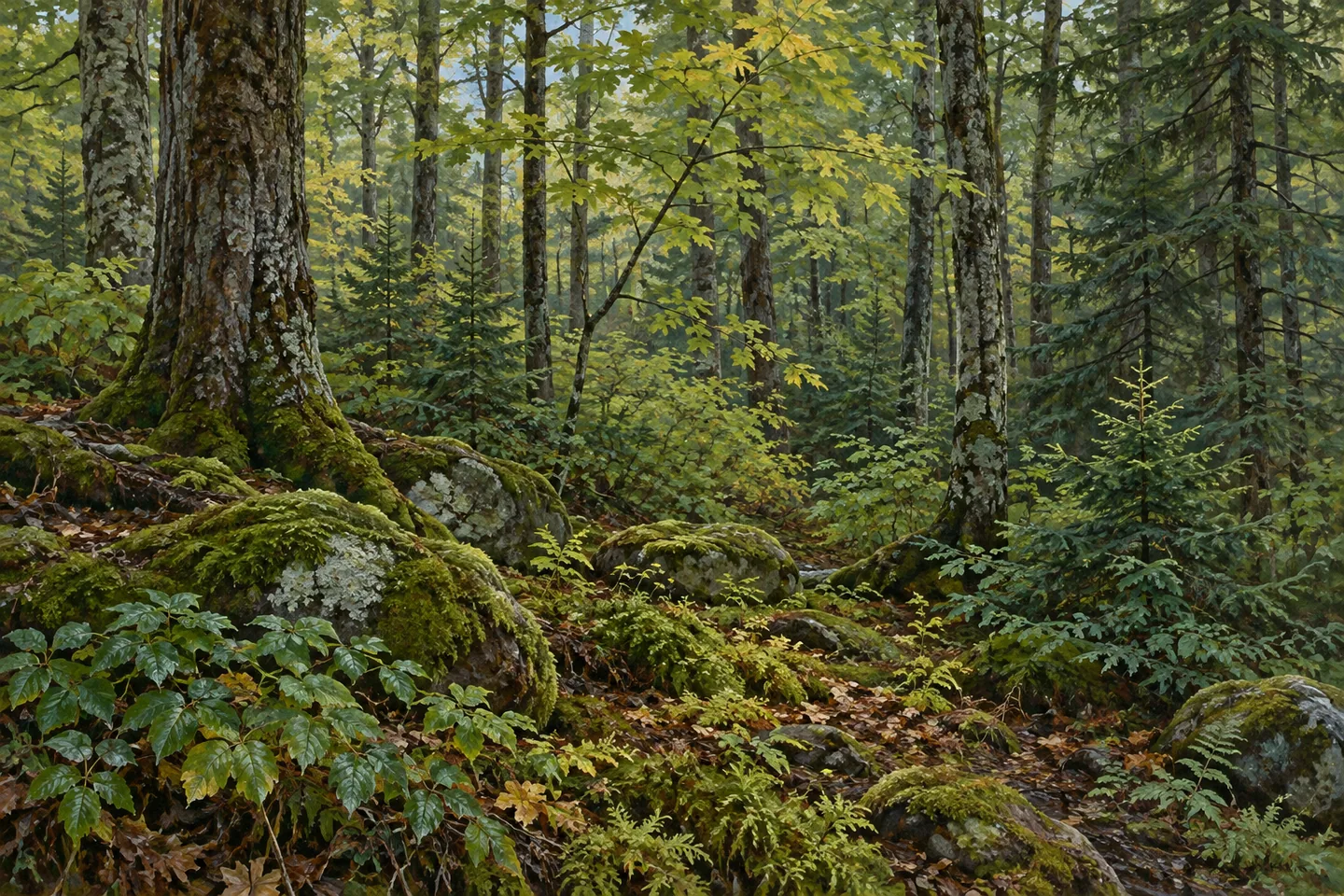
Stone Hill State Forest occupies 1,025 acres in Amboy, Oswego County. Its name might suggest that rocky uplands tell the whole story, but much of the property is wetland, including hemlock swamps. Mature hardwoods, hemlock and small conifer plantations create a varied woodland setting. A half-mile hiking trail off Stone Hill Road supplies a defined walking feature within a forest whose wider interest comes from the relationship between ground conditions, earlier farming and later tree cover.
The wetland character deserves attention before planning a route. DEC describes the majority of the forest as wet ground, with hemlock swamps among its habitats. That is a landscape description, rather than a statement that every path is submerged or that every part can be crossed. It gives a reason to observe changes in vegetation from suitable access. A short walk can be interesting because of the setting around it, without requiring an excursion into the wettest areas.
The woodland includes mature northern hardwood and hardwood-hemlock cover. Red maple, black cherry, sugar maple, beech, yellow birch, red oak and hemlock are among the species described by DEC. They contribute different forms of canopy and understory, rather than one uniform stand. Where differences are visible, compare the woodland's structure without turning a tree list into a requirement to locate every species. The character of a mixed forest can be appreciated before every trunk has a name.
Small plantations of pine, larch and spruce add another layer. The forest's history places them in a landscape formerly made up of farmland, fields, meadows, woodland and homesteads. The state acquired land here for reforestation in the 1930s. That period explains the beginning of public ownership and a change in land use; it does not establish the planting year of each surviving tree. Natural woodland and plantations now belong to the same public property while retaining different origins.
The Tug Hill setting helps explain that earlier change. Rocky, acidic soils and demanding winters made farming difficult in the area. Read that as context for the transition from agricultural ground to managed forest, rather than as a complete history of every household. The present trees are the most visible part of the place, but their setting makes more sense when the former uses of the land are kept in view.
For an outing, distinguish the half-mile hiking trail from the winter corridor along the forest's eastern edge. That separate route uses an abandoned town road for roughly a mile as part of the snowmobile network. The two descriptions do not establish one combined loop. Use the current official map to select the intended route and return travel from Stone Hill Road, instead of joining features together simply because they occur within the same named forest.
Stone Hill rewards a modest, attentive approach. Its particular combination is a short walking feature within a much larger wetland-rich forest, mature hardwood and hemlock cover beside plantations, and a public land history rooted in reforestation. Notice those relationships from appropriate ground and let the actual route determine the day's scale. There is enough substance in the contrast between wet ground and tree cover without seeking a dramatic summit or an invented landmark.
Fun facts
- Stone Hill State Forest covers 1,025 acres in Amboy, Oswego County.
- Much of the property is wetland, including areas described as hemlock swamps.
- A half-mile hiking trail begins off Stone Hill Road.
- A separate roughly one-mile winter corridor uses an abandoned town road along the eastern side.
Before you go
- Use the current official map to distinguish the short hiking trail from the separate winter corridor.
- Observe wetland transitions from suitable ground rather than attempting to cross sensitive vegetation.
- Treat the 1930s acquisition history separately from the age of any individual tree or plantation.
Capture
- Use visible transitions between hemlock, hardwoods and damp vegetation as a composition subject.
- Compare stand structure without labeling a particular tree as an original planting.
- Use soft or overcast light to retain the textures of leaves, hemlock branches and low vegetation from the chosen route.
 Beaver Creek State Forest
 Forsyth Nature Center
 Mexico Point Park
Social
Stone Hill State Forest covers 1,025 acres in Amboy, Oswego County. #Cre8Travel
Much of this forest is wetland, with hemlock swamps among its habitats.
Mature hardwoods and hemlock share the landscape with small conifer plantations.
The state acquired land here for reforestation in the 1930s.
Former fields, woodland and homesteads belong to the area’s earlier land-use story.
A half-mile trail off Stone Hill Road provides a defined walking feature.
A separate winter corridor follows an abandoned town road along the eastern edge.
Choose a route with the current map and notice the relationship between wet ground and tree cover. A short walk can carry a larger landscape story.
Hashtags