 Cre8Travel
CRE8TRAVEL · NEW YORK PLACES
Baker School House State Forest
Baker School House State Forest: A Trail through Former Farm Ground
Discover
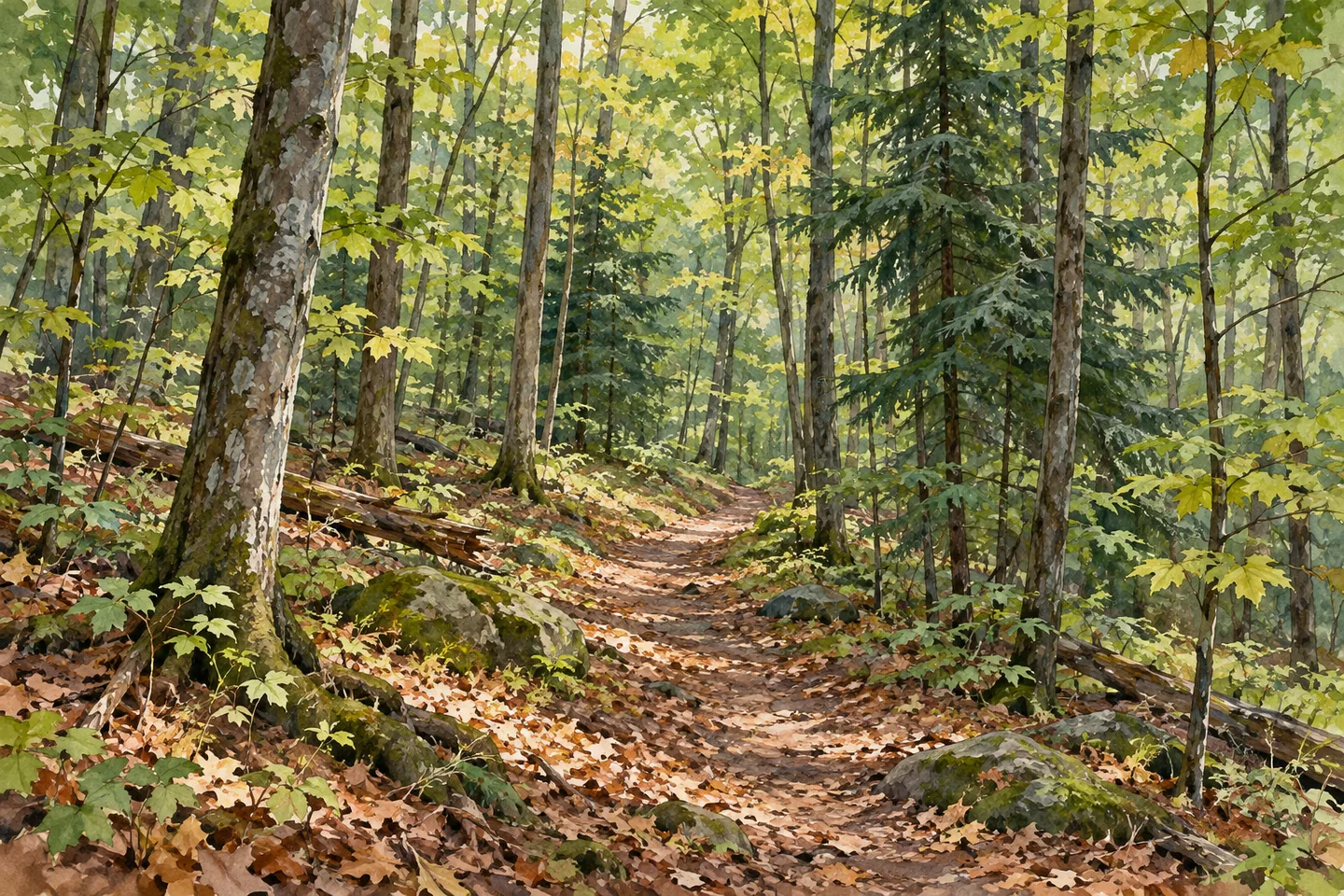
Baker School House State Forest offers a named long-distance trail within a landscape that once had a very different use. The 1,277-acre property lies in Freetown and Solon, Cortland County. A two-mile section of the Finger Lakes Trail crosses the central forest, giving walkers a practical focus among varied tree cover. It is a woodland visit with a clear route option and a history rooted in nineteenth-century farming.
Most of the land was used for agriculture during the 1800s. DEC describes the upland soils of the Allegheny Plateau as thin, acidic and often steep, with harsh winters and a short growing season adding to the difficulties. Farming declined and the state acquired land in the 1930s for reforestation. Reading that history alongside the present trees shifts the emphasis from an imagined untouched landscape to a place shaped by successive human uses.
The cover includes northern hardwoods, European and Japanese larch, Norway spruce, red pine and white cedar. That is a varied list to notice during a walk, without requiring every species to appear beside a single trail section. Compare trunk forms and foliage textures as you encounter them. The source identifies the cover types, but it does not assign a 1930s planting date to every individual larch or guarantee a particular autumn display.
The Finger Lakes Trail runs through the central portion. A separate 1.8-mile public forest access road provides an approach into the northern section, and hiking is allowed elsewhere unless posted otherwise. These are two different route references, not automatically a combined loop. Use the current map to plan a turnaround, identify boundaries and choose ground appropriate to your skills and the conditions.
The forest has no other designated hiking trails beyond the described Finger Lakes Trail section. That distinction is useful if extending a walk away from the named route: an unmarked woodland outing requires different preparation from a signed circuit. DEC recommends its outdoor-safety practices and suggests considering a guide if woodland experience is limited. The existence of an access road does not by itself establish a universally accessible trail surface.
Wild turkey, white-tailed deer and songbirds appear in the agency's wildlife description. The mix of cover types provides habitat context, but sightings depend on what is actually present during your visit. For a photograph, the woodland structure can hold the composition even when no animal appears. Pair a wider view along your route with a closer tree detail, leaving vegetation undisturbed.
Primitive camping is allowed with 150-foot setbacks from roads, trails and water. A Forest Ranger permit is required for stays longer than three nights or groups of ten or more. Review current guidance before an overnight visit and distinguish informal camping from a serviced campground. Follow Leave No Trace to minimize your impact on the woodland.
The approach uses Route 41 and Baker School House Road, with limited shoulder parking noted by DEC. Check current access before departure and avoid blocking the road. Taylor Valley State Forest is listed nearby, while Cortland is identified for amenities. Baker School House itself offers enough for a focused outing: a trail section, varied trees and the story of former farm ground becoming public woodland.
Fun facts
- The forest covers 1,277 acres in Freetown and Solon.
- A two-mile Finger Lakes Trail section crosses its central portion.
- A 1.8-mile public forest access road approaches the northern section.
- Cover types include European and Japanese larch, Norway spruce, red pine and white cedar.
- Former agricultural land was acquired for reforestation in the 1930s.
Before you go
- Use the current map to distinguish the central trail from the northern access road.
- Plan any unmarked extension according to your navigation skills and current conditions.
- Account for limited roadside shoulder parking when choosing an approach.
- Review camping setbacks and ranger-permit requirements before staying overnight.
- Follow Leave No Trace and DEC outdoor-safety guidance.
Capture
- Use the Finger Lakes Trail as a leading line where encountered through appropriate access.
- Compare the forms of documented larch, pine, spruce or cedar without assigning individual tree ages.
- Pair a wider woodland frame with a close bark or foliage study, leaving plants undisturbed.
 Stockport Wildlife Management Area
 Hoxie Gorge State Forest
 Downerville State Forest
Social
Baker School House State Forest covers 1,277 acres in Freetown and Solon, Cortland County. Former farmland is part of its woodland history. #Cre8Travel
Two miles of the Finger Lakes Trail cross the central part of Baker School House State Forest. Use the current map to choose your walk. #Cre8Travel
A 1.8-mile public forest access road approaches Baker School House’s northern section. It is separate from the named central trail reference. #Cre8Travel
European and Japanese larch, Norway spruce, red pine and white cedar appear among Baker School House’s documented cover types. #Cre8Travel
Thin, acidic upland soils and a short growing season contributed to the farming difficulties described in Baker School House’s history. #Cre8Travel
The state acquired former agricultural land at Baker School House for reforestation in the 1930s. Today’s trees carry several chapters of land use. #Cre8Travel
Beyond its Finger Lakes Trail section, Baker School House has no other designated hiking trails. Plan unmarked woodland exploration carefully. #Cre8Travel
At Baker School House, compare a wider trail scene with one small tree detail. Which tells more of the woodland story? #Cre8Travel
Hashtags