 Cre8Travel
CRE8TRAVEL · MAINE PLACES
True Farm Living Forest
True Farm Living Forest: Learning to Read the Trees
Discover
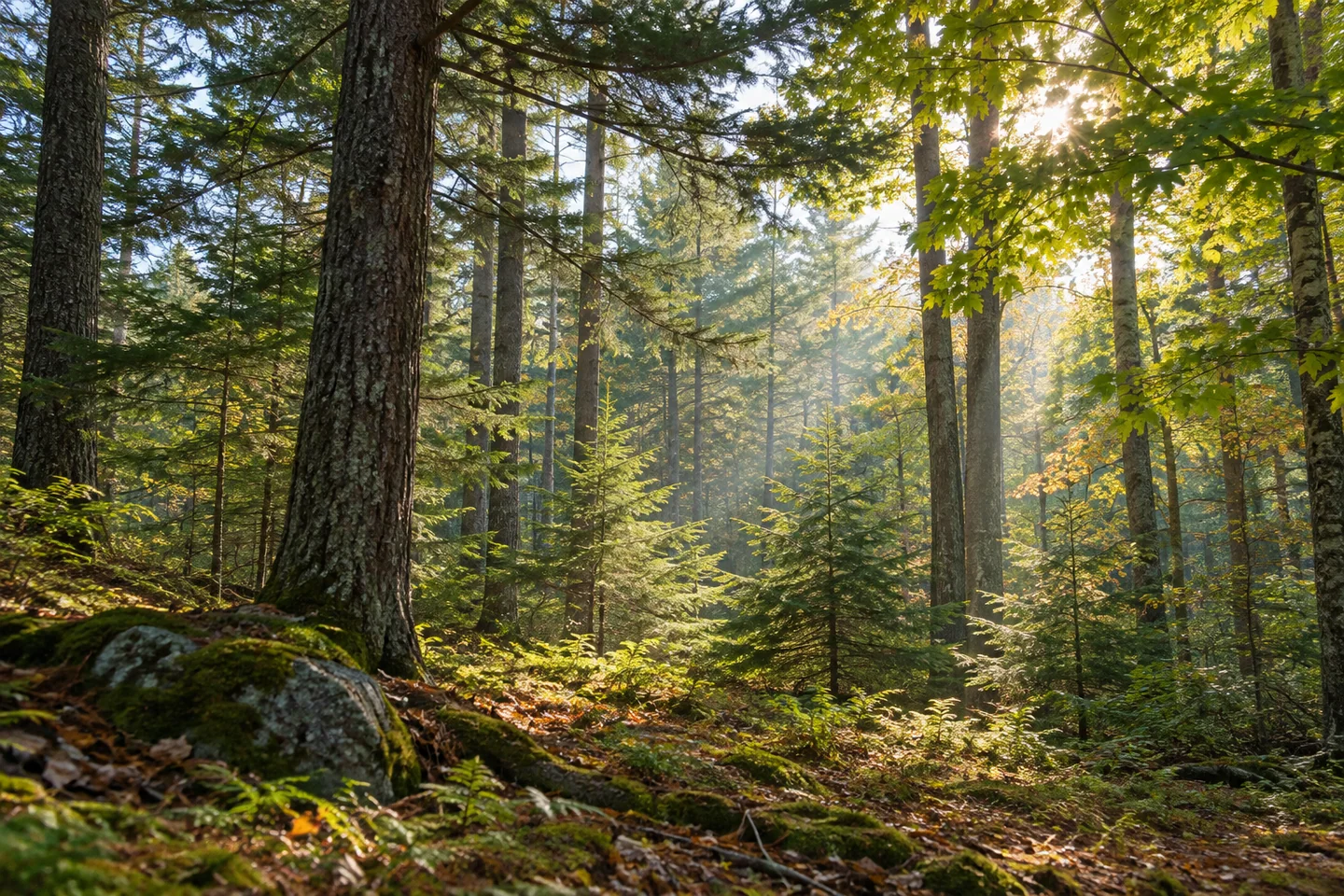
True Farm Living Forest in Mechanic Falls is a place to look at trees as individuals and as a changing stand. The New England Forestry Foundation publishes a recreation map for the property, giving a woodland visit a practical starting point. Come with an interest in how a forest is tended rather than expecting a staffed demonstration or a continuous scenic overlook. A walk here can become an exercise in noticing relationships: which crowns have space, where light reaches the ground, and how the next generation of trees fits beneath the present one.
NEFF's conservation report describes management of the forest since 1971, predominantly white pine with smaller amounts of hardwood. The report also records an adjoining purchase in 2019. That long view is useful for a visitor. A forest does not become legible only at the moment of a harvest, and conservation does not freeze every tree into one unchanging arrangement. Think about the different time scales in the scene: a day's walk, a season of growth, and decisions whose results might become clearest years after the people making them have moved on.
A specific example appears in David Ayers's December 2025 account for NEFF. During a September site visit, he met a Maine Conservation Corps crew undertaking timber stand improvement. Their work included identifying promising trees, pruning, and reducing nearby competition. He described a coordinated team moving through the stand and light reaching ground that had previously been shaded. This was a working visit by the land manager's own staff, not an independent leisure review. Its value is in explaining the process behind changes a walker might otherwise overlook.
You need not find that same work area to borrow the question it raises. From the route, compare two neighboring crowns and consider where their branches meet. Look at the ground beneath a denser patch, then at a place where more light falls. These are suggested observations, not a claim that a particular treatment or species can be identified without expertise. The point is to give the walk a subject. An ordinary grouping of trees can hold more interest when you begin asking what room, light, and time mean for its future.
For navigation, use the property's recreation map rather than approaching from any road that happens to touch the green outline. The published map marks a trailhead and property sign near Edwards Road, trails within NEFF land, streams, and wetlands. It also explicitly identifies neighboring private property without forest access. Those boundaries matter as much as the trail lines. Match the map to the sign on the ground, choose a route within the property, and keep vehicle access unobstructed. A short return along the same known path is a perfectly reasonable way to visit.
Photograph the woodland at the scale you have been studying: a trunk with its surrounding space, or overlapping crowns against the sky. Leave enough context to show how one tree belongs to a stand, and avoid placing equipment where someone else needs to pass. Follow any posted diversion and give forestry work a wide berth if encountered. True Farm's distinctive reward is an informed second look at a familiar landscape. The trees become evidence of choices, growth, and care rather than simply a green background to a walk.
Fun facts
- A 2025 staff account documents timber stand improvement at True Farm.
- The recreation map marks neighboring private areas that do not provide forest access.
Before you go
- Use the property-specific recreation map and match it to the on-site sign near Edwards Road.
- Respect the mapped private boundaries and keep vehicle access unobstructed.
- Give any forestry operation a wide berth and follow posted diversions.
Capture
- Frame a tree together with its surrounding space to show its relationship with the stand.
- Use overlapping crowns as a subject from the route; keep equipment out of the walking line.
 Burnt Meadow Pond
 Packard-Littlefield Farm
 Twitchell Pond
Social
True Farm Living Forest invites a closer look at how a woodland is tended.
A short walk can have a subject: space, light, and the next generation of trees.
NEFF’s 2025 staff account describes a crew pruning and reducing competition around selected trees.
A working forest records choices that may take years to show their full effects.
Use the forest’s own map, including its marked private boundaries.
The property map identifies the trailhead near Edwards Road.
A photograph of one tree can still tell a story about the surrounding stand.
What would you notice first on this walk: the crowns, the light, or the young trees below?
Hashtags