 Cre8Travel
CRE8TRAVEL · MAINE PLACES
Little Red Schoolhouse, Farmington
Farmington’s Little Red Schoolhouse: Lessons and Survival
Discover
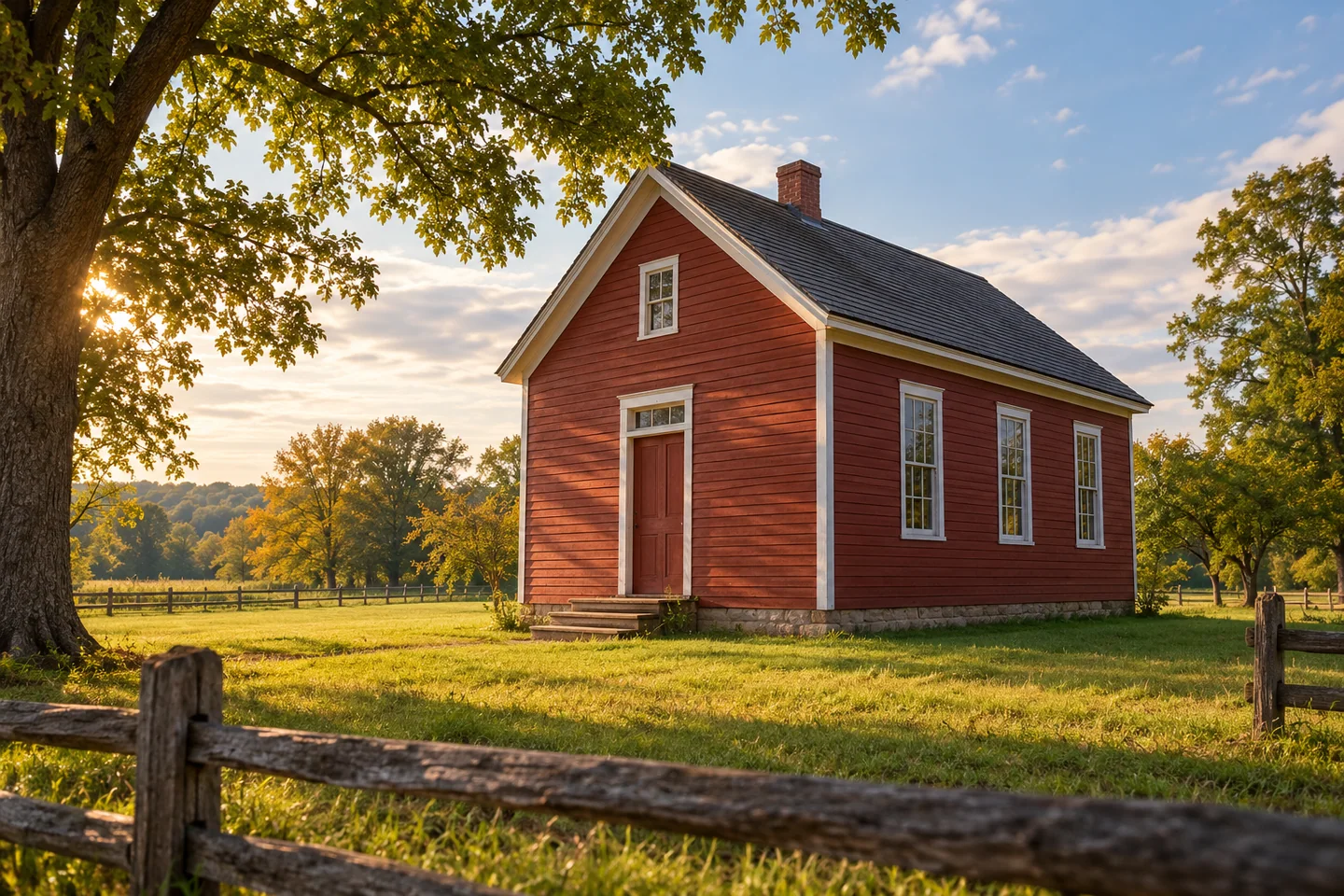
Farmington's Little Red Schoolhouse brings a classroom into the setting of an agricultural fair. The building now stands at the High Street fairgrounds, where the official grounds map identifies it as the Red School House. Its story connects rural education, teacher preparation and the practical effort needed to save a small wooden building. Make the schoolhouse the focus of a planned museum stop, confirming when it will be available rather than assuming that every fairground building opens whenever the grounds are in use.
The school began in 1852 as the Briggs district school. Its National Register documentation describes an unusually arched classroom ceiling and traces the marks of older furnishings in the interior woodwork. Such evidence offers a good question for a guide: how can a building reveal the arrangement of a classroom after furniture has changed? Look for interpretation that explains the room, and distinguish what can actually be seen during the visit from details recorded in an older survey.
The school also belongs to the history of learning to teach. The nomination describes its involvement in rural model-school education associated with Farmington's teacher-training institution. That makes the room a setting for more than pupils' lessons. It was part of an effort to think about how those lessons should be taught. A small rural classroom can therefore be connected with wider educational ideas, while still retaining the scale of a place used by local children.
Farmington Historical Society's education exhibit places the building within the decline of the town's rural schools. It records ordinary classes ending in 1958, followed by a later period serving children with special educational needs before that use ended in 1969. The museum subsequently helped visitors understand earlier classroom life, sometimes with retired teachers returning to interpret it. This sequence is more interesting than imagining the room frozen at one date. The building's different uses reveal changing approaches to education and to remembering it.
Saving the structure required another change: a new location. Bobbie Hanstein's 2016 Daily Bulldog report explains that keeping it on its former leased site had become difficult. Ronald Pratt helped secure a future at the fairgrounds, supported by the agricultural society and people attached to the school. The report includes volunteer director Susan McCleery Small's memories of attending as a child and her affection for her teacher. Her account gives the preservation effort a personal foundation, beyond the wish to keep an old building standing.
The fair's current map confirms the schoolhouse within the present grounds. Contact the organizer about museum access for the intended visit, especially outside the fair itself. Bring any classroom-history question before concentrating on the camera. If photography is allowed, a wide interior view can show how one shared room organized activity, while an explained detail can record something learned there. Avoid disturbing displayed objects to improve a picture.
The schoolhouse rewards attention to both education and survival. Its older classroom, later teaching roles and relocation all belong to the same building's story. A visit can ask how much must change for a historic place to remain available, and what people choose to preserve when they make that change. That question gives this small fairground museum a significance that extends beyond a nostalgic view of schooldays.
Fun facts
- The schoolhouse dates to 1852.
- It now stands at Farmington’s High Street fairgrounds.
- Its historical documentation describes an arched classroom ceiling.
Before you go
- Use the present fairground location rather than the former Wilton Road site.
- Confirm the schoolhouse museum’s opening separately.
- Ask about the building’s role in teacher preparation.
- Leave displayed objects undisturbed.
Capture
- If permitted, show how the classroom is organized before isolating a detail.
- Photograph the building from an authorized position within the fairgrounds.
 Madrid Village Schoolhouse
 Together Place Mural at Shaw’s, Bangor
 Pemaquid Pond
Social
Farmington’s Little Red Schoolhouse connects rural education with a story of preservation.
The building is identified on the current fairground map.
An arched ceiling distinguishes the historical classroom description.
The room belonged to the history of teacher preparation as well as children’s lessons.
Former pupils helped give preservation a personal meaning.
Confirm museum access rather than assume an open fairground means an open classroom.
Record the explanation behind a detail, as well as its appearance.
What changes allow an old schoolhouse to keep teaching visitors?
Hashtags