 Cre8Travel
CRE8TRAVEL · MAINE PLACES
Horn Pond
Horn Pond: At the Beginning of the Salmon Falls River
Discover
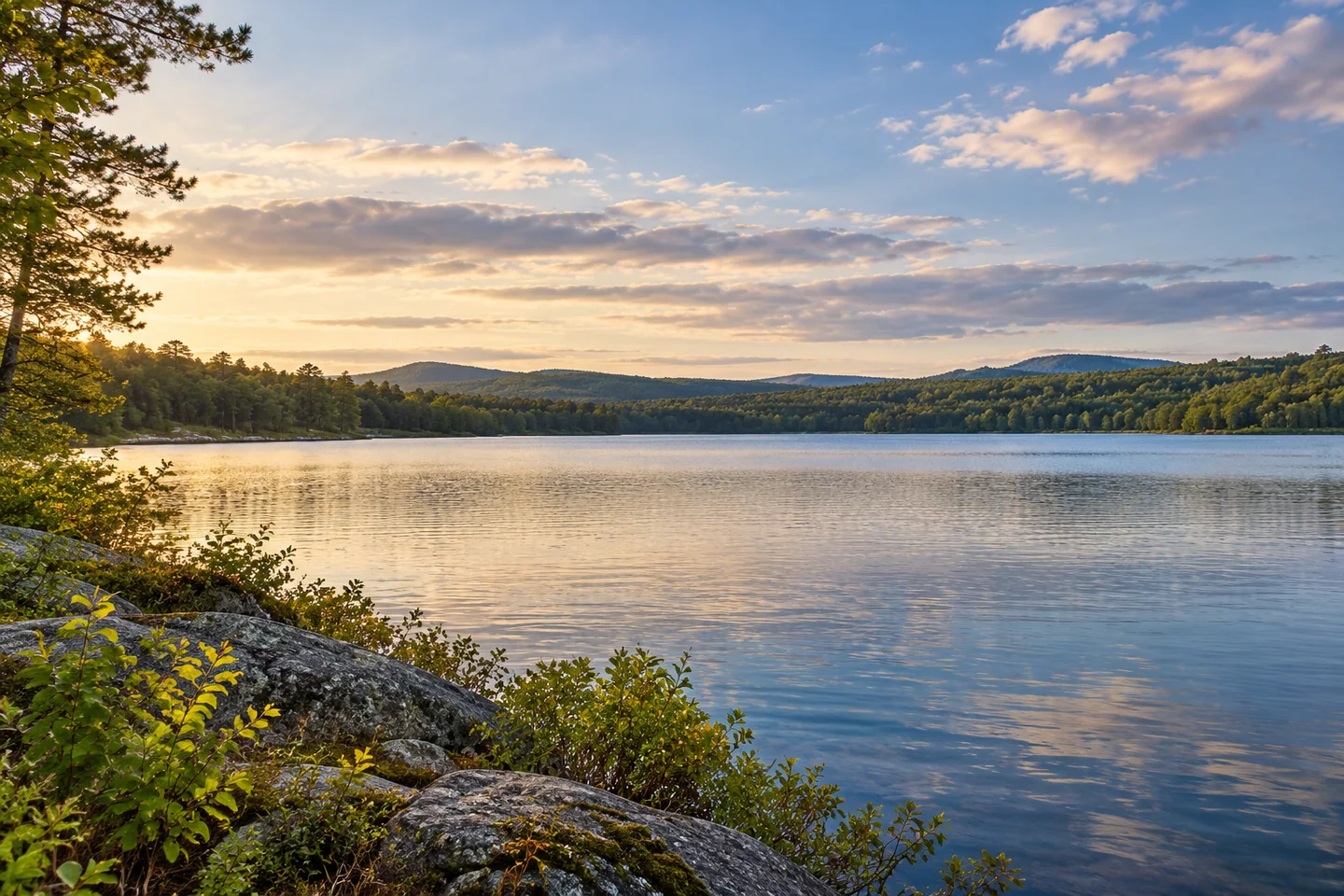
Horn Pond in Acton, Maine, and Wakefield, New Hampshire, sits where a lake outing can also become a lesson in connected waters. Match both town names when planning: the better-known Horn Pond in Woburn, Massachusetts, is a different destination. Here, the association identifies the boat launch on Maine Route 109 near Lovell Lake Road. Begin with that established access, then decide how much time belongs on the water and how much belongs to looking carefully at the setting around the outlet.
The pond receives springs and water from Great East Lake and Wilson Lake. Its outlet feeds the Salmon Falls River, whose waters eventually reach the Piscataqua River and the Gulf of Maine. Seen that way, this is more than an isolated surface enclosed by a shoreline. A quiet pause can carry the thought of water arriving from neighboring lakes and continuing toward the coast. You need not trace those connections by boat to appreciate the larger geography they create.
There is an industrial story behind some of those connections. The local association describes the Newichawannock Canal as a nineteenth-century project carrying water from Great East Lake toward Horn Pond to support textile mills downstream. This background adds another layer to the landscape: water has been valued for power and controlled movement as well as for recreation. Treat the canal as historical context, rather than assuming that a connected line on a map establishes a safe or permitted paddling passage through dams and engineered channels.
A January 2013 Acton Wakefield Watersheds Alliance tour places the Horn Pond dam at the beginning of the Salmon Falls River and associates its surroundings with a nineteenth-century mill site. The writer's winter journey is a useful historical account, not a current facility inspection. From authorized public ground, consider the meeting of pond, outlet, and human engineering without approaching moving water or climbing structures. A view can explain something about a place without requiring access to every part of it.
The older state fisheries description introduces a less visible dimension. Revised in 1999, it describes a mixed cold-water and warm-water fishery, with limited summer cold-water habitat and oxygen conditions affecting management. That historical snapshot is not a present-day water-quality assessment. It does, however, suggest why a pond cannot be understood from its surface alone. For an angler, preparation includes checking current rules and conditions rather than converting an old species list into a promise about today's catch.
For boating, the association emphasizes staying between the navigational markers at the shallow launch approach and being considerate about wakes, swimmers, and wildlife. Inspect the approach before committing to it, and do not improvise around a missing or unclear marker. Once afloat, choose an outing with a comfortable return and enough room to share the water. For photographs, try one broad frame that gives the pond breathing room, then a closer study of water movement from a safe, lawful position. Horn Pond's interest lies in the relationship between scales: a manageable outing, neighboring lakes, a history of water power, and a river beginning its longer journey.
Fun facts
- Horn Pond straddles Acton, Maine, and Wakefield, New Hampshire.
- Its outlet feeds the Salmon Falls River.
- The Newichawannock Canal historically conveyed water from Great East Lake toward Horn Pond.
Before you go
- Use the established Route 109 launch and inspect the marked shallow approach before entering.
- Keep clear of dams and engineered channels; water connections do not establish navigable routes.
- Check current activity rules and leave room for swimmers, other craft, and wildlife.
Capture
- Use a broad composition from a lawful location to show the pond rather than private camps.
- Photograph water movement only from safe ground or a stable craft, keeping clear of outlet structures.
 Little Pennesseewassee Pond
 Province Lake
 Milton Three Ponds
Social
Horn Pond belongs to Acton, Maine, and Wakefield, New Hampshire.
Water arrives from neighboring lakes and continues toward the Salmon Falls River.
A lake view here can also be the beginning of a watershed story.
Nineteenth-century water-power connections add history to the landscape.
Use the established Route 109 access and inspect the marked approach.
An old fisheries survey offers context, while current conditions guide the outing.
You do not need to paddle every connection to appreciate where the water goes.
What would draw your attention first: the pond, the outlet, or the history of water power?
Hashtags