 Cre8Travel
CRE8TRAVEL · MAINE PLACES
Heart of Poland Conservation Area
Heart of Poland: Find the Details in a Local Woodland
Discover
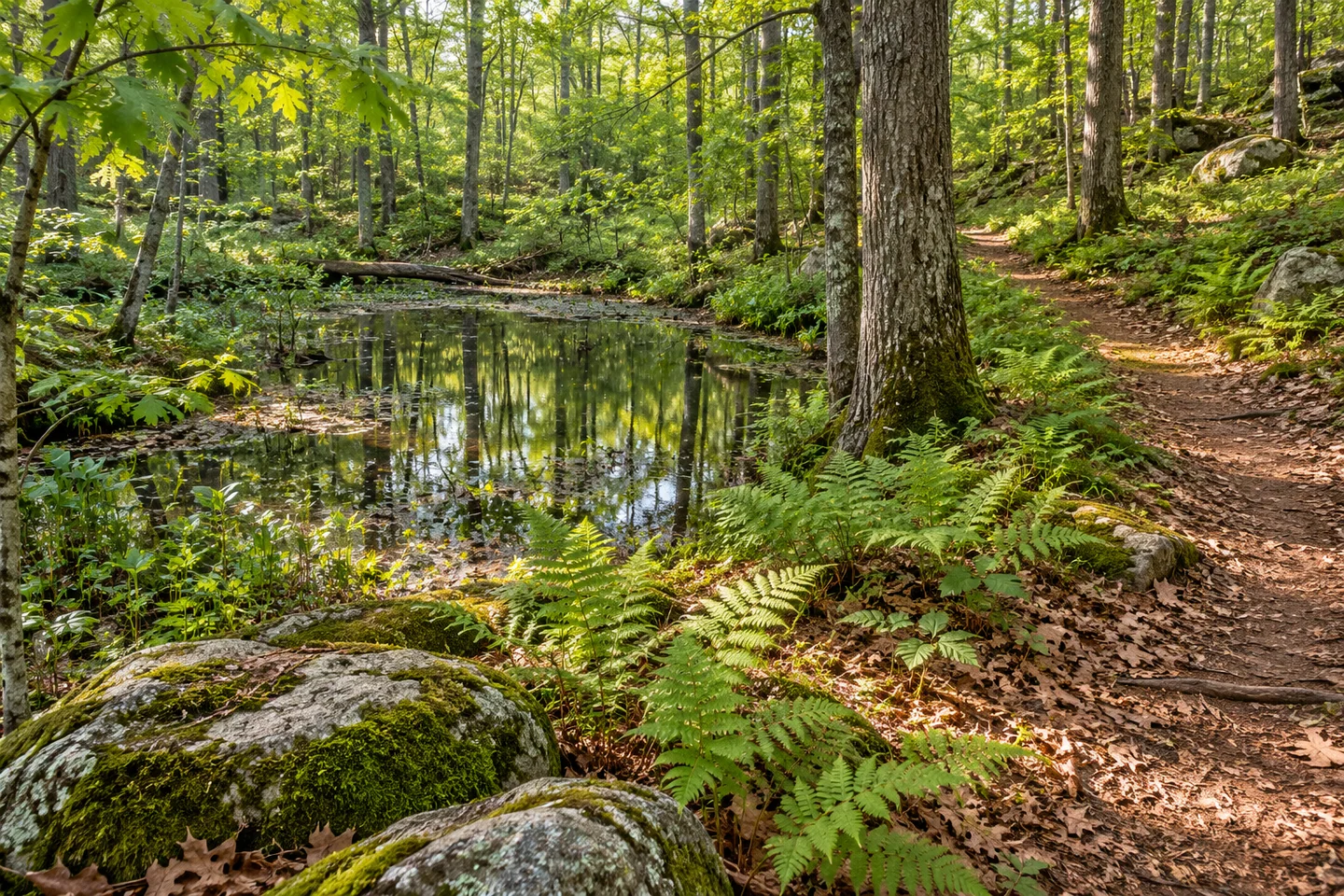
Heart of Poland Conservation Area brings a small network of woodland trails close to the center of town. Its paths connect the Ricker Memorial Library side with Tripp Lake Road, combining a useful local walking route with several reasons to stop and look more closely. Begin at a designated entrance, read the map, and choose a circuit that leaves time for the features along it. The attraction is the variety within the woods: rock, water, trees, and signs of earlier work.
The network grew through a deliberate community effort. Poland's Trail Committee formed in 2012 with the goal of connecting town properties by a hiking path. A later purchase of the Furman lot helped complete Huntress Trail, and additional Hilt Hollow parcels enabled the White Oak and Cave trails to join the system. That history explains why the paths feel like a connected neighborhood resource. They are the product of several land decisions and volunteer work brought together for public walking.
Goldfine's original Maine by Foot account finds the conservation area pleasant, while making clear that its hills can produce some immediate exertion. The writer appreciates a well-marked network and the opportunity to include the quarry spur. That is a useful balance for planning: proximity to a library and town center does not make every section flat. Choose the distance and climbing that suit the group, then give yourself permission to take the hills slowly enough to notice what changes around them.
Maine Trail Finder's operator-submitted guide points toward several distinct features within the same outing. Huntress Trail passes a vernal pool, while Cave Trail leads to a small geological feature and dike formation. White Oak Trail introduces a stand of its namesake trees, and a quarry spur adds another kind of rock landscape. These destinations help give a walk some shape, but they are parts of one conservation area rather than separate excursions to collect. Use the map to decide which combination makes a satisfying route.
The town brochure identifies the quarry as a trace of stone working from the early twentieth century or earlier. It also describes a brook flowing from a black ash swamp through the conservation area. Water and past industry therefore offer two different ways to read the woodland. Look from the marked paths without collecting material or disturbing the small seasonal pool. The town asks visitors to leave wildlife unfed, keep pets leashed, and carry out waste, simple requirements that help retain the character that makes these features worth finding.
The Maine by Foot account is appealing for the scale of attention it gives this local walk. A hillside, a junction, and a quarry detour are enough to make a distinctive outing without the promise of a grand mountain panorama. Bring that same curiosity to your own circuit. Start behind and to the right of the library if using that entrance, follow the current blazes, and return within the area's dawn-to-dusk access. A short woodland network can feel complete when its smaller landmarks receive the time they deserve.
Before you go
- Leash pets, leave natural material, and visit during daylight.
Visitor perspectives
- Goldfine enjoys the woods but notes hills.
Capture
- Try a quiet composition that gives one small woodland feature room to stand out.
 Puzzle Mountain
 Simard-Payne Memorial Park
 Jacobs Pines
Social
Heart of Poland connects library-side woods with the Tripp Lake Road entrance.
Community land purchases helped turn separate paths into a connected network.
Goldfine enjoys the woods but notes hills that quickly make walkers work.
A vernal pool and small rock features add variety to the circuit.
A former quarry preserves a trace of earlier stone working.
A modest woodland walk can reward close attention to its smaller landmarks.
Choose the route that leaves you time to notice the details.
An interesting walk does not need a distant summit.
Hashtags