 Cre8Travel
CRE8TRAVEL · MAINE PLACES
Ethel H. Blum Gallery
Blum Gallery: Art and Human Ecology in Bar Harbor
Discover
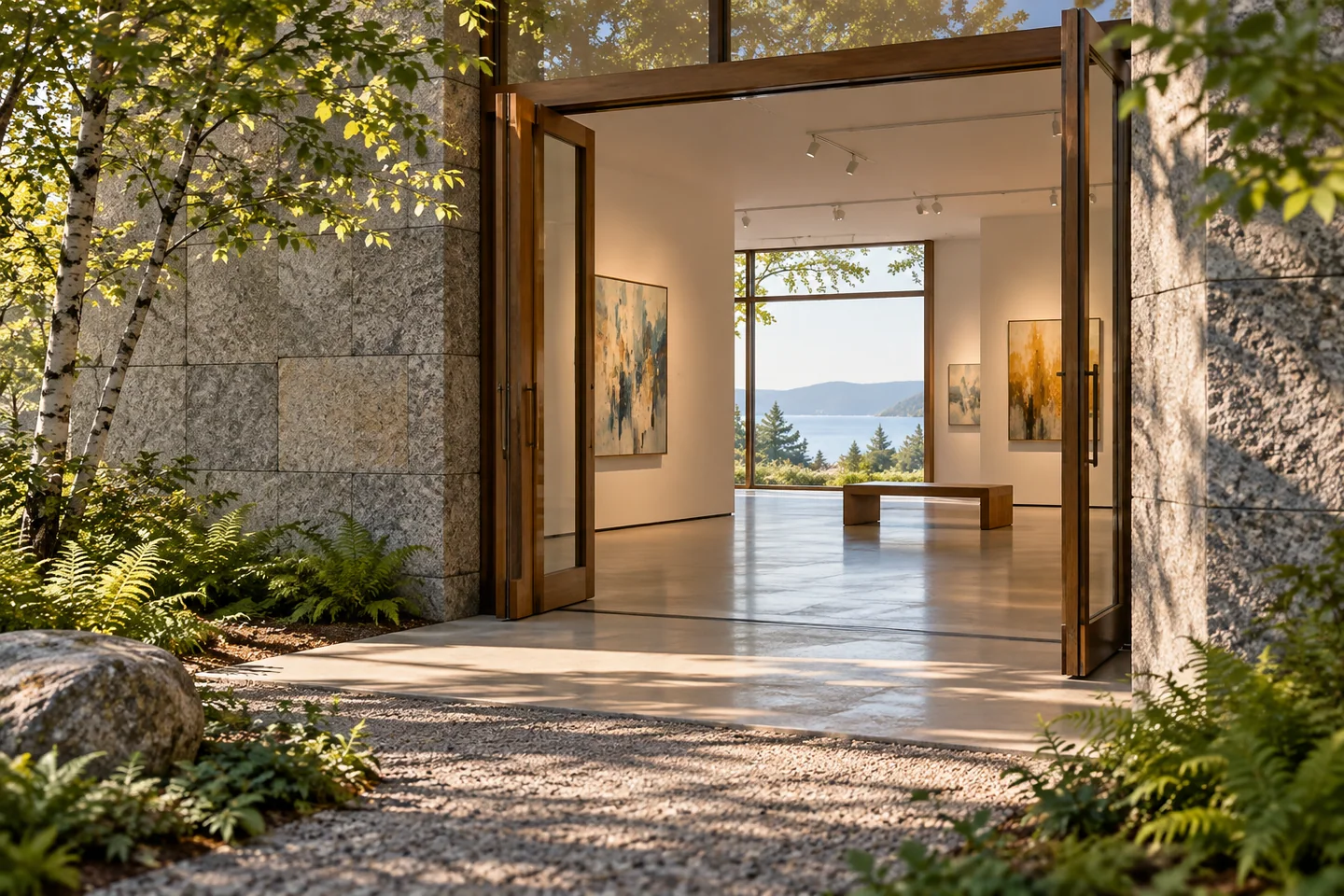
The Ethel H. Blum Gallery brings art into the human-ecology setting of College of the Atlantic in Bar Harbor. The college's listing with the Maine Arts Commission describes a program connecting students with the wider Downeast community through contemporary and classic work. Its examples range from watercolors and drawings to found-object sculpture and work by students and faculty. That breadth is a useful starting point: approach the gallery as a place where different materials and ideas meet, rather than expecting one permanent collection. Consult the college about the exhibition and visitor arrangements before making a special journey. The gallery remains identified on the college's campus map, but an exhibition space within a working college needs a more specific plan than simply arriving at a campus building.
The name remembers Ethel H. Blum, a watercolorist who lived from 1900 to 1991. The college's philanthropy report records the gallery's dedication in 1993 and her training at the Art Students League and Brooklyn Museum Art School. A longtime summer resident of Mount Desert Island, Blum particularly enjoyed painting coastal Maine. That connection makes the gallery's name more than a donor label. It joins a person's repeated attention to the island with a place where other artists can ask what makes a landscape, a community or an everyday subject worth looking at again.
The surrounding courtyard has its own design history. In her 2010 senior project, Sasha Paris describes its creation in 1992 alongside the Gates building, both designed by Turner Brooks. Her account records a lawn, gravel circulation paths and a pedestal allowing sculptures to be changed. She also notes the placement of a granite feather sculpture during a 2005 campus exhibition. These are dated observations of an evolving campus, rather than a claim that a particular sculpture or planting must remain. They suggest looking at the gallery's threshold as a designed relationship between movement, pause and display, without making the courtyard a separate destination.
A completed student exhibition gives a particularly clear example of the gallery's interdisciplinary history. In 2012, Alice Anderson presented Coastal Culture: Maine's Fisheries and Working Waterfronts. The college's announcement, reproduced by US Harbors, describes woodcuts, photographs, drawings, film and installation used to explore how seafood reaches the table. Anderson's preparation included work at a Stonington lobster hatchery and attendance at regional meetings about scallop management. Her aim was to make the labor and scale of fishing easier for people outside the industry to understand. The example is valuable precisely because it moves beyond a picturesque lobster-boat image. Art became a way to connect marine science, policy and the conversations of working people. The 2012 presentation has ended; it illustrates the gallery's past practice rather than advertising something currently on view.
For your own visit, choose one displayed work and spend a little time identifying the question it raises before reading its label. Then compare that first response with the artist's explanation. If photographs are permitted, frame the room's relationship to the work without blocking another viewer or reproducing an entire artwork without permission.
Fun facts
- The gallery was dedicated to watercolorist Ethel H. Blum in 1993.
- A 2012 student exhibition explored fisheries through several art forms.
Before you go
- Check current exhibition and campus visitor arrangements with the college.
- Ask before photographing artworks or other visitors.
Capture
- With permission, use the gallery threshold to frame the relationship between a displayed work and its architectural setting.
 Courthouse Gallery Fine Art and Art Park
 Peleg Thomas Fields and Shoreline
 Pleasant River Lake
Social
Blum Gallery connects art with a human-ecology education.
Students and the wider community both belong to its audience.
Its namesake trained as a watercolorist.
The gallery’s dedication took place in 1993.
The courtyard’s design history reaches back to 1992.
A past student project connected art with working fisheries.
An exhibition history can inspire questions without promising a permanent display.
Look first, read the label, then look again. #Cre8Travel
Hashtags