 Cre8Travel
CRE8TRAVEL · MAINE PLACES
Crescent Lake
Crescent Lake: A Name, a Watershed, a Day Outside
Discover
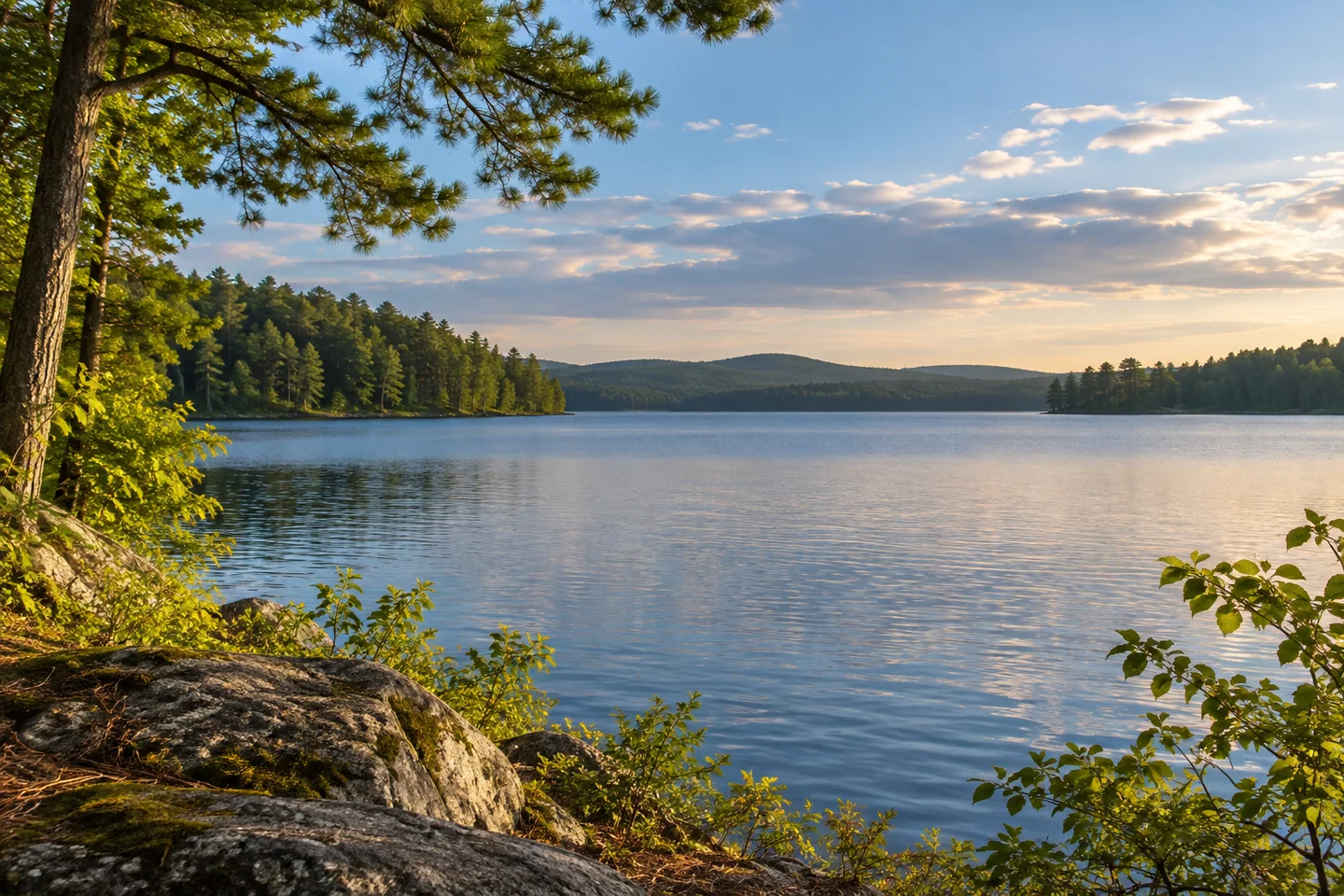
Crescent Lake in Raymond and Casco is an inviting place to let a lake day stay local. Rather than beginning with a long list of activities, choose a recognized public approach, look at the water in front of you, and decide how much of the lake suits the day. Its roughly seven hundred acres are part of a much larger water story, linking the surrounding land with Panther Pond and eventually Sebago Lake. The scenery belongs to a chain of connected places, even when a visit stays close to shore.
The name itself provides an introduction. Crescent Lake Watershed Association recounts that the water was once known as Rattlesnake Pond, with a change adopted by summer cottage owners in 1925. The association also points to an older reference in Nathaniel Hawthorne's diary. It is a useful reminder that lake names have histories and audiences. Today's gentler-sounding label belongs to the same landscape that earlier maps described differently; it does not mean the place began with vacation cottages.
Public facilities are specific parts of the shore. The town's planning material identifies a public beach, while the watershed protection plan records the Raymond public launch and public beach areas in both Raymond and Casco. Choose the current designated entrance for the activity you intend. Private summer camps and homes also occupy shoreline, so a visible beach, dock, or path should not be read as permission to use it. Check the posted arrangements at your actual arrival point, particularly when transporting a boat.
The lake's protection plan explains why the surrounding roads and yards deserve attention alongside the water. Runoff can carry sediment and nutrients downhill, changing conditions in the lake. Local work has included watershed surveys, erosion-control improvements, water monitoring, and education about boat wakes. The plan also describes information kiosks at public beach areas. Reading a little of that material can turn a pause before launching into a better understanding of what makes a lake visit possible in the first place.
Crescent's volunteer community makes that work visible. The watershed association has been active since 2008 and collaborates with Raymond Waterways Protective Association on inspections of boats and equipment. Inspectors explain how fragments of aquatic plants can travel from one waterbody to another and help boaters check places that are easy to overlook. Cooperate when the service is present, but carry the habit with you when it is not. The lake's future does not depend on an inspector standing beside every launch, every time.
Once those details are settled, choose a simple way to pay attention. From a permitted shore position, compare the open surface with the wooded edge, or let a nearby branch provide a modest frame for the water. A paddle should be planned for the weather, craft, and return you have, without assuming that a connection on the map makes a longer trip suitable. There is enough here for a visit built around one area: a name with a past, a working conservation community, and water that continues into another lake after your own day has ended.
Fun facts
- The lake was formerly called Rattlesnake Pond, according to its watershed association.
- The watershed association traces its activity to 2008.
- Crescent Lake’s water continues toward Panther Pond and eventually Sebago Lake.
Before you go
- Use the current public beach or Raymond launch arrangements, respecting private camps and docks.
- Read the watershed information at public-access kiosks when available.
- Inspect equipment before changing lakes and cooperate with courtesy inspections.
Capture
- Use a modest piece of wooded shoreline to frame open water from a permitted position.
- Photograph a public interpretive detail only if permitted; avoid making private camp waterfronts the subject of intrusive close views.
 Mechanics Hall
 Panther Pond
 Aziscohos Lake
Social
Crescent Lake had an earlier name: Rattlesnake Pond. Local history adds another layer to the view.
Raymond and Casco share the lake; its watershed reaches farther than the water’s edge.
This lake connects downstream with Panther Pond and Sebago Lake.
A designated public entrance makes a much better plan than guessing about a private dock.
Look for watershed interpretation at the public access areas. It explains what the view cannot show alone.
Crescent’s volunteers work on monitoring, erosion prevention, and aquatic-plant inspections.
Check the boat, trailer, and gear before moving to another waterbody.
Would the old name or the connected-water story make you look at Crescent Lake differently?
Hashtags