 Cre8Travel
CRE8TRAVEL · MAINE PLACES
Cochnewagon Lake
Cochnewagon Lake: A Public Shore beside Monmouth Center
Discover
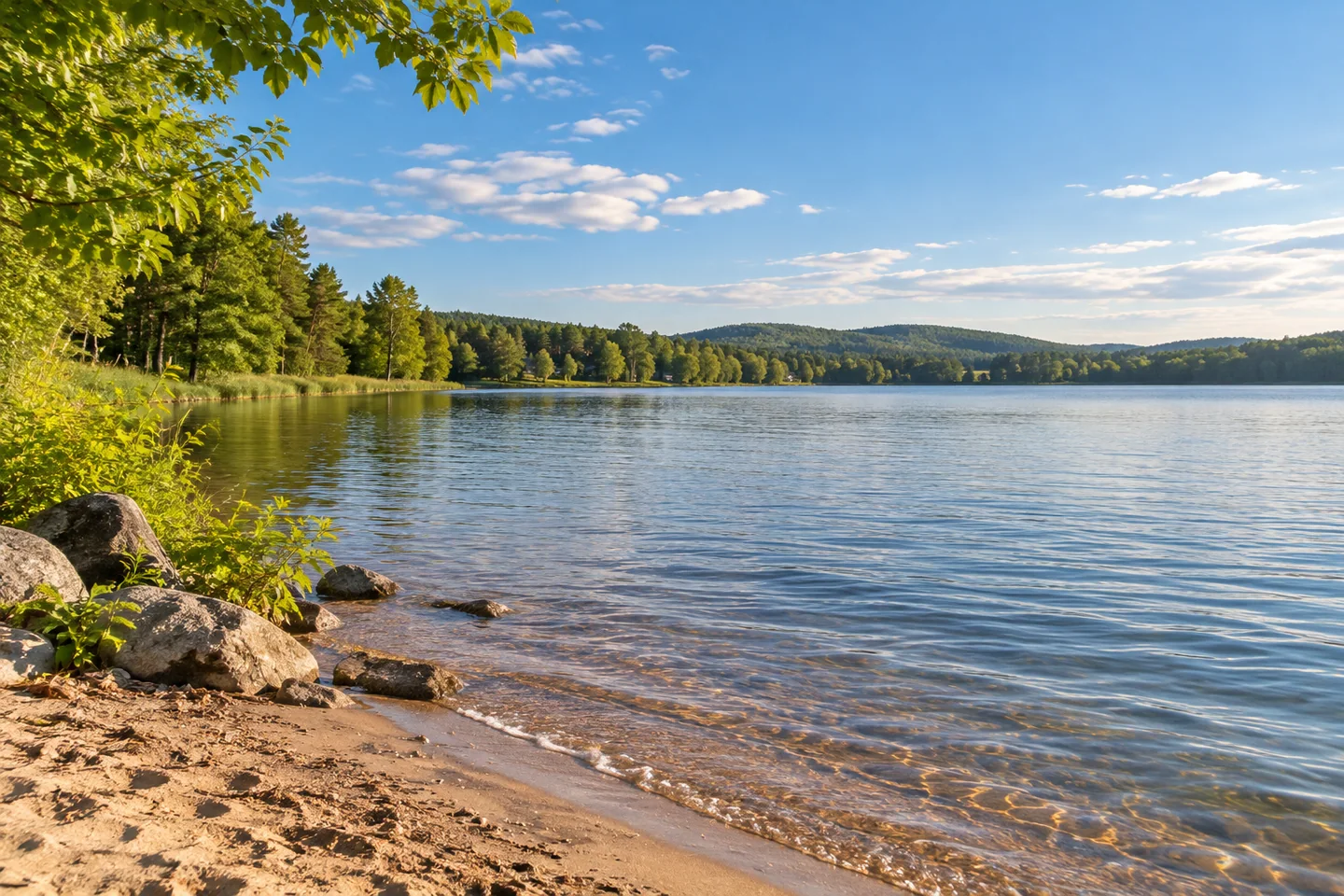
Cochnewagon Lake places a water outing close to Monmouth's center rather than at the end of a remote back road. The town's 2026 comprehensive plan identifies Center Beach on Beach Road, on the northeastern shore, with parking shared by the boat launch. Start with that named public arrival. A beach visit and a boating trip can begin beside each other while requiring quite different preparations.
The surrounding landscape reaches into the lake's story. A state watershed project describes shorefront homes, upland dairy farmland, and gravel roads within its drainage area, with water flowing onward to Annabessacook Lake. During the 2009–2010 investigation, staff surveyed roads and returned to some locations during rainstorms. Shorefront observations were also made from a boat. Looking across the water can therefore prompt another question: what happens on the land when rain starts moving toward it?
The fisheries survey revised in 2006 describes a shallow pond with conditions suited to warmwater fish. Bass, white perch, and pickerel figure in its account of the fishery. Its depth observations help explain why this lake should not be imagined as a deep, cold mountain basin. The report provides useful background for understanding the waterbody, while leaving any decision about a fishing trip dependent on current conditions and regulations.
A very different kind of boating appears in Jessica Lowell's eyewitness report from Monmouth's July 2022 Beach Party. Families turned cardboard boxes and colorful duct tape into makeshift canoes before racing from the beach. Some craft sank quickly, while others completed their course. The memorable scene is one of shared ingenuity and cheerful uncertainty, showing how a lakeshore can serve as a town gathering place as well as a destination for ordinary recreation.
Water quality has required sustained attention. The watershed project records a major alum treatment in 1986, followed by improved transparency for many years and renewed blooms in 2006 and 2007. Its later survey identified erosion concerns around roads and shorefront properties, and residents gathered to hear the findings. This is a dated account of restoration work, not a statement that today's water is suitable for swimming or that the underlying challenges have disappeared.
Fish management adds another historical layer. Brown trout were introduced in 1966, and the state survey explains that insufficient spawning and nursery habitat required stocking to maintain that fishery at the time. The distinction matters: the presence of a species in a report can reflect management as much as naturally reproducing populations. Treat the record as an explanation of past choices rather than a promise of a particular catch.
Lowell's account also describes the organizing work behind the summer gathering: arranging food vendors, a band, sponsors, and the hope of favorable weather. Those details connect the view to a community effort. They do not confirm another event's date or programme. A quieter independent visit can still carry that perspective, with the beach understood as a place used and cared for by people who live nearby.
Choose photographs that answer different questions: one can explain the relationship between the public arrival and the water, while another records a small visual detail that caught your attention. Work from stable permitted positions and avoid making identifiable strangers the subject without agreement. Finish with a caption that separates what you observed from what you learned about the lake's past.
Fun facts
- The state fisheries survey records the introduction of brown trout in 1966.
Before you go
- Begin at the named Center Beach and boat-launch approach.
- Plan a manageable outing and leave shared arrival space clear.
Capture
- Make one image explain the setting and another record a small detail.
- Keep personal subjects out of close frames without agreement.
 Flying Pond
 Pocasset Lake
 Torsey Lake
Social
Center Beach and the Cochnewagon boat launch share parking on Beach Road.
A watershed survey followed runoff concerns from roads and shorefront land.
A dated fisheries survey describes conditions favoring warmwater fish.
A 2022 town gathering sent colorful cardboard canoes onto the water.
A lake can be part of everyday community life.
Let the visit’s scale match the time available.
Distinguish a historical record from today’s observation.
Two purposeful photographs can tell different parts of one outing.
Hashtags