 Cre8Travel
CRE8TRAVEL · NEW YORK PLACES
Huyck Preserve
Huyck Preserve: A Landscape with a Long Memory
Discover
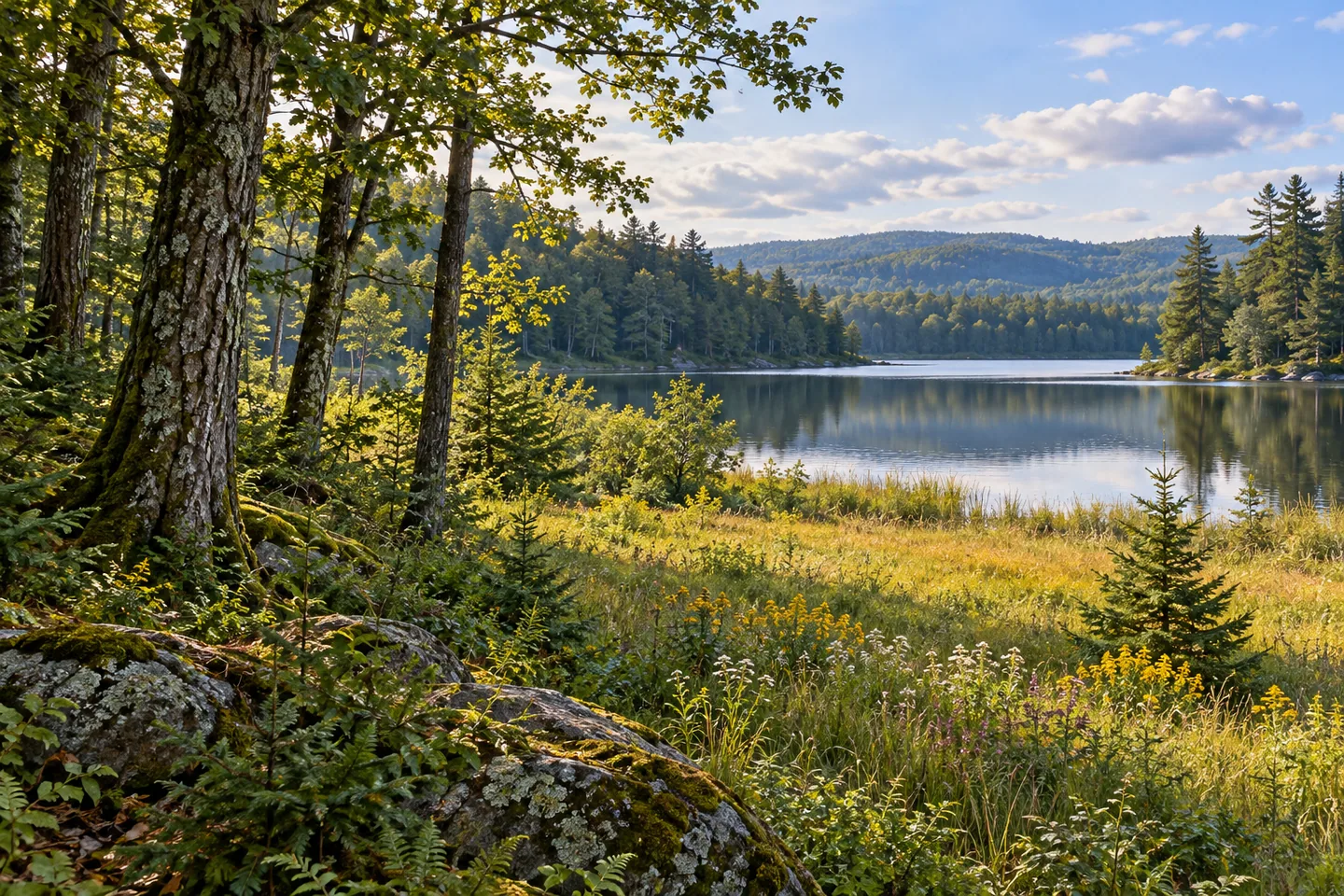
A woodland walk and a scientific question can begin in the same place. At Huyck Preserve in Rensselaerville, southwest of Albany, forests, fields and wetlands form a landscape used for conservation, education and long-term biological research. More than two thousand acres include Lake Myosotis, Lincoln Pond and Hennicke Marsh. The public trail network offers a way into that setting, while the preserve's research history suggests a different pace of attention: return to a place, notice change and keep asking questions.
The preserve began in 1931 with a gift of about five hundred acres from Jessie Van Antwerp Huyck in memory of her husband, Edmund Niles Huyck. Her purpose combined protection of the landscape with public enjoyment and knowledge of nature. That pairing remains useful for understanding a visit. This is neither an unmanaged patch of scenery nor a research site separated entirely from the public. Its identity rests on the relationship between caring for land and learning from it.
The landscape also carries an industrial past. A felt mill established in 1870 at the foot of Rensselaerville Falls connected the water with village work. A damaging flood in 1878 contributed to changes that led the Huyck mill operation to move to Albany. The family retained the land for community and recreational use. That history places the later preserve within a longer story of changing purposes, from water-powered production toward protection and study.
Research became a formal part of the preserve in 1938, when the Biological Research Station was established. The first supported biologists included Eugene Odum, Donald Griffin and Edward Raney, whose work belonged to ecology, animal behavior and fish biology. Their later careers give the station an important place in scientific history, but the broader idea is accessible without specialist knowledge. A protected landscape makes it possible to ask questions across time, rather than drawing every conclusion from a single visit.
Land protection expanded as well. The preserve's history records roughly fifteen hundred additional acres acquired within the watershed from 1967 onward. Its present extent should be distinguished from the wider watershed that surrounds it. Within the protected property, hardwood and conifer stands more than two hundred years old sit alongside other ecological communities. Lakes, pond, marsh and woodland provide several settings for observation, not one uniform forest scene or a promise of a particular wildlife encounter.
The operator describes twelve miles of public trails across the preserve. Choosing one manageable part of that network leaves room to compare nearby changes: an open field against woodland, the edge of a wetland, or different forms of tree growth. The research and education programmes provide another way to engage with those differences when suitable activities are offered. They have their own arrangements and should not be assumed to accompany every ordinary walk.
Check current operator information and a trail map before planning the route. The visitor centre is associated with the Mill House in the hamlet, but its availability is separate from public trail access. A satisfying visit need not cover every named feature. Choose a question small enough to carry through the walk: where does the ground become wetter, where does the canopy open, or how does a woodland edge change the view? Huyck's long research tradition makes that kind of patient curiosity feel especially appropriate.
Fun facts
- The preserve was founded in 1931 with a gift of about five hundred acres.
- The Biological Research Station was formally established in 1938.
- The operator describes more than two thousand protected acres and twelve miles of trails.
Before you go
- Choose a route from the current preserve trail map rather than attempting the whole network.
- Check visitor-centre and programme arrangements separately from trail access.
- Treat lakes, pond, marsh and woodland as different ecological settings.
- Keep the protected property’s acreage distinct from that of the wider watershed.
Capture
- Compare open ground with a wooded edge in a restrained landscape composition.
- Use ordinary leaf, bark and water-edge textures for close studies from permitted visitor areas.
- Avoid implying that an illustration or isolated tree represents a documented ancient specimen.
 Greece Canal Park
 The Creative Little Garden
 Sixth Street and Avenue B Community Garden
Social
Huyck Preserve brings conservation, public learning and long-term research together. #Cre8Travel
The Rensselaerville preserve began with a five-hundred-acre gift in 1931.
A felt mill once linked the falls with village industry.
The Biological Research Station was formally established in 1938.
Eugene Odum, Donald Griffin and Edward Raney were among its first supported biologists.
Today’s protected landscape exceeds two thousand acres.
Lake Myosotis, Lincoln Pond, marsh and woodland offer different settings for observation.
What small question would you carry through a woodland walk?
Hashtags