 Cre8Travel
CRE8TRAVEL · MAINE PLACES
Scopan Lake
Scopan Lake: A Letter in the Landscape
Discover
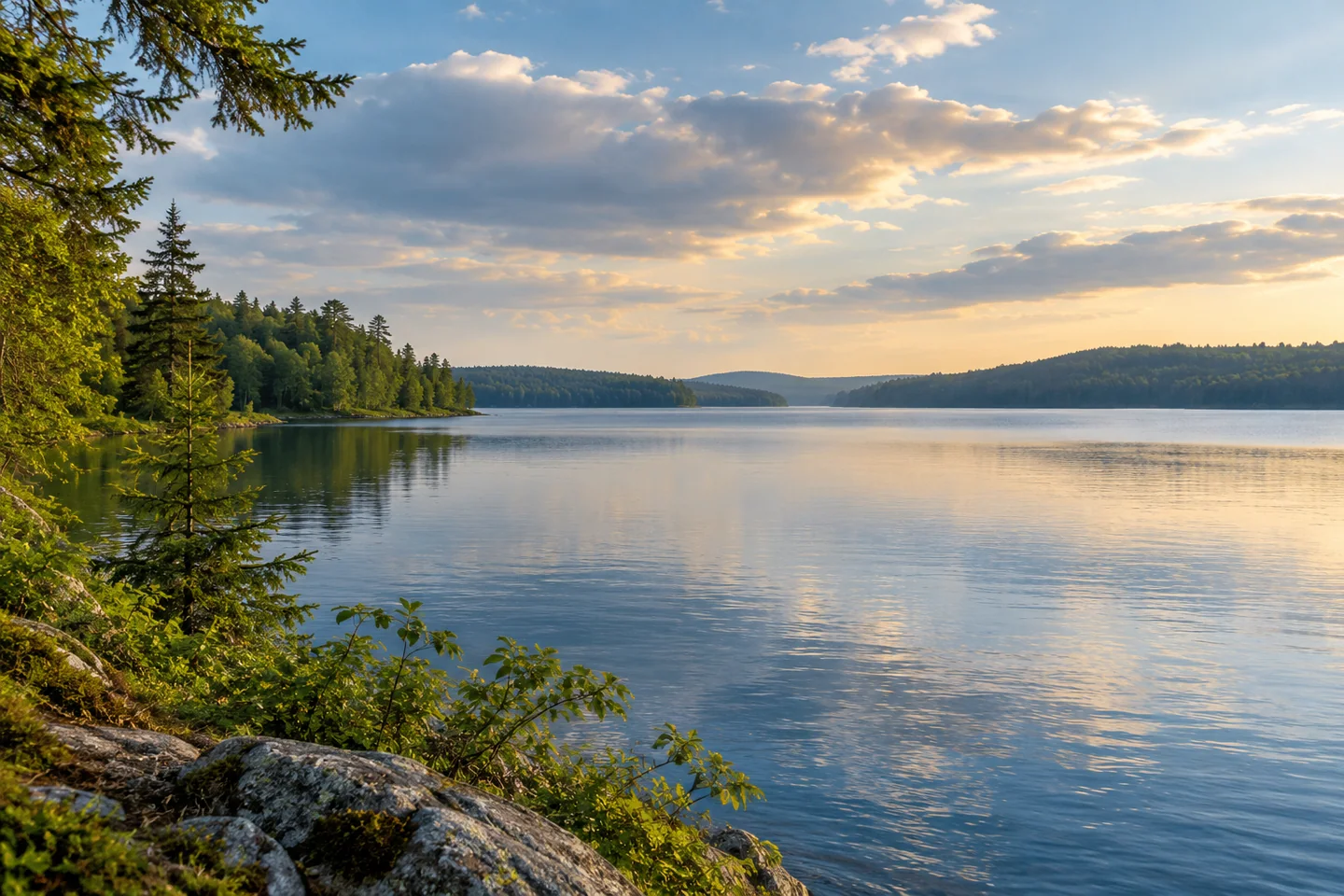
Scopan Lake invites two kinds of looking: the immediate experience of water and woods, and the larger view that explains how those pieces fit together. In Aroostook County near Masardis, the lake has a distinctive shape that even attracted NASA's attention. It also has a fisheries research history that rewards careful reading. Make the water itself the subject of the outing, beginning with a suitable public approach and enough curiosity to look beyond the first attractive photograph.
Use the outlet launch on Scopan Road. Check the present approach, posted requirements and conditions before bringing a boat, and choose a manageable outing for the group. A launch is a starting point for decisions about equipment and distance. Give the return journey a place in those decisions from the beginning. A lake visit can be satisfying without reaching every distant piece of shore, particularly when the aim is to notice how the landscape changes from a single stretch of water.
NASA's January 2025 Earth Observatory feature presents Scopan as a V-shaped reservoir. Its Landsat image was acquired in June 2024 and rotated to emphasize the letter. The western arm is shallower than the northern arm, which incorporates an older lake joined to the impounded water. The image gives the shoreline an unexpected second identity: a geographical form that can be read almost like writing. Comparing the satellite view with a map is a useful way to prepare, while keeping ordinary navigation information separate from an illustrative image.
The fishery adds a more complicated perspective. In a December 2018 study, Maine biologists Andrew Grant and Frank Frost investigated whether winter drawdown might affect trout and salmon spawning sites. They hoped to follow wild fish using radio transmitters, but captured too few and turned to hatchery fish as substitutes. High mortality and an early end to tracking limited the work. The report explicitly left the central drawdown question unresolved. It is a valuable example of research explaining what remains unknown, rather than supplying a simple verdict.
That distinction can improve a visitor's attention. A managed lake contains relationships among water levels, habitat, fish and human expectations that a surface view cannot settle. Read the dated study as an investigation, then use current information for any fishing decisions. A notebook entry might begin with a question instead of an answer. The combination of an easily recognized outline and a difficult ecological problem gives Scopan more substance than a scenic backdrop alone.
A personal memoir by musician Bonnie Leigh supplies a different scale again. She remembers family summer visits to camps at the lake, relatives making music together and the excitement of emerging from a wooded approach to see the water. Her recollections belong to private family places and an earlier period. They convey affection and anticipation without providing a public route to follow. That remembered arrival can encourage a visitor to appreciate the first view rather than immediately hurry beyond it.
For photographs, choose a stable authorized position and let the actual light shape the composition. Include enough shore to give the water a setting, then try a smaller detail that caught the eye. Comparing that image with the satellite outline, the research question and a family's memory creates several ways of understanding the same place. Scopan Lake becomes an outing in observation: one northern waterbody holding a striking form, an unfinished scientific story and a lasting place in people's lives.
Fun facts
- NASA featured Scopan’s V-shaped outline in January 2025.
- A 2018 radio-tracking study left its main drawdown question unresolved.
- Scopan is in Aroostook County.
Before you go
- Check current posted conditions before launching.
- Keep private camps outside the landing plan.
- Use contemporary fishing information alongside dated research.
- Compare the satellite view with a proper navigation map.
Visitor perspectives
- Bonnie Leigh’s undated personal memoir recalls musical family gatherings and the excitement of first seeing Scopan Lake after a wooded approach to private camps.
Capture
- Give the broad lake view a wooded shoreline reference from an authorized position.
- Try one detail alongside the wider scene, keeping the camera secondary while afloat.
 Togue Pond, Deboullie
 Dudley’s Corner School House
 St. David Catholic Church
Social
NASA’s Scopan Lake feature makes a northern reservoir look like a letter in the landscape.
The satellite view emphasizes a V-shaped outline.
A 2018 fisheries investigation explains the limits of its own findings.
A research question can make a familiar-looking lake more interesting.
Bonnie Leigh remembers family music and the first glimpse of water on summer visits.
Private family memories provide perspective, while current public access supplies the approach.
Make room for a close detail as well as the broad water photograph.
Would a map, a research story or a family memoir change how you see a lake?
Hashtags