 Cre8Travel
CRE8TRAVEL · MAINE PLACES
Civil Engineering Steel Sculpture, UMaine
Steel Connections in the Open at UMaine
Discover
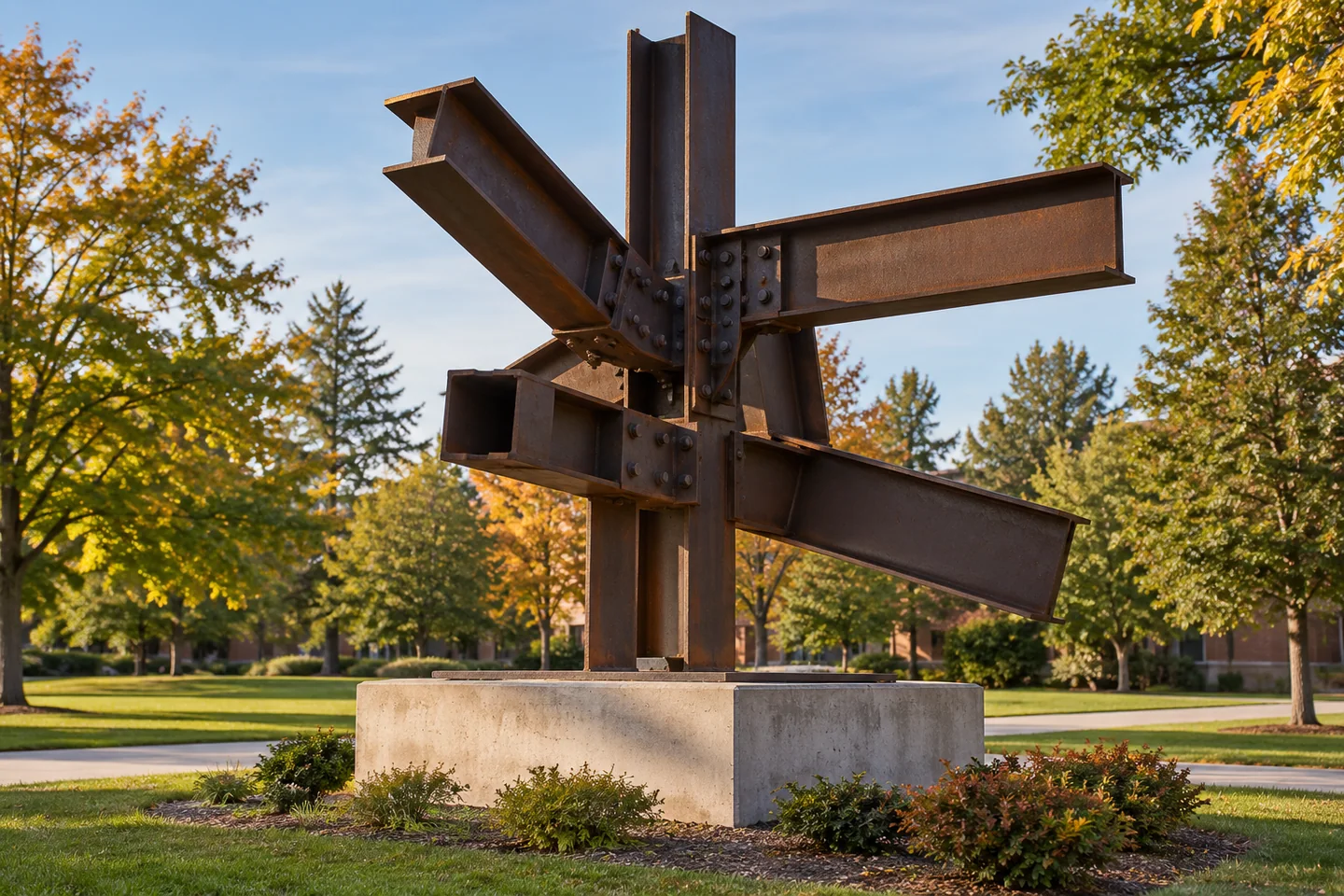
The Civil Engineering Steel Sculpture at the University of Maine offers a different reason to stop on a campus art walk. Rather than concealing how it is assembled, the object invites attention to the meeting of structural pieces. Its practical purpose is part of its interest. A visitor who usually passes buildings without considering their hidden connections can encounter an outdoor teaching object that makes those relationships visible at a manageable scale.
The university's self-guided tour locates the sculpture on the south side of Boardman Hall, approached from the Mall. It dates the installation to 1998 and explains that the work follows a standard design demonstrating structural connections. Consult current campus visitor-parking guidance before arriving, then make the final approach through the appropriate pedestrian routes. The outdoor sculpture is the focus of the visit; access to classrooms or laboratories is a separate matter.
Start by looking at the overall arrangement before following one joint. The American Institute of Steel Construction explains that its teaching sculptures bring steel shapes and connection types together in a three-dimensional model. The examples can include splices, stiffeners and different ways of connecting framing members. For someone without engineering training, the useful question is simply how separate pieces meet. Looking for repeated forms and changed details can make the object engaging without needing to calculate forces.
The wider project began at the University of Florida in 1986 with civil engineering professor Duane Ellifritt. AISC's account explains that students had difficulty visualizing three-dimensional connections from classroom drawings. The sculpture provided an accessible physical alternative to relying entirely on construction-site visits. A later version of the design allowed other institutions to build their own teaching aids. Maine's installation belongs to that educational tradition, while its making also involved people and companies in this state.
UMaine records a direct student contribution: under faculty supervision, students made the reinforced-concrete base. Maine companies supplied fabrication, concrete and a crane for erection, with contributors acknowledged on an attached plaque. This gives the sculpture another dimension as a record of cooperation. The steel above ground may draw the eye first, but the base and the work of putting everything into position are also part of the object's history.
Consider viewing it from more than one permitted position. A connection that seems obvious from the front can appear different from the side, which is precisely the value of a three-dimensional teaching object. Compare a photograph with what you can see by moving your viewpoint. Neither a single image nor a drawing can reveal every relationship at once. There is no need to climb the sculpture or test its components to appreciate that lesson.
For photographs, begin with a view that includes the concrete base and assembled steel, then choose one joint as a detail. Keep pedestrian routes clear and leave the work untouched. The Civil Engineering Steel Sculpture makes an unusually direct connection between campus art and practical learning: design becomes material, separate components become an assembly, and a familiar part of the built world becomes something worth looking at closely.
Fun facts
- UMaine dates this teaching sculpture to 1998.
- Students made its reinforced-concrete base under faculty supervision.
- Maine companies contributed fabrication, concrete and crane work.
Before you go
- Follow current university visitor-parking guidance.
- Approach the sculpture on the south side of Boardman Hall from the Mall.
- Look from permitted pedestrian positions without climbing.
- Read the contributor plaque as part of the making story.
Capture
- Include the base and assembled steel in one establishing frame.
- Use a separate detail to show one structural connection.
 Together Place Maine Icons Mural
 Cloke Plaza Bell Tower, UMaine
 Gnome Home Roam and Village Square
Social
UMaine’s Civil Engineering Steel Sculpture makes structural connections visible.
The university dates its installation to 1998.
Students helped make the concrete foundation under faculty supervision.
Local companies contributed fabrication, concrete and crane work.
The wider teaching-sculpture idea began with Duane Ellifritt at the University of Florida.
A changing viewpoint can reveal what one flat photograph leaves hidden.
Keep to pedestrian routes and leave the sculpture untouched.
What do you notice first: the whole assembly or the way two pieces meet?
Hashtags