 Cre8Travel
CRE8TRAVEL · MAINE PLACES
Abbott Park
Abbott Park: A Storybook Landscape on Farmington’s Campus
Discover
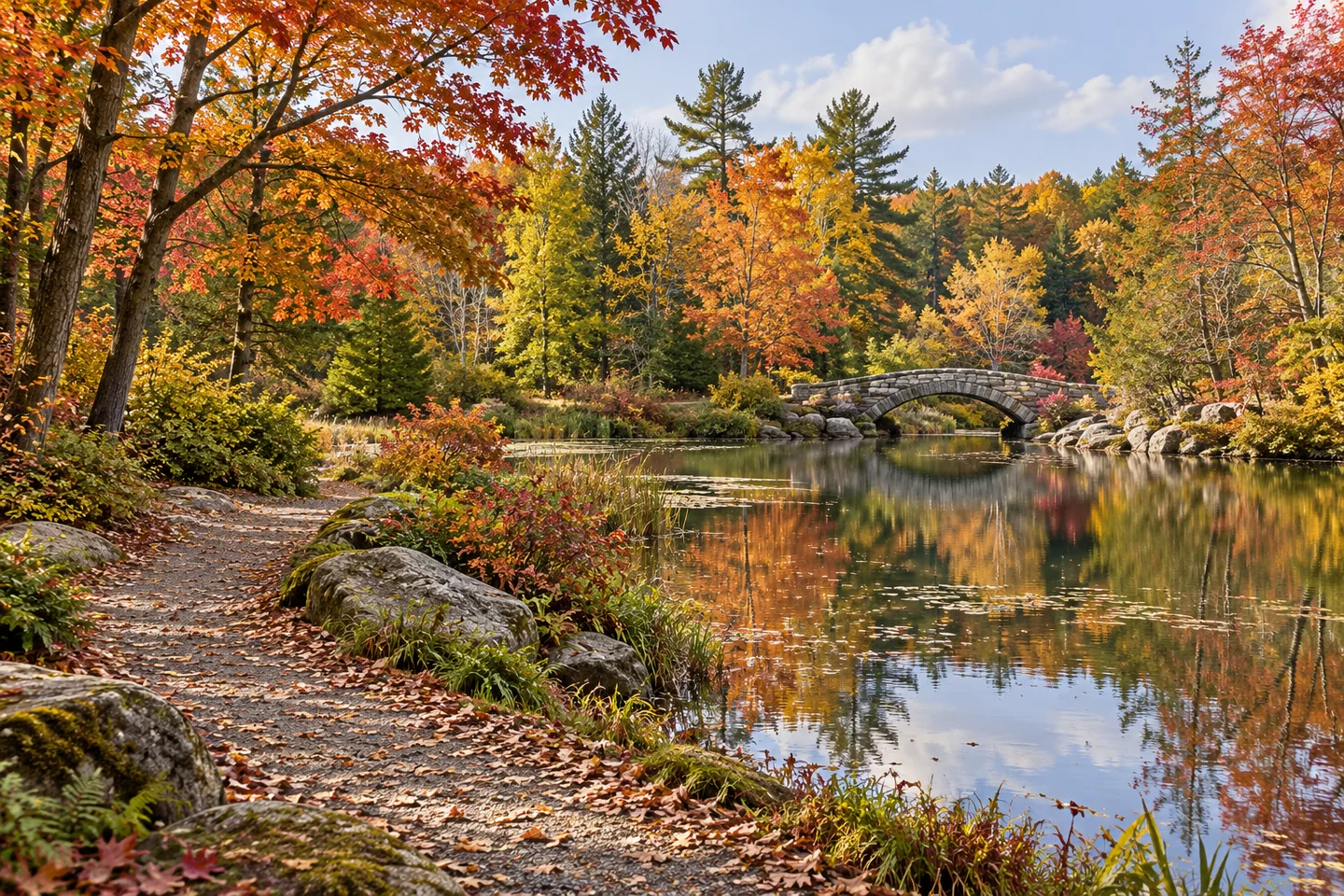
Abbott Park in Farmington brings a storybook landscape into the setting of a university campus. The Cultural Landscape Foundation traces its origins to children’s author Jacob Abbott, who reshaped a marsh and sand hill into ponds, paths and ornamental grounds in the nineteenth century. Rollo Pond took its name from his books, while ‘Little Blue’ recalled a miniature mountain modeled after Mount Blue. The small landscape was an imaginative project as well as a place to spend time outside.
A later owner, A. H. Abbott, continued the landscape’s development while operating the boys’ school on the property. Stone bridges evoked famous bridges elsewhere, and plantings formed an arboretum. Today the foundation identifies the pond, bridges and remaining woodland paths as part of the university setting. Those features invite a particular kind of looking: consider how a small designed place can suggest a larger world, with water, stone and trees arranged to give a walk its own sequence of encounters.
The park’s educational life continues in another form. Writing for the Farmington Flyer, Cassie Libby described encountering its history through an archaeology class scheduled to excavate there. A conversation with local historian Layne Nason opened up the former Abbott School’s story, including surviving foundations and the relationship between the old grounds and the present campus. Her account makes a useful point for a visitor: a seemingly quiet patch beside an academic building may hold evidence of several earlier communities.
The university has also used the park as a place for studying the forest itself. Allen Cherkis’s 2021 research abstract asks how carbon storage varies among tree species and how regeneration might influence the future woodland. The study measured trees in sample transects and tallied younger growth. You do not need to conduct measurements to appreciate that perspective. Simply noticing differences in size and the presence of younger trees can add another time scale to a visit already rich in human history.
Laura G’s October 2020 photo journal offers the scale of an ordinary outing. She described including Abbott Park in walks around Farmington and making autumn photographs when a hoped-for deer sighting did not happen that day. Her attention settled on the pond, bridges and seasonal color instead. The account is a reminder that an unplanned stop can be worthwhile on its own terms, without a particular wildlife encounter or a long route to complete.
Locate the park beside the Roberts Learning Center and treat it as part of an active campus. Respect any study areas, temporary barriers or instructions while enjoying the established outdoor routes. In Libby’s account, the park serves both informal recreation and occasional class outings. That combination is part of its character: a place where someone might stop between other activities, while another person is examining the ground’s history in much greater detail.
A rewarding way to explore is to keep two questions together: what did someone once intend this landscape to be, and what does it offer now? Let a bridge, a view across water or a stretch of woodland supply the starting point. The answers need not become a complete history lesson. They can simply make a short pause more attentive, connecting an ordinary visit with the imagination and work that shaped the place.
Fun facts
- University research has examined carbon storage in the park’s trees.
Before you go
- Respect campus study areas and any temporary route instructions.
- Enjoy the setting without expecting the wildlife seen on another person’s visit.
Visitor perspectives
- Laura G included Abbott Park in town walks and enjoyed photographing its fall setting, even when a hoped-for deer sighting did not occur.
- Cassie Libby describes discovering Abbott Park’s deeper history through an archaeology class and an interview with local historian Layne Nason.
Capture
- Use a bridge and its watery setting as a composition from an established route.
- Look for reflections and autumn color without disturbing the pond edge.
 Pinnacle Park
 Coastal Maine Botanical Gardens
 Manson Park
Social
Abbott Park began with an author’s imaginative approach to a landscape.
Rollo Pond carries a literary name into a university setting.
Cassie Libby encountered the park’s history through an archaeology class.
Older trees and younger growth can suggest different woodland time scales.
A 2021 student study asked how carbon storage varies by tree species.
Laura G’s photo journal found autumn color rewarding without a deer sighting.
Ask what a landscape was intended to be, then notice what it offers today.
A short pause can connect everyday surroundings with a much longer story.
Hashtags